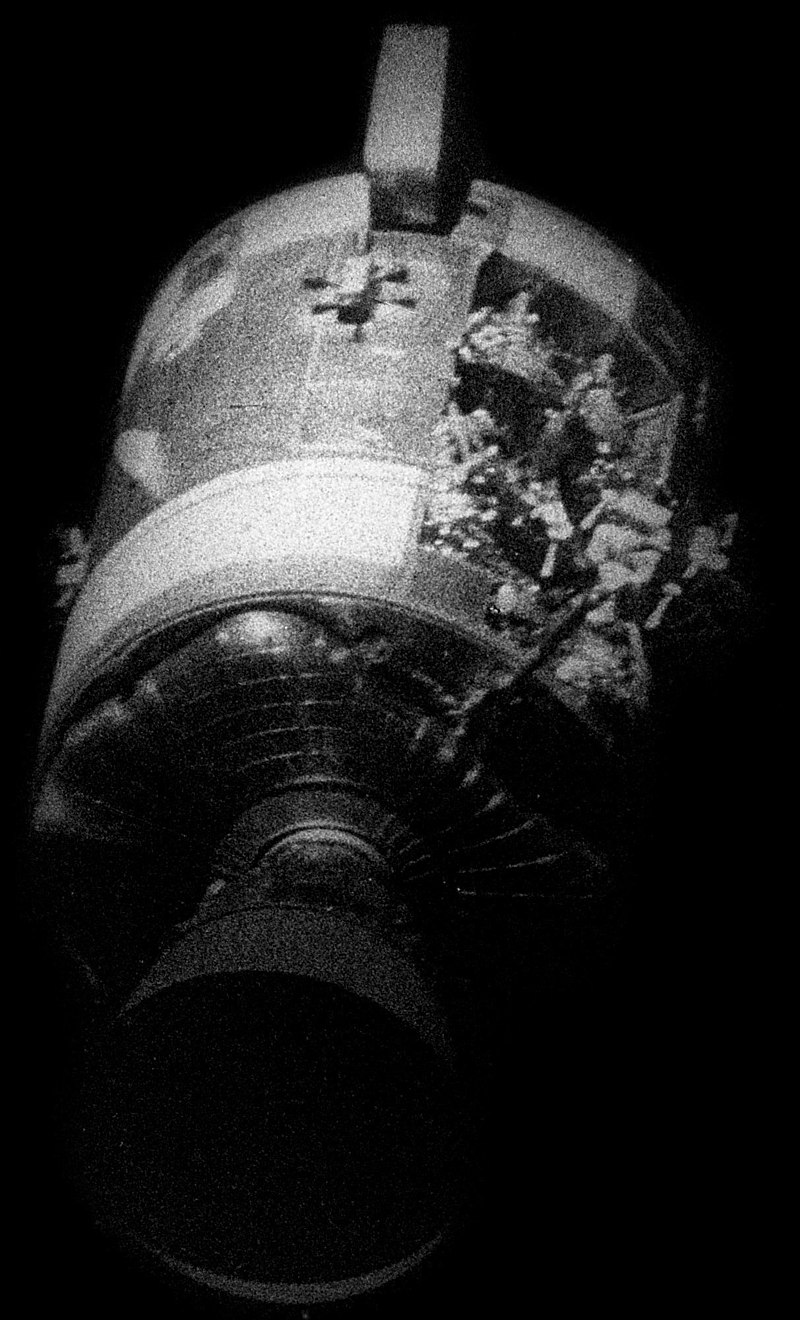
Apollo 13 Service Module, as seen from the Lunar Excursion Module (LEM), Aquarius, as the Service Module was jettisoned just hours before the Command Module, Odyssey, returned to Earth. This photograph shows the damage caused by the oxygen tank explosion.
(Image Sources: NASA, Wikipedia.org, By NASAScan by Kipp Teague - Apollo 13 Image Library (image link), Public Domain, https://commons.wikimedia.org/w/index.php?curid=71871333)
By Glenn A. Walsh
Reporting for SpaceWatchtower
What could have been a second tragedy
for America's Space Program became, what has been called by NASA
Astronaut Jim Lovell, NASA's “successful failure.” NASA's
planning and ingenuity, following the explosion of an oxygen tank as
the Apollo 13 spacecraft, with astronauts Jim Lovell, Jack Swigert,
and Fred Haise, cruised toward the Moon, ended the Moon mission but
brought the astronauts home safely.
It was exactly 50 years ago, as of the
posting of this blog-post, on Monday, 1970 April 13 at 10:07:53 p.m.
Eastern Standard Time (EST) / April 14, 3:07:53 Coordinated Universal
Time (UTC) that the Apollo 13 Service Module's No. 2 Oxygen Tank
exploded, which also caused Oxygen Tank No. 1 to fail. As Daylight
Saving Time did not begin until the last Sunday in April (April 26)
in 1970, today this time equates to 11:07:53 p.m. Eastern Daylight
Saving Time (EDT).
This occurred less than a year after
the triumphant Apollo 11 mission, when the first two humans, Neil
Armstrong and Buzz Aldrin, landed and walked on the Moon on 1969 July
20. It also occurred nearly a half-year (in November of 1969) after
the mission of Apollo 12, the second flight to land astronauts on the
Moon. And, just a little more than two years after the Apollo 8
mission, when three astronauts successfully orbited another planetary
body, the Earth's Moon, for the first time in history on Christmas
Eve in 1968.
It also occurred a little more than
three years after NASA's first tragedy, when astronauts Gus Grissom,
Ed White, and Roger Chaffee were killed when a flash-fire engulfed
their Apollo 1 space capsule during a pre-launch ground test on 1967
January 27. In later years, NASA would experience two more tragedies
when astronauts would die with the explosion of the Challenger Space
Shuttle on 1986 January 28 and the re-entry dis-integration of the
Space Shuttle Columbia on 2003 February 1.
The loss of oxygen to Outer Space, from
the two oxygen tanks, meant that the Apollo 13 astronauts no longer
had that oxygen to breathe or to generate spacecraft electricity. The
Apollo 13 Service Module, where the explosion occurred, was no longer
operable. The Command Module, which housed the three astronauts
during the flight to the Moon, had to be shut-down to preserve its
limited resources for re-entry when returning to Earth.
So, the astronauts had to use the Lunar
Excursion Module (LEM) as a lifeboat for their trip back to Earth, as
the LEM had fully-charged batteries and full oxygen tanks. With its
own life systems, and now that the Moon mission had been scrubbed,
the LEM was available for the mission of keeping the astronauts alive
for the trip back to Earth.
NASA had anticipated the possible need
to use the LEM for this purpose, but had always considered the need
unlikely. Had the oxygen tank explosion occurred on the return trip
to Earth, after the LEM had been used to reach the Moon and then
jettisoned before leaving lunar orbit, the astronauts would have had
no lifeboat and would have perished in Deep Space.
But, there were two problems. First,
the LEM was designed to house two astronauts on the short trip to the
lunar surface and accomodate them for two days. Now, the LEM would
have to house three astronauts for several extra days.
Second, the LEM was not designed to
return to Earth, as it had no shielding for re-entering the Earth's
atmosphere. So, the astronauts could ride the LEM all the way to the
Earth's atmosphere. But to return to our planet, they would have to
move back into the Command Module (the only part of the spacecraft
with shielding that would allow them to re-enter the atmosphere) and
jettison the LEM and the Service Module.
Consequently, the trip back to Earth
was a difficult one for the crew. There was limited electrical power,
a shortage of drinking water, and the LEM cabin was chilly and damp.
The removal of carbon dioxide from the
LEM cabin became a critical item of concern, as the Command Module's
cartridges for removing carbon dioxide were not compatible with the
LEM system. NASA ground controllers and the crew were able to
improvise a solution to this problem.
To return the astronauts to Earth, NASA
had two options. The “direct abort” return path would return the
astronauts to Earth before reaching the Moon. But, it was not known
whether the explosion had damaged the Service Module's main
propulsion system, and whether the Service Module's fuel cells could
last long enough to implement this option.
So, NASA controllers decided Apollo 13
should take the longer route, by swinging around the Moon before
returning to Earth. Consequently as the spacecraft swung around the
Moon, on 1970 April 14 at 7:21 p.m. EST / April 15, 0:21 UTC, Apollo
13 traveled farther from the Earth than any other spacecraft with a
human crew: 248,655 statute miles / 400,171 kilometers from Earth, a
record held to this day in the Guinness Book of World Records.
Following Apollo 13's return to Earth,
NASA set-up an investigative review board to determine what happened
and what changes should be made to prevent future such problems. The
investigation found fault with pre-flight testing of the oxygen tanks
and the fact that flammable Teflon and aluminum were used inside the
tanks storing very combustible oxygen.
Oxygen tanks were re-designed for
Apollo 14 and subsequent missions. Thermostats were upgraded. As
stirring fans had to be removed, a third oxygen tank was added in a
different location to isolate it from the other two tanks and the
fuel cells; this would ensure that no tank went below half-full.
All electrical wiring would now be
sheathed in stainless steel, and the fuel cell oxygen supply valves
were redesigned. Monitoring systems, in both the spacecraft and in
Mission Control, were beefed-up to allow for earlier alert of
potential problems. An emergency supply of 5 gallons / 19 liters of
water was added to the Command Module, and an emergency battery was
added to the Service Module. And, transfers of electrical power
between the Command and Lunar Excursion Modules were made easier.
Although Apollo 13 did not land on the
Moon, some mission experiments were completed. One experiment allowed
the Saturn V rocket third stage to slam into the Moon, as a good test
of the nuclear-powered seismograph left on the Moon by Apollo 12 (the
solar-powered seismograph left on the Moon by Apollo 11 did not
survive the first two-week lunar night); previous missions had sent
the third stage into solar orbit.
An experiment to measure the amount of
atmospheric electrical phenomena during the launch to Earth orbit
(Apollo 12 had been struck by lightning shortly after launch)
indicated a greater risk during marginal weather. A series of
photographs taken by Apollo 13 confirmed that that Earth cloud
heights could be determined by synchronous satellites.
The Apollo 13 mission objective was to
explore the Moon around the area known as Fra Mauro. This mission was
re-assigned to Apollo 14.
For post-flight educational goals, some
Command Module interior components were displayed at the Museum of
Natural History and Science (now known as the Kentucky Science
Center) in Louisville until the year 2000. The exterior shell of the
Command Module was displayed at the Musée
de l'air et de l'espace (English: Air
and Space Museum) in Paris. Later, the Command Module
shell and internal components were reassembled and are now on display
at the Cosmosphere museum in Hutchinson, Kansas.
Internet Links to Additional Information ---
Apollo 13 -
Link 1 >>> https://www.nasa.gov/mission_pages/apollo/missions/apollo13.html
Link 2 >>> https://www.youtube.com/watch?v=VIiZyBbZ2Dk
Link 3 >>> https://en.wikipedia.org/wiki/Apollo_13
Related Blog Posts ---
"American Lunar Society Founder on 50th Anniversary: 1st Humans Walk on Moon !" Tue., 2019 July 16.
Link >>> https://spacewatchtower.blogspot.com/2019/07/american-lunar-society-founder-on-50th.html
"Tell NASA Your, or Your Family's, Apollo 11 Moon Landing Memories: Oral History Project." Wed., 2019 May 15.
Link >>> http://spacewatchtower.blogspot.com/2019/05/tell-nasa-your-or-your-familys-apollo.html
"American Lunar Society Founder on 50th Anniversary: 1st Humans Orbit Moon. Mon., 2018 Dec. 24.
Link >>> http://spacewatchtower.blogspot.com/2018/12/50th-anniversary-incredible-legacy-of.html
"Pittsburgh Museum Displays Historic Apollo 11 Moon Mission Artifacts. Wed., 2018 Oct. 24.
Link >>> http://spacewatchtower.blogspot.com/2018/10/pittsburgh-museum-displays-apollo-11.html
"50th Anniversary: NASA's 1st Tragedy of the Space Era." Fri., 2017 Jan. 27.
Link >>> http://spacewatchtower.blogspot.com/2017/01/50th-anniversary-nasas-1st-tragedy-of.html
"30th Anniversary: Challenger Space Shuttle Disaster." Thur., 2016 Jan. 28.
Link >>> http://spacewatchtower.blogspot.com/2016/01/30th-anniversary-challenger-space.html
"NASA questions Apollo 13 commander's sale of list." Fri., 2012 Jan. 6.
Link >>> https://spacewatchtower.blogspot.com/2012/01/nasa-questions-apollo-13-commanders.html
"The Challenger Disaster Viewed at Pittsburgh's Buhl Planetarium." 2006 January.
Link >>> http://buhlplanetarium2.tripod.com/bio/2006ChallengerBuhl.htm
Source: Glenn A. Walsh Reporting for SpaceWatchtower, a project of Friends of the Zeiss.
Monday, 2020 April 13.
Like This Post? Please Share!
More Astronomy & Science News - SpaceWatchtower Twitter Feed:
Link >>> https://twitter.com/spacewatchtower
Astronomy & Science Links: Link >>> http://buhlplanetarium.tripod.com/#sciencelinks
Want to receive SpaceWatchtower blog posts in your in-box ?
Send request to < spacewatchtower@planetarium.cc >.
gaw
Glenn A. Walsh, Informal Science Educator & Communicator:
< http://buhlplanetarium2.tripod.com/weblog/spacewatchtower/gaw/ >
Electronic Mail: < gawalsh@planetarium.cc >
Project Director, Friends of the Zeiss: < http://buhlplanetarium.tripod.com/fotz/ >
SpaceWatchtower Editor / Author: < http://spacewatchtower.blogspot.com/ >
Formerly Astronomical Observatory Coordinator & Planetarium Lecturer, original Buhl Planetarium & Institute of Popular Science (a.k.a. Buhl Science Center), Pittsburgh's science & technology museum from 1939 to 1991.
Formerly Trustee, Andrew Carnegie Free Library and Music Hall, Pittsburgh suburb of Carnegie, Pennsylvania.
Author of History Web Sites on the Internet --
* Buhl Planetarium, Pittsburgh:
< http://www.planetarium.
* Adler Planetarium, Chicago:
< http://adlerplanetarium.
* Astronomer, Educator, Optician John A. Brashear:
< http://johnbrashear.tripod.com >
* Andrew Carnegie & Carnegie Libraries:
< http://www.andrewcarnegie.