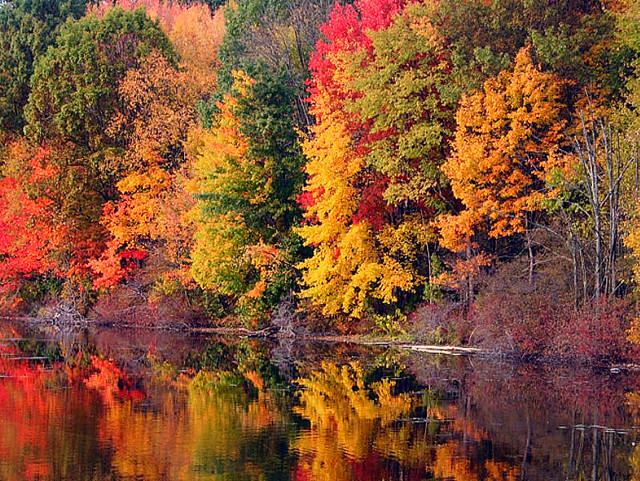
 The colors of Fall are reflected in Lake Arthur of Moraine State Park,
in north suburban Pittsburgh. Moraine State Park is named for the glacial
moraines that cover its land. The Park marks the approximate, greatest
southerly extent of travel of the glaciers, during the last glacial period.
(Image Source: flickr.com )
By Glenn A. Walsh
Reporting for SpaceWatchtower
The colors of Fall are reflected in Lake Arthur of Moraine State Park,
in north suburban Pittsburgh. Moraine State Park is named for the glacial
moraines that cover its land. The Park marks the approximate, greatest
southerly extent of travel of the glaciers, during the last glacial period.
(Image Source: flickr.com )
By Glenn A. Walsh
Reporting for SpaceWatchtower
The
second half of October marks both the end of the growing season, as
well as the peak in colorful Fall foliage in the Pittsburgh Quad-State
Region: Western Pennsylvania, Northern West Virginia, Eastern Ohio, and
Western Maryland. Although these came a few weeks earlier, in the higher
elevations of the Allegheny Mountains portion of the region.
The
annual change in color of leaves, from the ubiquitous greens of Spring
and Summer to the yellows, golds, oranges, reds, crimsons, purples, and
browns of many deciduous trees and shrubs in the Autumn, is one of the
greatest visible effects of Astronomy on the natural world we live in.
The increasing length of darkness, each day in Autumn, is the primary
cause of this color change.
Planet Earth has a 23.44-degree tilt
in its north-south axis to the
plane of its orbit around the Sun. Consequently, as the Earth revolves
around the Sun, a different portion of the planet each season of the
year receives the most direct sunlight. The Northern Hemisphere receives
the most direct sunlight in the Spring and Summer months, while the
intensity of sunlight diminishes during the Autumn until the beginning
of Winter, when the length and intensity of sunlight is at a minimum.
It
is the long nights and the lower intensity of energy coming from the
Sun, due to the Sun's lower angle in the sky, during the Autumn and
Winter months, that prevents the leaves from producing the nutrients
needed by the plant. Hence, the leaves do not keep their green color and
eventually fall-off. When the length and intensity of sunlight
increases in the Spring months, trees and shrubs grow new, green leaves
to harvest the sunlight into energy for the plant's needs.
After
the Summer Solstice in June, each day the Earth's Northern Hemisphere
receives less direct sunlight causing nighttime to become longer.
However, as the most direct sunlight hits the Northern Hemisphere on the
day of the Summer Solstice, and due to seasonal lag caused by large
bodies of water on the Earth, the green leaves continue to flourish on
most plants, except in areas of great drought. As the Earth reaches the
point in its orbit around the Sun marking the
Autumnal Equinox in the Northern Hemisphere, the less direct sunlight
and longer nights become significant.
The production of
chlorophyll in plants, during the Spring and Summer
months when sunlight is more abundant, is used to manufacture
food-sugars from sunlight through
a chemical process known as photosynthesis. The chlorophyll pigment
overwhelms other pigments in a plant's leaves; hence, the plant's leaves
reflect a green color.
Plants prepare for the days when less sunlight will be available for
food production by beginning to close-off the veins which carry fluids
to and from their leaves. This a protective measure, to reduce the
energy needs of the plant for the long Winter. Also, the tender leaves,
in which the leave's fluids could easily freeze in sub-freezing temperatures, could hurt the
plant and must be disposed-of. Hence, after the leaves change color,
they fall off of the plant.
As days go by in
the Fall with less intense sunlight available each day, chlorophyll
production begins to slow down, stops, and eventually all chlorophyll is
destroyed. Different species of trees and plants contain and produce
different
pigments, other than chlorophyll. Hence, when the chlorophyll is
destroyed, the different pigments determine what colors will be unveiled
in the leaves. The carotenoid pigment, which is always present in
leaves, is then
unmasked to show the yellow and gold colors of leaves, which remains
pretty-much the same each year.
Weather, also influenced by the
Earth's tilt on its axis and the amount of energy from the Sun received
on different parts of the planet, has some additional effect on the intensity
of pigment color in a leaf, each year, with temperature and moisture
being the main influences.
Often the most brilliant displays of
Fall color come when days are warm and sunny and nights are cool, but
not below the freezing-point. In such days, chlorophyll continues
producing sugars, but the closing of a leaf's veins traps these
additional sugars in the leaves. This spurs the production of
anthocyanin pigments, which results in leaves of dazzling red, purple,
and crimson colors.
Although, if Autumn days are too warm, as we
in the Pittsburgh region experienced in September, the leaves' veins may
not close-off soon enough, and Fall colors will be slightly delayed or
be less intense. A severe drought can also delay Fall colors. and, in
some cases, result in leaves falling off branches prematurely.
Many
areas of western and northern Pennsylvania, particularly in the
Allegheny Mountains, have vivid displays of Fall color at this time of
year. This is thanks to the astronomical effects of Earth, with the
23.44-degree tilt on its axis, revolving around the Sun..
More on Earth Seasons:
Link >>>
http://en.wikipedia.org/wiki/Season
More on the season of Autumn or Fall:
Link >>>
http://en.wikipedia.org/wiki/Autumn
More on Why Leaves Change Color:
Link >>>
https://www.sciencemadesimple.com/leaves.html
Source: Glenn A. Walsh Reporting for SpaceWatchtower, a project of Friends of the Zeiss.
Want to receive
SpaceWatchtower blog posts in your inbox ?
Send request to <
spacewatchtower@planetarium.cc
>..
gaw
Glenn A. Walsh, Project Director,
Friends of the Zeiss <
http://buhlplanetarium.tripod.com/fotz/
>
Electronic Mail - <
gawalsh@planetarium.cc
>
About the SpaceWatchtower Editor/Author: <
http://buhlplanetarium.tripod.com/#GAW >
SpaceWatchtower Blog: <
http://spacewatchtower.blogspot.com/
>
Also see: South Hills Backyard Astronomers Blog: <
http://shbastronomers.blogspot.com/ >
SPACE & SCIENCE NEWS, ASTRONOMICAL CALENDAR:
<
http://buhlplanetarium.tripod.com/#news
>
Twitter: <
https://twitter.com/spacewatchtower
>
Facebook: <
http://www.facebook.com/pages/SpaceWatchtower/238017839577841?sk=wall
>
Author of History Web Sites on the Internet --
* Buhl Planetarium,
Pittsburgh:
<
http://www.planetarium.cc >
*
Adler Planetarium, Chicago:
<
http://adlerplanetarium.tripod.com
>
* Astronomer, Educator, Optician John A. Brashear:
<
http://johnbrashear.tripod.com >
*
Andrew Carnegie & Carnegie Libraries:
<
http://www.andrewcarnegie.cc >
* Civil War Museum of Andrew Carnegie Free Library:
<
http://garespypost.tripod.com >
*
Duquesne Incline
cable-car railway, Pittsburgh:
<
http://inclinedplane.tripod.com
>
* Public Transit:
<
http://andrewcarnegie2.tripod.com/transit
>


