Wednesday, August 10, 2016

170th Anniversary: Smithsonian Institution

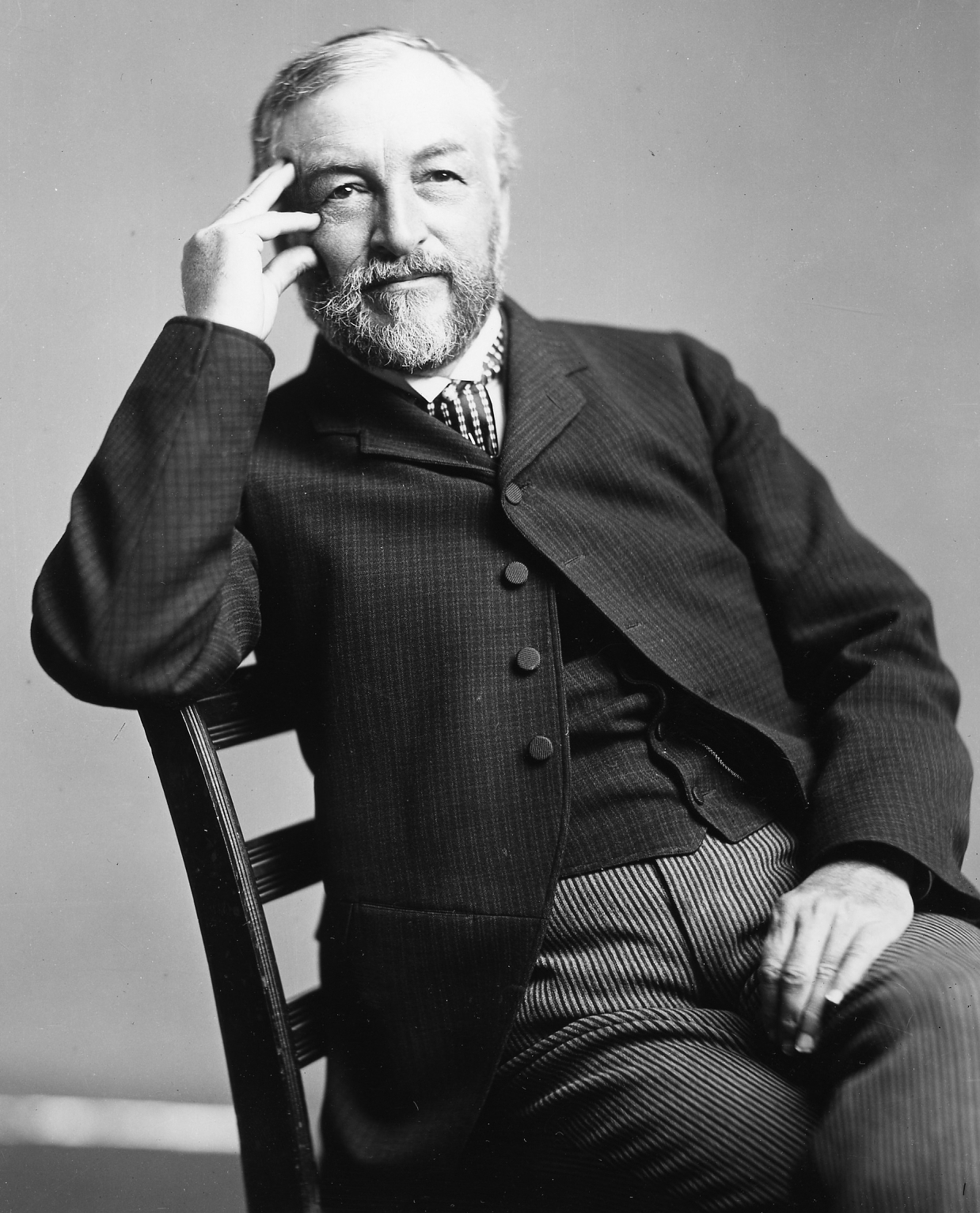
Samuel Pierpont Langley.jpg
In 1887, Samuel Pierpont Langley was chosen as the third
Secretary of the Smithsonian Institution, then considered the
nation's highest scientific appointment. Previously Director of
Pittsburgh's Allegheny Observatory, in 1890 Dr. Langley
established the Smithsonian Astrophysical Observatory.
(Image Sources: Wikipedia.org , By Low resolution in context, Public Domain,
https://commons.wikimedia.org/w/index.php?curid=1496860 )

By Glenn A. Walsh
Reporting for SpaceWatchtower

Today (2016 August 10) marks the 170th anniversary of an Act of the U.S. Congress which established a fairly unique educational institution, founded from the bequest of an English chemist who never visited America: the Smithsonian Institution, the granddaddy of America's museums!

Known as “America's Attic,” the Smithsonian is the world's largest museum and actually includes 19 museums, 9 research centers, and the National Zoo (officially known as the National Zoological Park). Each year, about 30 million people visit Smithsonian facilities, every visit being free-of-charge. The Institution is funded from their endowment; private, corporate, and government grants; and membership dues; as well as earned income from retail, concession, and licensing revenues.

The many Smithsonian museums include the National Air and Space Museum, the National Museum of Natural History, and the National Museum of American History. And, research facilities include the Smithsonian Astrophysical Observatory, which became the Harvard-Smithsonian Center for Astrophysics in 1973.

The idea for a Smithsonian Institution started from the will of deceased British chemist and mineralogist James Smithson, who was the illegitimate child of a wealthy Englishman, Hugh Percy, 1st Duke of Northumberland. Upon the death of James Smithson's mother, he and his half-brother, Col. Henry Louis Dickenson, had split the inherited fortune.

However, formation of a Smithsonian Institution was not the first choice according to Smithson's will. James Smithson, who died on 1829 June 27 in Genoa, Italy, never married, so when he wrote his will, he left his fortune to his nephew (son of his half-brother), Henry James Hungerford. However, Henry James Dickenson, the actual name of the nephew, had to change his surname to Hungerford to receive the inheritance. Upon the death of Henry James Hungerford, James Smithson's will specified that the inheritance would then go to Mr. Hungerford's children.

However, Henry James Hungerford died on 1835 June 5. He, also, had never married and left no children.

So with no direct descendants, James Smithson's will stipulated:

"I then bequeath the whole of my property, . . . to the United States of America, to found at Washington, under the name of the Smithsonian Institution, an Establishment for the increase & diffusion of knowledge among men."
James Smithson had traveled throughout Europe, but he never visited America. And, he never wrote-about or discussed his reasons for this unusual bequest, which equaled more than half a million dollars (at the time this fortune was so large, it was 1/66th of the United States' entire Federal budget!) . Of course, he probably figured that his descendants would receive the inheritance, and except for the family and a few estate attorneys, no one would have ever known about the Smithsonian Institution clause of the will.
So, he probably wrote the Smithsonian Institution clause as the expression of the importance he placed in education. And, with the recent founding of the American experiment in democracy, he may have thought that his fortune would have a greater impact in America, than in England which already had endowed educational institutions.
As the money donated by Andrew Carnegie to establish more than 2,000 libraries greatly spurred the public library movement, the educational value of Smithson's bequest has probably exceeded Smithson's wildest imagination! However, in the beginning, the actual founding of the Smithsonian Institution almost did not happen!
Six years after Smithson's death, U.S. President Andrew Jackson announced the bequest, which the U.S. Congress officially accepted on 1836 July 1. Then came the politics! Congress debated the use of the money, according to the terms of Smithson's will, for more than eight years. However, during this time the U.S. Treasury invested the money in bonds issued by the state of Arkansas, which soon defaulted!
John Quincy Adams, then former President of the United States who had returned to Congress as a U.S. Representative from Massachusetts, persuaded Congress to restore the funds of the bequest, with interest, and use the money as Smithson's will had stipulated, despite efforts by other Congressmen to use the money for other purposes. Adams was very interested in science and education, and he had unsuccessfully sought the establishment of a national astronomical observatory while he was President. Shortly before his death, Adams gave his last public address at the laying of the cornerstone for the country's first public observatory, the Cincinnati Observatory, in 1843.
On 1846 August 10, U.S. President James K. Polk signed an Act of Congress officially establishing the Smithsonian Institution as a legal trust, to be administered by a Board of Regents and a Secretary.
Joseph Henry, the Smithsonian's first Secretary, wanted the Smithsonian Institution to be a center for scientific research. However, in the beginning, it was a depository for various Washington and U.S. Government collections, which were not appropriate for the Library of Congress or the National Archives. This included thousands of animal and plant specimens from a U.S. Navy global Exploring Expedition (1838 to 1842), as well as similar specimens and artifacts from military and civilian surveys of the American West.
Shortly after the Smithsonian's founding, they set-up a plan for weather observations and meteorological research. The Smithsonian Institution soon attracted many scientists, who created the Megatherium Club, one of the earliest such groups of scientists in America.
Of the Smithsonian's 19 museums, 11 are located on the National Mall in Downtown Washington, D.C. Other museums are located elsewhere in Washington, as well as two in New York City and one in across the Potomac River from Washington in Chantilly, Virginia. A Smithsonian exhibit space in London's Queen Elizabeth II Olympic Park is now being planned, and it would be their first permanent museum outside of the United States. Additionally, the Smithsonian Institution has affiliations with 168 other museums around the country, Puerto Rico, and Panama, including Pittsburgh's Senator John Heinz History Center. Traveling exhibits, from the Smithsonian, often are exhibited in these affiliate museums.
Among the many museums is the National Air and Space Museum, with 6.7 million visitors in 2014 making it the fifth most-visited museum in the world. Established in 1946 as the National Air Museum, it became the National Air and Space Museum in 1976, with the opening of the new main building on Washington's National Mall. This building includes the Albert Einstein Planetarium with a Zeiss VI-A Planetarium Projector, which was a Bicentennial gift to the nation from the people of the Federal Republic of Germany. Additionally, the Einstein Planetarium has recently been renovated to include more advanced projectors that project digital and high-definition images.

One of the Smithsonian's first research centers, the Smithsonian Astrophysical Observatory was established in 1890 by the Smithsonian's third Secretary, Samuel Pierpont Langley, who had previously been Director of Pittsburgh's Allegheny Observatory. The Smithsonian Astrophysical Observatory has been located in Cambridge, Massachusetts since 1955, to affiliate with the Harvard College Observatory.

At this time, the famous astronomer Harlow Shapley, who had recently resigned as Harvard College Observatory Director, continued with Harvard as the Robert Treat Paine Professor of Practical Astronomy until his retirement in 1956. In 1947, Harlow Shapley served as Interim President at the founding of the Astronomical League, a national umbrella organization of amateur astronomy clubs. In 1941, Dr. Shapley gave the keynote address at the dedication of the rather unique 10-inch Siderostat-type Refractor Telescope at Pittsburgh's original Buhl Planetarium and Institute of Popular Science (November 19 marks the 75th anniversary of this historic telescope).

The Harvard College Observatory and the Smithsonian Astrophysical Observatory formalized their long-time collaboration in 1973, with the formation of the Harvard-Smithsonian Center for Astrophysics.

The National Museum of American History preserves and displays our nation's heritage in the areas of social, political, cultural, scientific, and military history. And, they continue collecting appropriate items and artifacts for the museum. Last month, during both major political conventions, museum curators were on the convention floor seeking to obtain political memorabilia, after the conclusion of each convention.
Museum collections of the Smithsonian are vast and diverse. It includes 138 million artworks, artifacts, and specimens. Of these, 127 million specimens and artifacts are held in the National Museum of Natural History. More than 2 million library volumes are held in the Smithsonian's own library system and the Smithsonian Archives hold 156,830 cubic feet of archival material.
The Smithsonian publishes two major magazines: Smithsonian (monthly) and Air & Space Smithsonian (bi-monthly). Smithsonian Magazine started publication in 1970 after then-Smithsonian Secretary S. Dillon Ripley asked retired Life Magazine editor Edward K. Thompson to create a magazine "about things in which the Smithsonian [Institution] is interested, might be interested or ought to be interested.”

Internet Links to Additional Information ---

Smithsonian Institution -
Link 1 >>> http://www.si.edu/
Link 2 >>> https://en.wikipedia.org/wiki/Smithsonian_Institution

Smithsonian's National Air and Space Museum -
Link 1 >>> https://airandspace.si.edu/
Link 2 >>> https://en.wikipedia.org/wiki/National_Air_and_Space_Museum

Smithsonian's National Museum of American History -
Link 1 >>> http://americanhistory.si.edu/
Link 2 >>> https://en.wikipedia.org/wiki/National_Museum_of_American_History

Smithsonian's National Museum of Natural History -
Link 1 >>> http://naturalhistory.si.edu/
Link 2 >>> https://en.wikipedia.org/wiki/National_Museum_of_Natural_History

Smithsonian Astrophysical Observatory -
Link 1 >>> https://www.cfa.harvard.edu/sao/
Link 2 >>> https://en.wikipedia.org/wiki/Smithsonian_Astrophysical_Observatory

Smithsonian Donor James Smithson: Link >>> https://en.wikipedia.org/wiki/James_Smithson

Former U.S. President John Quincy Adams, who helped Smithsonian establishment:
Link >>> http://spacewatchtower.blogspot.com/2014/02/presidents-day-astronomy-president.html

Smithsonian's 3rd Director, Samuel Pierpont Langley:
Link >>> http://johnbrashear.tripod.com/bio/LangleySP.htm

Halloran, Liz. "'America's Attic' Team Dredges Convention For Historical Riches." News Report.
National Public Radio 2012 Sept. 6.
Link >>> http://www.npr.org/sections/itsallpolitics/2012/09/06/160708601/americas-attic-team-dredges-convention-for-historical-riches

Related Blog Posts ---

"Air & Space Museum Debates Preservation of U.S. Plane at Pearl Harbor Attack." 2014 Dec. 7.

Link >>> http://spacewatchtower.blogspot.com/2014/12/air-space-museum-debates-preservation.html


"$30 Million Rehab of Air & Space Museum Announced." 2014 April 5.

Link >>> http://spacewatchtower.blogspot.com/2014/04/30-million-rehab-of-air-space-museum.html


"Space Artifacts Move to New Climate-Controlled Facility." 2014 Feb. 20.

Link >>> http://spacewatchtower.blogspot.com/2014/02/space-artifacts-move-to-new-climate.html


"Presidents' Day: The Astronomy President - John Quincy Adams." 2014 Feb. 17.

Link >>> http://spacewatchtower.blogspot.com/2014/02/presidents-day-astronomy-president.html

Source: Glenn A. Walsh Reporting for SpaceWatchtower, a project of Friends of the Zeiss.
             2016 Aug. 10.


                                                               Historic 10-inch Siderostat-type Refractor Telescope at Pittsburgh's original Buhl Planetarium and Institute of Popular Science.
        2016: 75th Year of Pittsburgh's Buhl Planetarium Observatory
     Link >>> http://spacewatchtower.blogspot.com/2016/01/astronomical-calendar-2016-january.html

                             Like This Post? - Please Share!

Want to receive SpaceWatchtower blog posts in your inbox ?
Send request to < spacewatchtower@planetarium.cc >..

gaw

Glenn A. Walsh, Project Director,
Friends of the Zeiss < http://buhlplanetarium.tripod.com/fotz/ >
Electronic Mail - < gawalsh@planetarium.cc >
SpaceWatchtower Blog: < http://spacewatchtower.blogspot.com/ >
Also see: South Hills Backyard Astronomers Blog: < http://shbastronomers.blogspot.com/ >
Barnestormin: Writing, Essays, Pgh. News, & More: < http://www.barnestormin.blogspot.com/ >
About the SpaceWatchtower Editor / Author: < http://buhlplanetarium2.tripod.com/weblog/spacewatchtower/gaw/ >
SPACE & SCIENCE NEWS, ASTRONOMICAL CALENDAR:
http://buhlplanetarium.tripod.com/#news >
Twitter: < https://twitter.com/spacewatchtower >
Facebook: < http://www.facebook.com/pages/SpaceWatchtower/238017839577841?sk=wall >
Author of History Web Sites on the Internet --
* Buhl Planetarium, Pittsburgh:
  < http://www.planetarium.cc >
* Adler Planetarium, Chicago:
  < http://adlerplanetarium.tripod.com >
* Astronomer, Educator, Optician John A. Brashear:
  < http://johnbrashear.tripod.com >
* Andrew Carnegie & Carnegie Libraries:
  < http://www.andrewcarnegie.cc >
* Civil War Museum of Andrew Carnegie Free Library:
  < http://garespypost.tripod.com >
Duquesne Incline cable-car railway, Pittsburgh:
  < http://inclinedplane.tripod.com >
* Public Transit:
  < http://andrewcarnegie2.tripod.com/transit >

Monday, August 1, 2016

Astronomical Calendar: 2016 August

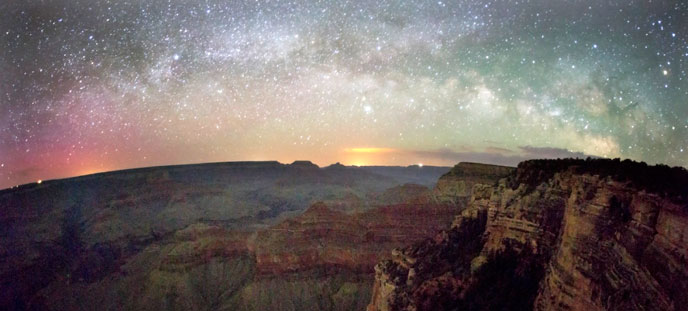
View of night sky, Grand Canyon
The 'Milky Way,' looking into the center of our Milky Way Galaxy, visible at the south rim of the Grand Canyon. On June 6, the Grand Canyon National Park in Arizona received the designation of "International Dark-Sky Park" from the International Dark-Sky Association (IDA). August 25 marks the centennial of America's National Park Service, the world's first designated National Parks.
More on the Grand Canyon receiving Dark-Sky status:
Link >>> https://www.nps.gov/subjects/nightskies/grcadarksky.htm
 (Image Source: National Park Service)

Astronomical Calendar for 2016 August: 
Link >>> http://buhlplanetarium4.tripod.com/astrocalendar/2016.html#aug

Source: Friends of the Zeiss.
              2016 August 1.

                                                               Historic 10-inch Siderostat-type Refractor Telescope at Pittsburgh's original Buhl Planetarium and Institute of Popular Science.
        2016: 75th Year of Pittsburgh's Buhl Planetarium Observatory
     Link >>> http://spacewatchtower.blogspot.com/2016/01/astronomical-calendar-2016-january.html

                             Like This Post? - Please Share!

Want to receive SpaceWatchtower blog posts in your inbox ?
Send request to < spacewatchtower@planetarium.cc >..

gaw

Glenn A. Walsh, Project Director,
Friends of the Zeiss < http://buhlplanetarium.tripod.com/fotz/ >
Electronic Mail - < gawalsh@planetarium.cc >
SpaceWatchtower Blog: < http://spacewatchtower.blogspot.com/ >
Also see: South Hills Backyard Astronomers Blog: < http://shbastronomers.blogspot.com/ >
Barnestormin: Writing, Essays, Pgh. News, & More: < http://www.barnestormin.blogspot.com/ >
About the SpaceWatchtower Editor / Author: < http://buhlplanetarium2.tripod.com/weblog/spacewatchtower/gaw/ >
SPACE & SCIENCE NEWS, ASTRONOMICAL CALENDAR:
http://buhlplanetarium.tripod.com/#news >
Twitter: < https://twitter.com/spacewatchtower >
Facebook: < http://www.facebook.com/pages/SpaceWatchtower/238017839577841?sk=wall >
Author of History Web Sites on the Internet --
* Buhl Planetarium, Pittsburgh:
  < http://www.planetarium.cc >
* Adler Planetarium, Chicago:
  < http://adlerplanetarium.tripod.com >
* Astronomer, Educator, Optician John A. Brashear:
  < http://johnbrashear.tripod.com >
* Andrew Carnegie & Carnegie Libraries:
  < http://www.andrewcarnegie.cc >
* Civil War Museum of Andrew Carnegie Free Library:
  < http://garespypost.tripod.com >
Duquesne Incline cable-car railway, Pittsburgh:
  < http://inclinedplane.tripod.com >
* Public Transit:
  < http://andrewcarnegie2.tripod.com/transit >

Monday, July 25, 2016

NASA Time-Lapse Video From Space: Sunlit Earth Over One Year

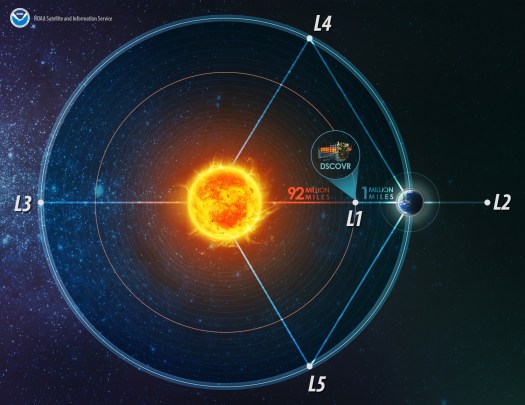
DSCOVR location in relation to the Earth and sun / Image courtesy of NOAA
Location of the DSCOVR satellite, in relation to the Earth and Sun, known as
Lagrange Point 1 (L1).
(Graphic Source: National Oceanic and Atmospheric Administration)

By Glenn A. Walsh
Reporting for SpaceWatchtower

On YouTube, NASA has released a time-lapse video (2 minutes, 46 seconds in length), taken from a distance of one million miles from the Earth, showing the Earth over a period of one year. More than 3,000 color photographs, taken at least once every two hours beginning on 2015 July 6, show several events (including a Solar Eclipse and Lunar Transits) that occurred on the sunlit side of our planet while rotating on its axis 366 times.

These photographs were taken by the EPIC (Earth Polychromatic Imaging Camera) camera on the DSCOVR (Deep Space Climate Observatory) satellite, sponsored by the National Oceanic and Atmospheric Administration (NOAA). This satellite is in orbit of the Earth, about a million miles away from our planet, at the spot in space known as Lagrange Point 1.

Lagrange Point 1 (L1) is one of five Lagrange Points in relation to three bodies in space. In this case, L1 is the point in space where the gravity of the Earth, gravity of the Sun, and, also, the Apparent Centrifugal Force of a third body (DSCOVR satellite) are in a rough equilibrium This allows the satellite, located in such a position, to remain in orbit around the Earth using a minimum of fuel, and to always remain directly between the Sun and the Earth.

The five Lagrange Points are named for 18th century mathematician Joseph-Louis Lagrange, who wrote about these points in a 1772 paper regarding, what he called, the “three-body problem.”

EPIC takes images of ten different wavelengths. Then, three of these wavelengths, correlated to the colors red, green, and blue, are combined to provide a realistic, color image of what the viewer would see, if the viewer was on the satellite.

This video shows moving cloud and weather patterns and large storms, along with continents and oceans quickly passing along on the surface as each day passes. Good views of the North Pole and the South Pole are seen in the video, during their respective Summer seasons (when the respective Pole is tilted towards the Sun, and hence, also tilted towards the satellite).

The EPIC camera caught the Moon's shadow move across the Earth's surface during the 2016 March 8 - 9  Total Solar Eclipse, which was visible from parts of Indonesia and the Pacific Ocean. Additionally, since this satellite is four times farther from the Earth than is Earth's Moon, the EPIC camera viewed the Moon transit, or move across the Earth's disk, a couple of times during this year of observation (2015 July 16 and 2016 July 4).

As this satellite is “parked” at L1, it could view both the Sun and the sunlit Earth 24 hours a day. The DSCOVR satellite, operated by NOAA, is an Earth observation satellite which could help weather forecasting for NOAA's National Weather Service (NWS). Another satellite located at L1, SOHO (Solar and Heliospheric Observatory), continually watches and studies the Sun.

As an Earth observation satellite, DSCOVR and the EPIC camera are tasked with watching Earth's weather patterns, as well as measuring ozone and aerosol in the atmosphere, the type and height of clouds, vegetation on Earth's land masses, hotspots on the planet, and making estimates of Ultraviolet (UV) radiation on the Earth's surface. This is the first time we are receiving continual images of our planet from this great a distance. The DSCOVR satellite is expected to last at least five years.

NASA Time-Lapse Video: Link >>> https://www.youtube.com/watch?v=CFrP6QfbC2g

Internet Links to Additional Information ---

More on the DSCOVR satellite:
Link >>> https://en.wikipedia.org/wiki/Deep_Space_Climate_Observatory

More on the EPIC camera:
Link >>> https://en.wikipedia.org/wiki/Deep_Space_Climate_Observatory#EPIC

More on Lagrange Points:
Link 1 >>> http://www.haydenplanetarium.org/tyson/read/2002/04/01/the-five-points-of-lagrange
Link 2 >>> https://en.wikipedia.org/wiki/Lagrangian_point

More on Apparent Centrifugal Force and Centripetal Force:
Link 1 >>> http://phun.physics.virginia.edu/topics/centrifugal.html
Link 2 >>> http://sydney1206.blogspot.com/2013/05/centripetal-force.html
Link 3 >>> http://www.livescience.com/52488-centrifugal-centripetal-forces.html

More on NOAA:
Link >>> https://en.wikipedia.org/wiki/National_Oceanic_and_Atmospheric_Administration

Source: Glenn A. Walsh Reporting for SpaceWatchtower, a project of Friends of the Zeiss.
             2016 July 25.


                                                               Historic 10-inch Siderostat-type Refractor Telescope at Pittsburgh's original Buhl Planetarium and Institute of Popular Science.
        2016: 75th Year of Pittsburgh's Buhl Planetarium Observatory
     Link >>> http://spacewatchtower.blogspot.com/2016/01/astronomical-calendar-2016-january.html

                             Like This Post? - Please Share!

Want to receive SpaceWatchtower blog posts in your inbox ?
Send request to < spacewatchtower@planetarium.cc >..

gaw

Glenn A. Walsh, Project Director,
Friends of the Zeiss < http://buhlplanetarium.tripod.com/fotz/ >
Electronic Mail - < gawalsh@planetarium.cc >
SpaceWatchtower Blog: < http://spacewatchtower.blogspot.com/ >
Also see: South Hills Backyard Astronomers Blog: < http://shbastronomers.blogspot.com/ >
Barnestormin: Writing, Essays, Pgh. News, & More: < http://www.barnestormin.blogspot.com/ >
About the SpaceWatchtower Editor / Author: < http://buhlplanetarium2.tripod.com/weblog/spacewatchtower/gaw/ >
SPACE & SCIENCE NEWS, ASTRONOMICAL CALENDAR:
http://buhlplanetarium.tripod.com/#news >
Twitter: < https://twitter.com/spacewatchtower >
Facebook: < http://www.facebook.com/pages/SpaceWatchtower/238017839577841?sk=wall >
Author of History Web Sites on the Internet --
* Buhl Planetarium, Pittsburgh:
  < http://www.planetarium.cc >
* Adler Planetarium, Chicago:
  < http://adlerplanetarium.tripod.com >
* Astronomer, Educator, Optician John A. Brashear:
  < http://johnbrashear.tripod.com >
* Andrew Carnegie & Carnegie Libraries:
  < http://www.andrewcarnegie.cc >
* Civil War Museum of Andrew Carnegie Free Library:
  < http://garespypost.tripod.com >
Duquesne Incline cable-car railway, Pittsburgh:
  < http://inclinedplane.tripod.com >
* Public Transit:
  < http://andrewcarnegie2.tripod.com/transit >

Monday, July 18, 2016

New, Large Asteroid Found in Outer Solar System


Slow-motion of image of newly-
discovered Asteroid 2015 RR245,
in the Outer Solar System.
(Image Source: Outer Solar System Origins
Survey Team)

By Glenn A. Walsh
Reporting for SpaceWatchtower

A new, large asteroid has been found in the Kuiper Belt of the Outer Solar System. In fact due to the current size estimates of the Asteroid / Minor Planet named 2015 RR245, some scientists wonder if it should be designated as a Dwarf Planet.

Although first spotted last September 9 (hence, the 2015 designation), it was not until subsequent observations of the object in February and June when astronomers concluded that 2015 RR245 was a large asteroid. It was first spotted by J.J. Kavelaars of the National Research Council of Canada, using the Canada-France-Hawaii Telescope on top of Mauna Kea in Hawaii.

These observations were part of the four-year Outer Solar System Origins Survey (OSSOS), which started in February of 2013. Involving more than 40 scientists at institutes in 8 countries, this international collaboration seeks to discover distant moving objects in the Outer Solar System, which may allow the scientists to test models regarding how our Solar System evolved.

Using follow-up images of this asteroid in February and June, taken by Michele Bannister of the University of Victoria, more specific estimates of the object were derived. The “year” of 2015 RR245 (i.e. the time it takes to make one revolution around the Sun) is 730 Earth years.

The eccentric orbit of this asteroid takes it to a maximum distance from the Sun of 11.9 billion miles / 19.2 billion kilometers. However, the current location of 2015 RR245 in its orbit means the object is now approaching the Sun (possibly, one of the reasons we now found this object). At its closest, the orbit will bring 2015 RR245 as close as 3.1 billion miles / 5 billion kilometers to the Sun in the year 2096. Currently, this Kuiper Belt object is about 5.9 billion miles / 9.5 billion kilometers from the Sun.

The size of the object is more indefinite. With an apparent visual magnitude in the Mauna Kea telescope of 22, it may be as large as 450 miles / 700 kilometers across. This estimate goes on the assumption that the object's surface is only reflecting 10 per-cent of sunlight.

However, if the object's surface has a lot of ice, it may be reflecting as much as 25 per-cent of sunlight. Hence, such a brighter object may only be about 279 miles / 450 kilometers across.

The size of the object is one determinant of its eligibility to be considered a Dwarf Planet. Thus far, the International Astronomical Union (IAU) has designated, officially, only 5 Dwarf Planets: Asteroid Ceres, Pluto, and three other (besides Pluto) objects beyond the orbit of Neptune (known as Trans-Neptune objects): Eris, Haumea, and Makemake. A sixth Trans-Neptune object, 2007 OR10, is considered large enough to someday be designated as a Dwarf Planet.

Although no other, official, Dwarf Planets have been designated, thus far, the IAU criteria for such designations means that several more Trans-Neptune objects may qualify. And, 2015 RR245 may eventually be one of them.

The IAU's Minor Planet Center, which operates at the Smithsonian Astrophysical Observatory along with the Harvard College Observatory in Cambridge, Massachusetts, has catalogued 1,491 Trans-Neptune objects, as well as another 501 objects with odd, very elliptical orbits in the Outer Solar System. With continuing astronomical observations of the Outer Solar System, they usually find a new Trans-Neptune object every week! However, most of these objects are much, much smaller than 2015 RR245.

Internet Links to Additional Information ---

Canada-France-Hawaii Telescope Announcement of Discovery of 2015 RR245:
Link >>> http://cfht.hawaii.edu/en/news/NewDwarfPlanet/

More details regarding 2015 RR245 - Minor Planet Electronic Circular 2016-N67:
Link >>> http://www.minorplanetcenter.net/mpec/K16/K16N67.html

More on the Outer Solar System Origins Survey: Link >>> http://www.ossos-survey.org/

More on the Canada-France-Hawaii Telescope:
Link >>> https://en.wikipedia.org/wiki/Canada%E2%80%93France%E2%80%93Hawaii_Telescope

More on the Kuiper Belt: Link >>> https://en.wikipedia.org/wiki/Kuiper_belt

More on Dwarf Planets: Link >>> https://en.wikipedia.org/wiki/Dwarf_planet

Source: Glenn A. Walsh Reporting for SpaceWatchtower, a project of Friends of the Zeiss.
             2016 July 18.


                                                               Historic 10-inch Siderostat-type Refractor Telescope at Pittsburgh's original Buhl Planetarium and Institute of Popular Science.
        2016: 75th Year of Pittsburgh's Buhl Planetarium Observatory
     Link >>> http://spacewatchtower.blogspot.com/2016/01/astronomical-calendar-2016-january.html

                             Like This Post? - Please Share!

Want to receive SpaceWatchtower blog posts in your inbox ?
Send request to < spacewatchtower@planetarium.cc >..

gaw

Glenn A. Walsh, Project Director,
Friends of the Zeiss < http://buhlplanetarium.tripod.com/fotz/ >
Electronic Mail - < gawalsh@planetarium.cc >
SpaceWatchtower Blog: < http://spacewatchtower.blogspot.com/ >
Also see: South Hills Backyard Astronomers Blog: < http://shbastronomers.blogspot.com/ >
Barnestormin: Writing, Essays, Pgh. News, & More: < http://www.barnestormin.blogspot.com/ >
About the SpaceWatchtower Editor / Author: < http://buhlplanetarium2.tripod.com/weblog/spacewatchtower/gaw/ >
SPACE & SCIENCE NEWS, ASTRONOMICAL CALENDAR:
http://buhlplanetarium.tripod.com/#news >
Twitter: < https://twitter.com/spacewatchtower >
Facebook: < http://www.facebook.com/pages/SpaceWatchtower/238017839577841?sk=wall >
Author of History Web Sites on the Internet --
* Buhl Planetarium, Pittsburgh:
  < http://www.planetarium.cc >
* Adler Planetarium, Chicago:
  < http://adlerplanetarium.tripod.com >
* Astronomer, Educator, Optician John A. Brashear:
  < http://johnbrashear.tripod.com >
* Andrew Carnegie & Carnegie Libraries:
  < http://www.andrewcarnegie.cc >
* Civil War Museum of Andrew Carnegie Free Library:
  < http://garespypost.tripod.com >
Duquesne Incline cable-car railway, Pittsburgh:
  < http://inclinedplane.tripod.com >
* Public Transit:
  < http://andrewcarnegie2.tripod.com/transit >

Monday, July 11, 2016

Leap-Year to be Even Longer w/ Added Leap-Second!


Time display of the last Leap-Second, from the < www.time.gov >
Internet web site of the National Institute of Standards and Technology,
U.S. Department of Commerce. This time was Coordinated Universal
Time (UTC), which translated to 7:59:60 p.m. Eastern Daylight Saving
Time (EDT) on 2015 June 30.
(Image Sources: Wikipedia.org , By US Government / NIST - Screen Grab from web
display of www.time.gov, Public Domain, https://commons.wikimedia.org/w/index.
php?curid=41453932 )

By Glenn A. Walsh
Reporting for SpaceWatchtower

Every four years (usually), the calendar year is longer by 24 hours, than the previous three years. However this Leap-Year of 2016 will be even longer, by one second, with the addition of a Leap-Second at the end of the year.

On July 6, the U.S. Naval Observatory announced that a Leap-Second would be added to the civil time scale on the evening of 2016 December 31 at 23:59:60 Coordinated Universal Time (UTC) / 6:59:60 p.m. Eastern Standard Time (EST). Leap-Seconds are added, occasionally when needed, at either the end of June or the end of December, or both.

Since the first Leap-Second was added in June of 1972, 26 Leap-Seconds have been added over the years. Leap-Seconds added in both June and December of the same year have occurred only once, thus far: in 1972, the year Leap-Seconds commenced. The last Leap-Second was added on 2015 June 30 at 23:59:60 UTC / 7:59:60 p.m. Eastern Daylight Saving Time (EDT).

Leap-Seconds have been added, periodically, to respond to the continual slowing of the rotation rate of the Earth, so the world's clocks do not vary significantly from the normal sunrise and sunset times throughout the year. Tidal forces from the Moon (and to a lesser extent, the Sun), in addition to the well-known ocean tides, work to slow the Earth's rotation rate. Geologic conditions that change the distribution of the Earth's mass, such as the movement of the Earth's crust relative to its core, are a contributing factor to slowing of the rotation rate.

In theory, a negative Leap-Second, retracting one second at the end of June or December, is also possible. This would occur if the Earth's rotation rate started accelerating. However, there has never been a need for a negative Leap-Second.

The slowing of the Earth's rotation rate is not consistent, and hence, Leap-Seconds are irregularly spaced and unpredictable. No Leap-Seconds were added between the Leap-Second of 1998 December 31 and the Leap-Second of 2005 December 31, while Leap-Seconds were added each year from 1972 to 1979 (including the two Leap-Seconds in 1972). The International Earth Rotation and Reference Systems Service (IERS), based in Frankfurt, Germany, usually decides to install a Leap-Second in the time scale about six months in advance of implementation.

Of course, the Earth's rotation rate does not suddenly slow down by one second, at certain intervals. The Earth's rotation rate has been continually slowing down, and this continues to be monitored by scientists.

Currently, the Earth's rotation rate, measured as UT1 (Universal Time-1 - Mean Solar Time at the Prime Meridian in Greenwich, England), is behind scientists' more consistent UTC (derived from International Atomic Time, determined by atomic clocks) by two-tenths of a second (clock correction known as DUT1, which is UT1 minus UTC). So, for the civil time scale to stay more consistent with the Earth's rotation rate, a Leap-Second is needed to slow down UTC by one second.

If the Leap-Second occurred today (2016 July 11), this would make the Earth's rotation rate in advance of UTC by eight-tenths of a second. Then, it may take a couple years for the Earth to slow down enough, to the point where UT1 would again be behind UTC and another Leap-Second would be needed.

Of course, by December 31, UT1 may (or may not) actually be five-tenths or six-tenths of a second behind UTC. UTC is never allowed to advance more than nine-tenths of a second ahead of UT1, although usually a Leap-Second is added long before that could happen.

Leap-Seconds have proven to be a problem for computers. Hence, in 2005 there was a proposal to eliminate Leap-Seconds, possibly replacing them with Leap-Hours as a way to keep the civil time scale in-sync with the Earth's rotation rate. However, this issue has been quite controversial among scientists and government officials, so the decision to make any change has been delayed.

Precise time signals, which will include the Leap-Second on December 31 as well as the daily DUT correction, are now provided by government agencies via radio, telephone, and the Internet. This includes agencies such as the U.S. Naval Observatory (USNO), National Institute of Standards and Technology (NIST) [originally known as the National Bureau of Standards (NBS)] of the U.S. Department of Commerce, and the National Research Council (NRC) of Canada. Earlier in the 19th century, the Allegheny Observatory in Pittsburgh provided precise time signals to the railroads and some cities via the telegraph.

Radio time signals, with voice announcements each minute, are provided by three short-wave radio stations in North America: WWV in Fort Collins, Colorado and WWVH in Kekaha, Kauai, Hawaii, both operated by the National Institute of Standards and Technology, and CHU in Ottawa, Ontario, operated by the National Research Council of Canada. Radio-controlled clocks automatically receive the precise time from NIST-operated, long-wave radio station WWVB in Fort Collins, Colorado.

Internet Links to Additional Information ---

More on the Leap-Second -
Link 1 >>> http://www.timeanddate.com/time/leapseconds.html
Link 2 >>> https://en.wikipedia.org/wiki/Leap_second
Link 3 >>> http://earthsky.org/human-world/leap-second-june-30-december-31-why-need-controversy

More on Universal Time (including UT1 & UTC):
Link >>> http://en.wikipedia.org/wiki/Universal_Time

More on Coordinated Universal Time:
Link >>> http://en.wikipedia.org/wiki/Coordinated_Universal_Time

More on International Atomic Time:
Link >>> http://en.wikipedia.org/wiki/International_Atomic_Time

More on precise, international radio time services ---

WWV (SW), Fort Collins, Colorado (Voice announcements of precise time):
Link >>> https://en.wikipedia.org/wiki/WWV_%28radio_station%29

WWVH (SW), Kekaha, Kauai, Hawaii (Voice announcements of precise time):
Link >>> https://en.wikipedia.org/wiki/WWVH

CHU (SW), Ottawa, Ontario, Canada (Voice announcements of precise time):
Link >>> https://en.wikipedia.org/wiki/CHU_%28radio_station%29

WWVB (LW), Fort Collins, Colorado (For Radio-Controlled Clocks only):
Link >>> https://en.wikipedia.org/wiki/WWVB

More on precise time via telegraph in the 19th century, from Pittsburgh's Allegheny Observatory:
Link >>> http://spacewatchtower.blogspot.com/2016/03/some-states-to-abandon-daylight-saving.html

Related Blog Posts ---

"'Leap Second' Tue. Evening Due to Slowing Earth Rotation Rate." 2015 June 30.

Link >>> http://spacewatchtower.blogspot.com/2015/06/leap-second-tue-evening-due-to-slowing.html


"Slowing Earth Rotation Rate Necessitates June 'Leap Second'." 2015 Jan. 27.

Link >>> http://spacewatchtower.blogspot.com/2015/01/slowing-of-rotation-rate-necessitates.html


"Centennial: New Allegheny Observatory Dedication." 2012 Aug. 28.

Link >>> http://spacewatchtower.blogspot.com/2012/08/centennial-new-allegheny-observatory.html


"Second Added to All Clocks Saturday Evening by Scientists." 2012 June 29.

Link >>> http://spacewatchtower.blogspot.com/2012/06/second-added-to-all-clocks-saturday.html


"End of the "Leap Second"?" 2012 Jan. 17.

Link >>> http://spacewatchtower.blogspot.com/2012/01/end-of-leap-second.html


Source: Glenn A. Walsh Reporting for SpaceWatchtower, a project of Friends of the Zeiss.
             2016 July 11.


                                                               Historic 10-inch Siderostat-type Refractor Telescope at Pittsburgh's original Buhl Planetarium and Institute of Popular Science.
        2016: 75th Year of Pittsburgh's Buhl Planetarium Observatory
     Link >>> http://spacewatchtower.blogspot.com/2016/01/astronomical-calendar-2016-january.html

                             Like This Post? - Please Share!

Want to receive SpaceWatchtower blog posts in your inbox ?
Send request to < spacewatchtower@planetarium.cc >..

gaw

Glenn A. Walsh, Project Director,
Friends of the Zeiss < http://buhlplanetarium.tripod.com/fotz/ >
Electronic Mail - < gawalsh@planetarium.cc >
SpaceWatchtower Blog: < http://spacewatchtower.blogspot.com/ >
Also see: South Hills Backyard Astronomers Blog: < http://shbastronomers.blogspot.com/ >
Barnestormin: Writing, Essays, Pgh. News, & More: < http://www.barnestormin.blogspot.com/ >
About the SpaceWatchtower Editor / Author: < http://buhlplanetarium2.tripod.com/weblog/spacewatchtower/gaw/ >
SPACE & SCIENCE NEWS, ASTRONOMICAL CALENDAR:
http://buhlplanetarium.tripod.com/#news >
Twitter: < https://twitter.com/spacewatchtower >
Facebook: < http://www.facebook.com/pages/SpaceWatchtower/238017839577841?sk=wall >
Author of History Web Sites on the Internet --
* Buhl Planetarium, Pittsburgh:
  < http://www.planetarium.cc >
* Adler Planetarium, Chicago:
  < http://adlerplanetarium.tripod.com >
* Astronomer, Educator, Optician John A. Brashear:
  < http://johnbrashear.tripod.com >
* Andrew Carnegie & Carnegie Libraries:
  < http://www.andrewcarnegie.cc >
* Civil War Museum of Andrew Carnegie Free Library:
  < http://garespypost.tripod.com >
Duquesne Incline cable-car railway, Pittsburgh:
  < http://inclinedplane.tripod.com >
* Public Transit:
  < http://andrewcarnegie2.tripod.com/transit >

Tuesday, July 5, 2016

On-Target: NASA's Juno Spacecraft Enters Polar Orbit of Jupiter

Juno obtained this color view on June 29, 2016
This is the last image of Jupiter taken by NASA's Juno spacecraft, as it approached Jupiter on 2016 June 29, at a distance of 3.3 million miles / 5.3 million kilometers from the Solar System's largest planet. After this photograph was taken, Juno's science .instruments were powered-down as it prepared for the difficult orbit insertion maneuver.
(Image Sources: NASA / JPL-Caltech/SwRI/MSSS)

By Glenn A. Walsh
Reporting for SpaceWatchtower

Late evening on American Independence Day (2016 July 4), and just one second difference from pre-burn predictions, NASA's Juno space probe entered polar orbit of the Solar System's largest planet, Jupiter.

The precarious orbit insertion maneuver occurred at the scheduled time of 11:05 p.m. Eastern Daylight Saving Time (EDT) / July 5 at 3:05 Coordinated Universal Time (UTC). However, NASA officials and scientists did not know the maneuver was successful until 11:53 p.m. / July 5 at 3:53 UTC, 48 minutes later, as the orbit insertion was accomplished by Juno's auto-pilot. This is because Jupiter is currently 48 light-minutes from Earth, and radio signals take 48 minutes to travel between Jupiter and the Earth, at this time.

Entering a highly elliptical orbit of Jupiter, which lasts for 53 days, was difficult and dangerous, as Juno had to risk Jupiter's heavy radiation belt, as well as debris orbiting the planet. This particular orbit will allow Juno to avoid Jupiter's dense radiation most of the time, but also make close investigations of Jupiter's North and South Poles as well as the Equator.

The spacecraft's nine science instruments and camera were deactivated before attempting the orbit insertion, to ensure that nothing interfered with the important engine burn; so, there are no actual photographs of the maneuver. However, the maneuver seemed to go flawlessly, when NASA's Jet Propulsion Laboratory (JPL) in Pasadena, California received confirmation that Juno had actually entered orbit around Jupiter. JPL scientists worked along-side engineers from Lockheed Martin, the primary aerospace contractor for the Juno mission.

Prior to turning-off the camera, Juno took a time-lapse video of Jupiter and some of its moons, which NASA released to the public. This video included the first mission surprise: Jupiter's moon, Callisto, appeared dimmer than expected. Juno will take further images of Callisto during the mission.

At a 1:00 a.m. EDT / 5:00 UTC, July 5, NASA / Jet Propulsion Laboratory (California Institute of Technology) media briefing, where questions were taken from both news reporters and from the public via Social Media, Juno's principal science investigator Scott Bolton announced, “NASA did it again,” regarding the tricky space maneuver. He added, "The mission team did great. The spacecraft did great. We are looking great. It's a great day." Scott Bolton does space research at the Southwest Research Institute in San Antonio.

Rick Nybakken, Juno project manager from JPL agreed saying, "The spacecraft worked perfectly, which is always nice when you're driving a vehicle with 1.7 billion miles on the odometer. Jupiter orbit insertion was a big step and the most challenging remaining in our mission plan, but there are others that have to occur before we can give the science team members the mission they are looking for."

Jupiter is one of four “gas giant” planets in the Solar System (the others being Saturn, Uranus, and Neptune), whose clouds are primarily composed of hydrogen and helium. The inner planets, including Mercury, Venus, Earth, and Mars, as well as many objects in the Asteroid Belt and Kuiper Belt (including Pluto) are rocky-type planets.

It is hypothesized that Jupiter formed shortly after the formation of our Sun, and the gravity from Jupiter's massive body may have led to the formation of the other planets. By studying Jupiter, we may find clues to the formation of the Earth.

Juno has a big mission for investigating a big planet. The space probe's primary goal is to understand the origin and evolution of Jupiter, using nine major science instruments. During the mission, Juno will:

  1. More accurately measure Jupiter's gravity to try to determine if Jupiter has a solid planetary core, underneath the heavy cloud cover.
  2. Map Jupiter's intense magnetic field.
  3. Measure the amount of water and ammonia in the deep atmosphere, which could give a clue as to the planet's origin.
  4. Observe the planet's auroras.
  5. Study the cloud belts and the mysterious Red Spot, a huge cyclone larger than the Earth, that has existed for hundreds of years, but now seems to be shrinking in size.
  6. Use data accumulated to try to understand how giant planets form and their role in the organizing of the Solar System.
  7. As many planets being discovered around other stars are as large or larger than Jupiter, more information from Jupiter could help us understand solar systems around other stars.

In the beginning, Juno will complete two 53-day orbits, each known as a “Perijove Pass.” Juno's scientific instruments will be turned-back-on by August 27; this is when the first close-up pictures of Jupiter are expected. On October 19, Juno's engines will change the spacecraft's orbit to a much closer 14-day orbit, where it will stay until the end of the mission in 2018, when it will have completed 37 orbits of Jupiter.

Juno will descend as close as 3,000 miles / 5,000 kilometers to the cloud-tops of Jupiter, the closest any spacecraft has come to the planet. Juno's computer and electronics are sealed in a titanium vault, to protect them from Jupiter's massive radiation. However, Juno is still expected to encounter radiation in excess of 10 million dental X-rays during the mission. Hence, the space probe can only take so much radiation before systems will begin to fail, and the mission is slated to end before the radiation destroys the computer and electronics.

The Juno spacecraft was launched from the Cape Canaveral Air Force Station in Florida on 2011 August 5. However, it did not have enough fuel to go straight to Jupiter, which is why the flight took nearly five years to travel 1.8 billion miles / 2.8 billion kilometers. Juno first went into an elliptical orbit of the Sun.

In October of 2013, Juno passed by the Earth for an Earth gravity-assist (a.k.a. “sling-shot” maneuver), which gave the spacecraft the additional energy needed to reach Jupiter. This gravity-assist gave Juno a boost of more than 8,800 miles-per-hour / 3.9 kilometers-per-second.

For the first time for a NASA mission to the outer planets, the spacecraft is powered by solar energy, rather than by a type of nuclear power (radioisotope thermoelectric generator). Solar panels are normally used for powering Earth satellites and space probes to the inner planets, which are much closer to the Sun than Jupiter. Juno's three huge solar arrays will not only provide energy, 500 watts, for powering the nine scientific instruments, but they will also be key in stabilizing the spacecraft.

Juno is the second spacecraft to orbit Jupiter. The space probe Galileo orbited Jupiter from 1995 to 2003. Eventually, NASA allowed Galileo to burn-up in Jupiter's atmosphere, to prevent it from inadvertently crashing onto one of Jupiter's moons, and subsequently contaminating the moon with bacteria from Earth. Likewise, at the end of Juno's 20-month, $1.1 billion mission, it too will burn-up in Jupiter's atmosphere, for the same reason.

The European Space Agency (ESA) plans to send a Jupiter Icy Moon Explorer space probe to the Jupiter system in 2030, with a launch in 2022. This mission is the successor to the originally proposed Jupiter Ganymede Orbiter by ESA.

NASA has also proposed an Europa Multiple Fly-By Mission, which would be launched around 2022 and include the fly-by of Jupiter's moon Europa 32 times while orbiting Jupiter, as well as landing a spacecraft on this Galilean Moon.

Several more space probes have investigated Jupiter, while flying-by and continuing into the outer Solar System (except Ulysses). These included Pioneer 10 (1973), Pioneer 11 (1974—on its way to Saturn), Voyager 1 (1979—on its way to Saturn and Saturn's largest moon, Titan), Voyager 2 (1979—on its way to Saturn, Uranus, and Neptune), Ulysses (1992—on its way to a detailed study of the Sun), Cassini (2000—on its way to Saturn), and New Horizons (2007—on its way to Pluto).

The spacecraft's name, Juno, comes from the NASA acronym, JUpiter Near-polar Orbiter. However, the name was also chosen because in Greco-Roman mythology, the goddess Juno was the name of the wife of the god Jupiter. And, Juno had the power to peer through clouds, created by Jupiter to hide from his wife, and learn of her husband's mischief. Likewise, the Juno spacecraft has the power to peer through the planet Jupiter's dense clouds, to learn more of the secrets of our Solar System's largest planet.

Internet Links to Additional Information ---

More about Juno:
Link 1 >>> https://www.nasa.gov/mission_pages/juno/main/index.html
Link 2 >>> https://en.wikipedia.org/wiki/Juno_(spacecraft)

More about Jupiter: Link >>> https://en.wikipedia.org/wiki/Jupiter

More about robotic exploration of Jupiter:
Link >>> https://en.wikipedia.org/wiki/Exploration_of_Jupiter

Social Media sites to follow the Juno mission:
Facebook - Link >>> http://www.facebook.com/NASAJuno
Twitter - Link >>> http://www.twitter.com/NASAJuno

Source: Glenn A. Walsh Reporting for SpaceWatchtower, a project of Friends of the Zeiss.
             2016 July 5.


                                                               Historic 10-inch Siderostat-type Refractor Telescope at Pittsburgh's original Buhl Planetarium and Institute of Popular Science.
        2016: 75th Year of Pittsburgh's Buhl Planetarium Observatory
     Link >>> http://spacewatchtower.blogspot.com/2016/01/astronomical-calendar-2016-january.html

                             Like This Post? - Please Share!

Want to receive SpaceWatchtower blog posts in your inbox ?
Send request to < spacewatchtower@planetarium.cc >..

gaw

Glenn A. Walsh, Project Director,
Friends of the Zeiss < http://buhlplanetarium.tripod.com/fotz/ >
Electronic Mail - < gawalsh@planetarium.cc >
SpaceWatchtower Blog: < http://spacewatchtower.blogspot.com/ >
Also see: South Hills Backyard Astronomers Blog: < http://shbastronomers.blogspot.com/ >
Barnestormin: Writing, Essays, Pgh. News, & More: < http://www.barnestormin.blogspot.com/ >
About the SpaceWatchtower Editor / Author: < http://buhlplanetarium2.tripod.com/weblog/spacewatchtower/gaw/ >
SPACE & SCIENCE NEWS, ASTRONOMICAL CALENDAR:
http://buhlplanetarium.tripod.com/#news >
Twitter: < https://twitter.com/spacewatchtower >
Facebook: < http://www.facebook.com/pages/SpaceWatchtower/238017839577841?sk=wall >
Author of History Web Sites on the Internet --
* Buhl Planetarium, Pittsburgh:
  < http://www.planetarium.cc >
* Adler Planetarium, Chicago:
  < http://adlerplanetarium.tripod.com >
* Astronomer, Educator, Optician John A. Brashear:
  < http://johnbrashear.tripod.com >
* Andrew Carnegie & Carnegie Libraries:
  < http://www.andrewcarnegie.cc >
* Civil War Museum of Andrew Carnegie Free Library:
  < http://garespypost.tripod.com >
Duquesne Incline cable-car railway, Pittsburgh:
  < http://inclinedplane.tripod.com >
* Public Transit:
  < http://andrewcarnegie2.tripod.com/transit >

Friday, July 1, 2016

Astronomical Calendar: 2016 July

Artist concept of Juno.
NASA's Juno space probe will go into polar orbit of Jupiter on the evening of American Independence Day, July 4, with the mission to investigate closer to the planet than any other spacecraft. And, this Summer will also mark the 40th anniversary of Viking 1 & 2, the first U.S. spacecraft to safely land on Mars.
More on Juno: Link >>> https://www.nasa.gov/mission_pages/juno/main/index.html
More on Viking 1 & 2: Link >>> http://mars.nasa.gov/programmissions/missions/past/viking/
(Artistic Image Sources: NASA, Jet Propulsion Laboratory / California Institute of Technology)

Astronomical Calendar for 2016 July: 
Link >>> http://buhlplanetarium4.tripod.com/astrocalendar/2016.html#jul

Source: Friends of the Zeiss.
              2016 July 1.

                                                               Historic 10-inch Siderostat-type Refractor Telescope at Pittsburgh's original Buhl Planetarium and Institute of Popular Science.
        2016: 75th Year of Pittsburgh's Buhl Planetarium Observatory
     Link >>> http://spacewatchtower.blogspot.com/2016/01/astronomical-calendar-2016-january.html

                             Like This Post? - Please Share!

Want to receive SpaceWatchtower blog posts in your inbox ?
Send request to < spacewatchtower@planetarium.cc >..

gaw

Glenn A. Walsh, Project Director,
Friends of the Zeiss < http://buhlplanetarium.tripod.com/fotz/ >
Electronic Mail - < gawalsh@planetarium.cc >
SpaceWatchtower Blog: < http://spacewatchtower.blogspot.com/ >
Also see: South Hills Backyard Astronomers Blog: < http://shbastronomers.blogspot.com/ >
Barnestormin: Writing, Essays, Pgh. News, & More: < http://www.barnestormin.blogspot.com/ >
About the SpaceWatchtower Editor / Author: < http://buhlplanetarium2.tripod.com/weblog/spacewatchtower/gaw/ >
SPACE & SCIENCE NEWS, ASTRONOMICAL CALENDAR:
http://buhlplanetarium.tripod.com/#news >
Twitter: < https://twitter.com/spacewatchtower >
Facebook: < http://www.facebook.com/pages/SpaceWatchtower/238017839577841?sk=wall >
Author of History Web Sites on the Internet --
* Buhl Planetarium, Pittsburgh:
  < http://www.planetarium.cc >
* Adler Planetarium, Chicago:
  < http://adlerplanetarium.tripod.com >
* Astronomer, Educator, Optician John A. Brashear:
  < http://johnbrashear.tripod.com >
* Andrew Carnegie & Carnegie Libraries:
  < http://www.andrewcarnegie.cc >
* Civil War Museum of Andrew Carnegie Free Library:
  < http://garespypost.tripod.com >
Duquesne Incline cable-car railway, Pittsburgh:
  < http://inclinedplane.tripod.com >
* Public Transit:
  < http://andrewcarnegie2.tripod.com/transit >