Saturday, February 1, 2020

Astro-Calendar: 2020 Feb. / Once-in-Century Palindrome: Feb. 2

Groundhogday2005.jpg
In addition to being Groundhog Day (above, photo of 2005 annual Groundhog Day ceremony on Gobler's Knob in Punxsutawney, Pennsylvania) and Super Bowl Sunday, February 2 is a once-in-a-century, calendar-date palindrome: 02 / 02 / 2020 (palindrome is a sequence of numbers which reads the same forward as it reads backward), and the 33rd day of the year (in the month including the Leap Year Day, February 29), which is followed by 333 more days! The previous calendar-date palindrome was 1111 November 11 (11 / 11 / 1111). The next two calendar-date palendromes will be 2121 December 12 (12 / 12 / 2121) and 3030 March 3 (03 / 03 / 3030).
More info: Link >>> https://www.washingtonpost.com/science/2020/01/31/sundays-date-is-rare-extra-special-palindrome/
(Image Sources: Wikipedia.org, CC BY-SA 2.0, https://commons.wikimedia.org/w/index.php?curid=216601)
               
Astronomical Calendar for 2020 February ---
Link >>> http://buhlplanetarium4.tripod.com/astrocalendar/20s20.html#feb

 Related Blog Post ---

"Astro-Calendar: Jan. / SpaceX Crew Dragon Test Launch Jan. 11"

Thursday, 2020 January 2.

Link >>> https://spacewatchtower.blogspot.com/2020/01/astro-calendar-jan-spacex-crew-dragon.html


Source: Friends of the Zeiss.
              Saturday, 2020 February 1.

                             Like This Post?  Please Share!

            More Astronomy & Science News - SpaceWatchtower Twitter Feed:
            Link >>> https://twitter.com/spacewatchtower

        Astronomy & Science Links: Link >>> http://buhlplanetarium.tripod.com/#sciencelinks

                Want to receive SpaceWatchtower blog posts in your in-box ?
                Send request to < spacewatchtower@planetarium.cc >.

gaw

Glenn A. Walsh, Informal Science Educator & Communicator:
http://buhlplanetarium2.tripod.com/weblog/spacewatchtower/gaw/ >
Electronic Mail: < gawalsh@planetarium.cc >
Project Director, Friends of the Zeiss: < http://buhlplanetarium.tripod.com/fotz/ >
SpaceWatchtower Editor / Author: < http://spacewatchtower.blogspot.com/ >
Formerly Astronomical Observatory Coordinator & Planetarium Lecturer, original Buhl Planetarium & Institute of Popular Science (a.k.a. Buhl Science Center), Pittsburgh's science & technology museum from 1939 to 1991.
Formerly Trustee, Andrew Carnegie Free Library and Music Hall, Pittsburgh suburb of Carnegie, Pennsylvania.
Author of History Web Sites on the Internet --
* Buhl Planetarium, Pittsburgh:
  < http://www.planetarium.cc >
* Adler Planetarium, Chicago:
  < http://adlerplanetarium.tripod.com >
* Astronomer, Educator, Optician John A. Brashear:
  < http://johnbrashear.tripod.com >
* Andrew Carnegie & Carnegie Libraries:
  < http://www.andrewcarnegie.cc >

Monday, January 27, 2020

New Solar Sail Better Uses Laser Energy for Spacecraft Propulsion


Artist's depiction of the proposed Japanese IKAROS space-probe using a solar sail powered by a powerful ground-based laser.
(Image Sources: Wikipedia.org, By Andrzej Mirecki - Own work, CC BY-SA 3.0, https://commons.wikimedia.org/w/index.php?curid=14656159)

By Glenn A. Walsh
Reporting for SpaceWatchtower

Solar sails which could propel spacecraft to other planets, or possibly even to distant stars, have been a dream of scientists since the 19th century. A light-sail design would accelerate a spacecraft slowly, but it would speed-up to high speeds over a longer period of time.

Particularly for possible interstellar travel, our current use of rockets with chemical propellants would not be efficient or effective. And, a large part of the thrust has to be used just to transport the heavy fuel needed for later in the mission.

Originally conceived to take advantage of the solar wind of our Sun (and, perhaps, that of other stars), today light-sail spacecraft are more likely to use strong ground-based (and, perhaps, some day space-based) lasers for such spacecraft propulsion.

However, when using a ground-based laser, one potential problem has been to keep the laser-sail spacecraft from straying away from the laser beam and veering off-course. Optical scientists from the Chester F. Carlson Center for Imaging Science at the Rochester Institute of Technology and the BEAM Engineering for Advanced Measurements are experimenting with solutions to this problem.

While previous light-sail designs simply acted like mirrors to reflect the laser-light back to the source, the new design uses liquid crystals in diffraction gratings to better stabilize the spacecraft. If the spacecraft starts drifting toward the left, the new sail deflects light to the right and visa-versa. Hence, the spacecraft is forced to position itself back to where the laser beam falls on the center of the sail.

Today, diffraction gratings are used to help encode music and other information on compact disks and digital video disks. One of the effects of diffraction, which some people may be familiar with, is the rainbow effect seen when light is reflected from a CD or DVD.

The original experiment, which was successful, simply used diffraction gratings on the left and right sides of the sail. Now, the researchers are beginning experiments to test diffraction gratings that could center a spacecraft, no-matter which direction it drifts (not just to the right or to the left). They hope that future experiments could be conducted in Earth orbit, on the International Space Station or a separate satellite.

This research was published by researchers Ying-Ju Lucy Chu, Nelson V. Tabiryan, and Grover A. Swartzlander, Jr. in the 2019 December 13 issue of the journal Physical Review Letters.

In 2016, Breakthrough Starshot Initiative announced a plan to launch swarms of micro-chip-sized spacecraft toward the Alpha Centauri star system, the closest multi-star system to the Earth. Proposed to cost up to $100 million, the very small spacecraft would include thin, reflective, and very light-weight laser-light sails, propelled by incredibly powerful lasers based on Earth. The project proponents hope each spacecraft could reach speeds close to 20 per-cent of the speed of light, reaching the Alpha Centauri system 20 years after launch.

Internet Links to Additional Information ---

Solar Sail: Link >>> https://en.wikipedia.org/wiki/Solar_sail

Breakthrough Starshot---
Link 1 >>> http://breakthroughinitiatives.org/initiative/3
Link 2 >>> https://en.wikipedia.org/wiki/Breakthrough_Starshot

Abstract: Research Paper -
"Experimental Verification of a Bigrating Beam Rider."
Ying-Ju Lucy Chu, Nelson V. Tabiryan, and Grover A. Swartzlander, Jr.
Phys. Rev. Lett. 123, 244302 - Published 2019 Dec. 13.
Link >>> https://journals.aps.org/prl/abstract/10.1103/PhysRevLett.123.244302

Related Blog Posts ---

"Nano-Space Probes to Star Alpha Centauri by Laser-Sail ?" Thur., 2017 Dec. 7.

Link >>> https://spacewatchtower.blogspot.com/2017/12/nano-space-probes-to-star-alpha.html


"Laser-Propelled Nano-Space Probe to Reach Alpha Centauri in 20 Years?." Thur., 2016 April 14.

Link >>> https://spacewatchtower.blogspot.com/2016/04/laser-propelled-nano-space-probe-to.html


"Solar Sail Spacecraft Test in 2016." Thur., 2014 July 17.

Link >>> https://spacewatchtower.blogspot.com/2014/07/solar-sail-spacecraft-test-in-2016.html


Source: Glenn A. Walsh Reporting for SpaceWatchtower, a project of Friends of the Zeiss.
              Monday, 2020 January 27.

                             Like This Post?  Please Share!

           More Astronomy & Science News - SpaceWatchtower Twitter Feed:
            Link >>> https://twitter.com/spacewatchtower

        Astronomy & Science Links: Link >>> http://buhlplanetarium.tripod.com/#sciencelinks

                Want to receive SpaceWatchtower blog posts in your in-box ?
                Send request to < spacewatchtower@planetarium.cc >.

gaw

Glenn A. Walsh, Informal Science Educator & Communicator:
http://buhlplanetarium2.tripod.com/weblog/spacewatchtower/gaw/ >
Electronic Mail: < gawalsh@planetarium.cc >
Project Director, Friends of the Zeiss: < http://buhlplanetarium.tripod.com/fotz/ >
SpaceWatchtower Editor / Author: < http://spacewatchtower.blogspot.com/ >
Formerly Astronomical Observatory Coordinator & Planetarium Lecturer, original Buhl Planetarium & Institute of Popular Science (a.k.a. Buhl Science Center), Pittsburgh's science & technology museum from 1939 to 1991.
Formerly Trustee, Andrew Carnegie Free Library and Music Hall, Pittsburgh suburb of Carnegie, Pennsylvania.
Author of History Web Sites on the Internet --
* Buhl Planetarium, Pittsburgh:
  < http://www.planetarium.cc >
* Adler Planetarium, Chicago:
  < http://adlerplanetarium.tripod.com >
* Astronomer, Educator, Optician John A. Brashear:
  < http://johnbrashear.tripod.com >
* Andrew Carnegie & Carnegie Libraries:
  < http://www.andrewcarnegie.cc >

Thursday, January 23, 2020

Public Invited to Vote to Name NASA's Mars 2020 Rover--By This Monday, Jan. 27


NASA's Mars 2020 Rover needs an official name.
(Image Sources: NASA, Wikipedia.org, By NASA/JPL-Caltech - https://photojournal.jpl.nasa.gov/jpeg/PIA21635.jpg, Public Domain, https://commons.wikimedia.org/w/index.php?curid=59224280)

By Glenn A. Walsh
Reporting for SpaceWatchtower

In October, SpaceWatchtower publicized the NASA naming contest, for American students, for the Mars 2020 Rover, scheduled to launch to the Red Planet this Summer. Well, the finalists have been announced, and now the public is invited to vote for your favorite name, from the final candidates.

The nine finalist names are (submission name, grade level, student name and state) :

  • Endurance, K-4, Oliver Jacobs of Virginia
  • Tenacity, K-4, Eamon Reilly of Pennsylvania
  • Promise, K-4, Amira Shanshiry of Massachusetts
  • Perseverance, 5-8, Alexander Mather of Virginia
  • Vision, 5-8, Hadley Green of Mississippi
  • Clarity, 5-8, Nora Benitez of California
  • Ingenuity, 9-12, Vaneeza Rupani of Alabama
  • Fortitude, 9-12, Anthony Yoon of Oklahoma
  • Courage, 9-12, Tori Gray of Louisiana

While the naming contest was limited to students in any school (Kindergarten through Grade 12, including home school students) in the United States, anyone in the world can vote in the public poll for their favorite name on-line, for the Mars 2020 Rover. The deadline for voting is Monday, 2020 January 27 at 11:59 p.m. Eastern Standard Time (EST) / January 28, 4:59 Coordinated Universal Time (UTC). The results of the poll will be a consideration in the final naming selection.

Vote in the Public Poll at this Internet link:

More than 28,000 student essays were submitted after the contest began on August 28 of last year; the students were required to write an essay explaining their choice of rover name. A diverse panel of nearly 4,700 judge volunteers, composed of educators, professionals, and space enthusiasts from all around the country, narrowed the pool down to 155 deserving semi-finalists from every state and territory in the country. 

"Thousands of students have shared their ideas for a name that will do our rover and the team proud," said Lori Glaze, director of NASA's Planetary Science Division in Washington. "Thousands more volunteered time to be part of the judging process. Now it is the public's opportunity to become involved and express their excitement for their favorites of the final nine."

At the conclusion of the public poll, the nine student finalists will discuss the proposed rover names with a NASA panel which includes Lori Glaze, Director of NASA's Planetary Science Division in Washington, NASA Astronaut Jessica Watkins, NASA / Jet Propulsion Laboratory Rover Driver Nick Wiltsie, and Clara Ma, who earned the honor of naming the Mars Rover Curiosity as a sixth-grade student in 2009.

The contest will finish-up in March, when the winning name will be announced, along with the student who proposed the name. The winning student will receive an invitation to watch the launch of the Mars 2020 Rover in July or August from the Cape Canaveral Air Force Station in Florida.

NASA calls the Mars 2020 Rover a “robotic scientist,” which weights more than 2,300 pounds / 1,000 kilograms. This robotic scientist will search for signs of past microbial life, characterize the planet's climate and geology, collect samples for future return to Earth, and pave the way for human exploration of the Red Planet. After the launch in July or August, the Mars 2020 Rover is scheduled to land in Mars' Jezero Crater on 2021 February 18.

Internet Links to Additional Information ---

Mars 2020 Rover:
Link 1 >>> https://mars.jpl.nasa.gov/mars2020/
Link 2 >>> https://en.wikipedia.org/wiki/Mars_2020

Related Blog-Posts ---

"For Students: Mars 2020 Name the Rover Essay Contest By Nov. 1." Tue., 2019 Oct. 15.

Link >>> https://spacewatchtower.blogspot.com/2019/10/for-students-mars-2020-name-rover-essay.html


"Place Your Name on Mars 2020 Rover Microchip By This Monday, Sept. 30." 2019 Sept. 26.

Link >>> https://spacewatchtower.blogspot.com/2019/09/place-your-name-on-mars-2020-rover.html


"Help Astronomers Name Large Kuiper Belt Asteroid." 2019 April 26.

Link >>> https://spacewatchtower.blogspot.com/2019/04/help-astronomers-name-large-kuiper-belt.html


Source: Glenn A. Walsh Reporting for SpaceWatchtower, a project of Friends of the Zeiss.
              Thursday, 2020 January 23.

                             Like This Post?  Please Share!

           More Astronomy & Science News - SpaceWatchtower Twitter Feed:
            Link >>> https://twitter.com/spacewatchtower

        Astronomy & Science Links: Link >>> http://buhlplanetarium.tripod.com/#sciencelinks

                Want to receive SpaceWatchtower blog posts in your in-box ?
                Send request to < spacewatchtower@planetarium.cc >.

gaw

Glenn A. Walsh, Informal Science Educator & Communicator:
http://buhlplanetarium2.tripod.com/weblog/spacewatchtower/gaw/ >
Electronic Mail: < gawalsh@planetarium.cc >
Project Director, Friends of the Zeiss: < http://buhlplanetarium.tripod.com/fotz/ >
SpaceWatchtower Editor / Author: < http://spacewatchtower.blogspot.com/ >
Formerly Astronomical Observatory Coordinator & Planetarium Lecturer, original Buhl Planetarium & Institute of Popular Science (a.k.a. Buhl Science Center), Pittsburgh's science & technology museum from 1939 to 1991.
Formerly Trustee, Andrew Carnegie Free Library and Music Hall, Pittsburgh suburb of Carnegie, Pennsylvania.
Author of History Web Sites on the Internet --
* Buhl Planetarium, Pittsburgh:
  < http://www.planetarium.cc >
* Adler Planetarium, Chicago:
  < http://adlerplanetarium.tripod.com >
* Astronomer, Educator, Optician John A. Brashear:
  < http://johnbrashear.tripod.com >
* Andrew Carnegie & Carnegie Libraries:
  < http://www.andrewcarnegie.cc >

Thursday, January 2, 2020

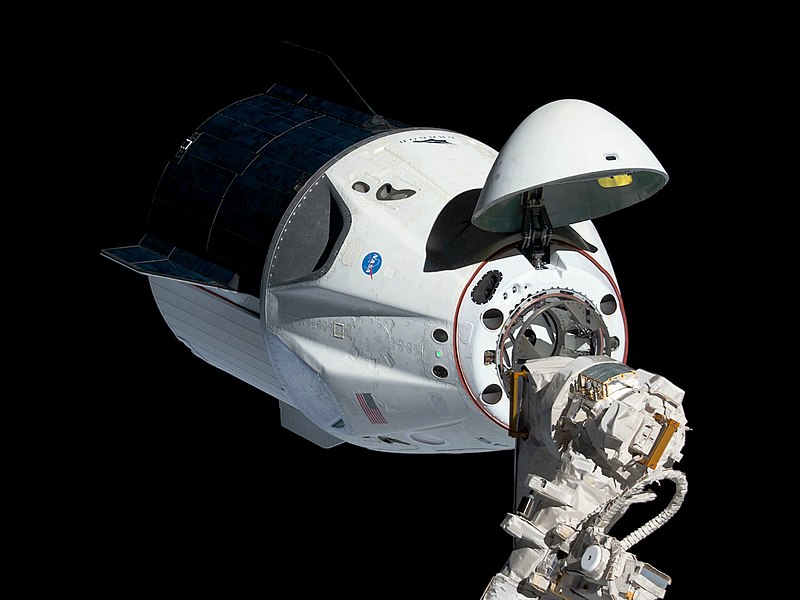
Astro-Calendar: Jan. / SpaceX Crew Dragon Test Launch Jan. 11

Crew Dragon at the ISS for Demo Mission 1 (cropped).jpg
SpaceX Crew Dragon spacecraft, which is scheduled to undergo a critical In-Flight Abort test flight on January 11. This uncrewed test flight, which will launch from the Cape Canaveral Air Force Station in Florida, will test a vital safety system to protect astronauts during an emergency soon after a launch. After the test, the spacecraft will splash-down in the Atlantic Ocean. "The demonstration of Crew Dragon's launch escape system is part of NASA's Commercial Crew Program and is one of the final major tests for the company before NASA astronauts will fly aboard the spacecraft," NASA officials wrote.
More information on the In-Flight Abort test flight:
Link >>> https://www.space.com/spacex-crew-dragon-in-flight-abort-launch-new-date.html
More on the SpaceX Crew Dragon spacecraft:
Link >>> https://en.wikipedia.org/wiki/Dragon_2 
(Image Sources: NASA, SpaceX, Wikipedia.org, By Unknown - NASA (direct url), Public Domain, https://commons.wikimedia.org/w/index.php?curid=77702696)

Astronomical Calendar for 2020 January ---
Link >>> http://buhlplanetarium4.tripod.com/astrocalendar/2020.html#jan

 Related Blog Post ---

"Astronomical Calendar: 2019 Dec. / Centennial: Death of Astronomy Philanthropist H.C. Frick"

Sunday, 2019 December 1.

Link >>> https://spacewatchtower.blogspot.com/2019/12/astronomical-calendar-2019-dec.html


Source: Friends of the Zeiss.
              Thursday, 2020 January 2.

                             Like This Post?  Please Share!

            More Astronomy & Science News - SpaceWatchtower Twitter Feed:
            Link >>> https://twitter.com/spacewatchtower

        Astronomy & Science Links: Link >>> http://buhlplanetarium.tripod.com/#sciencelinks

                Want to receive SpaceWatchtower blog posts in your in-box ?
                Send request to < spacewatchtower@planetarium.cc >.

gaw

Glenn A. Walsh, Informal Science Educator & Communicator:
http://buhlplanetarium2.tripod.com/weblog/spacewatchtower/gaw/ >
Electronic Mail: < gawalsh@planetarium.cc >
Project Director, Friends of the Zeiss: < http://buhlplanetarium.tripod.com/fotz/ >
SpaceWatchtower Editor / Author: < http://spacewatchtower.blogspot.com/ >
Formerly Astronomical Observatory Coordinator & Planetarium Lecturer, original Buhl Planetarium & Institute of Popular Science (a.k.a. Buhl Science Center), Pittsburgh's science & technology museum from 1939 to 1991.
Formerly Trustee, Andrew Carnegie Free Library and Music Hall, Pittsburgh suburb of Carnegie, Pennsylvania.
Author of History Web Sites on the Internet --
* Buhl Planetarium, Pittsburgh:
  < http://www.planetarium.cc >
* Adler Planetarium, Chicago:
  < http://adlerplanetarium.tripod.com >
* Astronomer, Educator, Optician John A. Brashear:
  < http://johnbrashear.tripod.com >
* Andrew Carnegie & Carnegie Libraries:
  < http://www.andrewcarnegie.cc >

Friday, December 20, 2019

Winter Begins Late Sat. Night; Ursid Meteor Shower Sun. Night

   http://buhlplanetarium.tripod.com/pix/graphics/solsticeimage008.png
This diagram shows the position of the Earth, in relation to the Sun, at the time of the Winter Solstice, as well as the other solstice and equinoxes of the year, in Earth's Northern Hemisphere.
[Graphic Source: ©1999, Eric G. Canali, former Floor Operations Manager of the original Buhl Planetarium & Institute of Popular Science / Buhl Science Center (Pittsburgh's science & technology museum 1939-1991) and Founder of the South Hills Backyard Astronomers amateur astronomy club; permission granted for only non-profit use with credit to author.]

By Glenn A. Walsh
Reporting for SpaceWatchtower

The season of Winter, in the Northern Hemisphere of Earth, begins at the moment of the Winter / December Solstice, late Saturday Evening, 2019 December 21 at 11:19 p.m. Eastern Standard Time (EST) / December 22, 4:19 Coordinated Universal Time (UTC). This moment also marks the astronomical beginning of the Summer season in the Southern Hemisphere.

Almost 24 hours later, Sunday evening / Monday morning will mark the peak time for the annual Ursid Meteor Shower. This meteor shower peaks Sunday Evening, 2019 December 22 at 10:00 p.m. EST / December 23, 3:00 UTC.

                                               Winter Solstice 2019

In etymology, the word solstice comes from the Latin terms sol (Sun) and sistere (to stand-still). In ancient times, astronomers / astrologers / priests recognized that one day of the year when the Sun would appear to reach its lowest point in the sky for the entire year. The motion of the Sun's apparent path in the sky (what is known astronomically today as the Sun's declination) would cease on this day, and the Sun would appear to stand-still, before reversing direction.

With our Gregorian Calendar, this usually occurs on, or very close to, December 21. In ancient times, when people used the Julian Calendar, the Winter Solstice was on, or very close to, December 25, what we now know as Christmas Day. Mid-Winter festivals, at the time of the Winter Solstice, were common in ancient times. Instead of competing with these traditions, the early Roman Catholic Church Christianized the Winter festivals by observing the birth of Jesus Christ on December 25 (the actual birth date of Jesus was probably in late Summer or early Autumn).

Today, we know that, while the Sun does have motions, it is actually the motion of the Earth, tilted on its axis 23.44 degrees from the plane of our Solar System while revolving around the Sun, that causes the Earth's seasons. Hence, as the Earth arrives at the point in its orbit around the Sun, where the south polar axis is most directly inclined toward the Sun (thus, the Sun appears at its lowest point for the year in the Northern Hemisphere sky) around December 21, this marks the Winter Solstice in the Northern Hemisphere (and the Summer Solstice in the Southern Hemisphere).

Alternately around June 21, the Summer Solstice marks the beginning of Summer in the Northern Hemisphere (and this date also marks the Winter Solstice, which is the beginning of Winter in the Southern Hemisphere) as the Earth reaches the point in its orbit where the north polar axis is most directly inclined toward the Sun.

The day of the December Solstice is the only time of the year when the Sun reaches the point of Local Solar Noon at the South Pole. Conversely, it is also the only time of the year when Local Solar Midnight occurs at the North Pole. And, of course, it is the reverse during the June Solstice: the only time the Sun reaches the point of Local Solar Noon at the North Pole and the only time when Local Solar Midnight occurs at the South Pole.

Although the Winter months in the Northern Hemisphere are known for the year's coldest weather, the Earth is actually at the point in its orbit closest to the Sun (astronomically known as the point of perihelion) on or very near January 2. The Earth is farthest from the Sun, each year shortly after the Northern Hemisphere's Summer Solstice, on or very near July 5 (the point of aphelion).
Solar radiation, and hence heat from the Sun, to warm an Earth hemisphere depends on the length of daylight and the angle of the Sun above the horizon. The tilt of the planet's axis toward the Sun determines the additional and more direct solar radiation received by a planet's northern or southern hemisphere, and hence, the warmer season of the respective hemisphere.

The Earth's perihelion in January, and aphelion in July, are due to the elliptical nature of the Earth's orbit around the Sun. Perihelion and aphelion would not occur if the Earth's orbit was a true circle.
Since the Earth is closest to the Sun near the beginning of the Northern Hemisphere's Winter Season, the Earth, then, moves faster in its orbit around the Sun than it moves in July, making the Northern Hemisphere's Winter a shorter season than Summer. Winter will last for only 89 days, while this past-Summer lasted nearly 93 days. This is one of the observed consequences of Johannes Kepler's Laws of Planetary Motion, which he published at the beginning of the 17th century.

The day of the Winter Solstice is known as the “shortest day of the year” and the “longest night of the year” as the Sun shines on the Northern Hemisphere for the shortest length of time for the entire year, on this day. For this reason, Homeless Persons' Memorial Day is commemorated on December 21.

Interestingly, the climate of a locale in the Southern Hemisphere is, on average, slightly milder than a location at the same latitude in the Northern Hemisphere, because the Southern Hemisphere has significantly more ocean water and much less land. Water warms-up and cools-down more slowly than does land. The only exception is the Antarctic Continent, which is colder than the Northern Hemisphere's Arctic region, possibly because most of the Arctic region is covered with water (although, often frozen water on the surface, but liquid water beneath the ice) while Antarctica is mostly a land mass.

                                              Ursid Meteor Shower

Almost 24 hours after the Winter Solstice comes the peak of the annual Ursid Meteor Shower, which actually begins on December 17 and usually lasts about a week ending December 24, 25, or 26. The Ursids seem to comprise a narrow stream of debris originating from Comet Tuttle. Hence, it is difficult to see Ursid meteors outside of a 12-hour window before and after the peak, where possibly 12 meteors per-hour could be seen, under ideal conditions.

The Ursid Meteor Shower is so-named because most meteors appear to radiate from a point near the Star Beta Ursae Minoris (apparent meteor shower radiant) in the Constellation Ursa Minor (better known as the asterism the “Little Dipper”), which is the brightest star in the bowl of the Little Dipper. Some people call these meteors “Ursids,” in an attempt to emphasize that their apparent radiant is Ursa Minor, not Ursa Major (the asterism the “Big Dipper”).

However, you should not, necessarily, be looking only at the Little Dipper when looking for meteors in this shower. Meteors can appear in any part of the sky at any time (although a meteor's tail may tend to point back toward the radiant).

Of course meteor showers, like all celestial observations, are weather-permitting. If there are more than a few clouds in the sky, meteors will be much more difficult to find. Clear skies are not always available in the skies of late Autumn and early Winter. And, it is always best to get away from city lights, for the opportunity to see the smaller, dimmer meteors. As always, the best time to view any meteor shower is between local midnight and local dawn, when the Earth is actually rotating into the stream of meteoric debris.

Binoculars and telescopes are not very useful for finding meteors. Meteors streak across the sky in a very short period of time, far too short to aim binoculars or a telescope. So, the best way to view a meteor shower is to lie on a blanket or beach towel on the ground, or use a reclining a chair, outdoors in an area with a good view of the entire sky (with few obstructions such as buildings, trees, or hills), and keep scanning the entire sky.

So, if you go out to see the Ursid Meteor Shower, start looking for meteors around local midnight, or perhaps a little later. Make sure you have a good site where you can see most of the sky, and that sky is relatively clear. Be sure to dress properly for the early morning temperatures, now that we are at the very beginning of Winter.

And, you want to go out ahead of time, before you actually start looking for meteors, to get your eyes accustomed to the dark sky. Dark-adapting your eyes for meteor-watching could take up to a half-hour.

Internet Links to Additional Information ---

Winter Solstice:
Link 1 >>> http://scienceworld.wolfram.com/astronomy/WinterSolstice.html
Link 2 >>> http://en.wikipedia.org/wiki/Winter

Solstice: Link >>> http://en.wikipedia.org/wiki/Solstice

Popular Winter Planetarium Sky Shows Shown at Pittsburgh's original Buhl Planetarium and Institute of Popular Science (1939 to 1991), including full scripts of each show:
The Star of Bethlehem >>> http://buhlplanetarium3.tripod.com/skyshow/bethlehem/
The Stars of Winter >>> http://buhlplanetarium3.tripod.com/skyshow/winter/

Calendar Formats ---
       Gregorian Calendar: Link >>> http://en.wikipedia.org/wiki/Gregorian_calendar
       Julian Calendar: Link >>> http://en.wikipedia.org/wiki/Julian_calendar

Ursid Meteor Shower: Link >>> http://en.wikipedia.org/wiki/UrsidsA

Homeless Persons' Memorial Day:
Link >>> http://nationalhomeless.org/about-us/projects/memorial-day/

Related Blog Post ---

"2019 Summer Begins at Moment of Solstice, Mid-Day." Fri., 2019 June 21.

Link >>> https://spacewatchtower.blogspot.com/2019/06/2019-summer-begins-at-moment-of.html


Source: Glenn A. Walsh Reporting for SpaceWatchtower, a project of Friends of the Zeiss.
              Friday, 2019 December 20.

                             Like This Post?  Please Share!

           More Astronomy & Science News - SpaceWatchtower Twitter Feed:
            Link >>> https://twitter.com/spacewatchtower

        Astronomy & Science Links: Link >>> http://buhlplanetarium.tripod.com/#sciencelinks

                Want to receive SpaceWatchtower blog posts in your in-box ?
                Send request to < spacewatchtower@planetarium.cc >.

gaw

Glenn A. Walsh, Informal Science Educator & Communicator:
http://buhlplanetarium2.tripod.com/weblog/spacewatchtower/gaw/ >
Electronic Mail: < gawalsh@planetarium.cc >
Project Director, Friends of the Zeiss: < http://buhlplanetarium.tripod.com/fotz/ >
SpaceWatchtower Editor / Author: < http://spacewatchtower.blogspot.com/ >
Formerly Astronomical Observatory Coordinator & Planetarium Lecturer, original Buhl Planetarium & Institute of Popular Science (a.k.a. Buhl Science Center), Pittsburgh's science & technology museum from 1939 to 1991.
Formerly Trustee, Andrew Carnegie Free Library and Music Hall, Pittsburgh suburb of Carnegie, Pennsylvania.
Author of History Web Sites on the Internet --
* Buhl Planetarium, Pittsburgh:
  < http://www.planetarium.cc >
* Adler Planetarium, Chicago:
  < http://adlerplanetarium.tripod.com >
* Astronomer, Educator, Optician John A. Brashear:
  < http://johnbrashear.tripod.com >
* Andrew Carnegie & Carnegie Libraries:
  < http://www.andrewcarnegie.cc >
Saturday, December 7, 2019

Laser Space Probe Finds the Unexpected

https://www.nasa.gov/sites/default/files/thumbnails/image/lpf_artist_impression_2015-11-24.jpg
Artist's rendering of the LISA Pathfinder space probe approaching solar orbit.
(Image Source: European Space Agency / C. Carreau)

By Glenn A. Walsh
Reporting for SpaceWatchtower

A laser space probe, designed as a space-based, proof-of-concept mission for finding gravitational-waves, has now been used to map microscopic dust shed by comets and asteroids. This is a clear demonstration that 'empty space' between stars and planetary bodies is not really all that empty!

Due to the space probe's extreme sensitivity, a requirement for the detection of gravitational-waves, NASA scientists have used data from the European Space Agency's (ESA) LISA Pathfinder spacecraft to detect 54 micrometeroid impacts on the spacecraft during the 2015 to 2017 time-frame. The micrometeroids detected are extremely small.

Their masses are measured in micrograms and are similar in size to grains of sand. This cosmic dust was actually smaller than the dust from comets that cause most meteor showers. However, they hit the spacecraft at approximate speeds of 40,000 miles-per-hour / 64,000 kilometers-per-hour, which could injure a spacecraft if the particles had been larger.

NASA scientists, headed by Ira Thorpe of the Goddard Space Flight Center in Greenbelt, Maryland, used modeling to determine where the micrometeroids originate. Their research was published in the September issue of the Astrophysical Journal, the prestigious publication founded in 1895 by George Ellery Hale, who would become Director of the Mount Wilson Observatory, and James E. Keeler, Director of the Allegheny Observatory.

The NASA scientists found that most of the micrometeroids come from short-period comets, whose orbits are determined by Jupiter; this is consistent with current ideas regarding micrometeroids near Earth. However, LISA Pathfinder also detected dust from some long-period comets, similar to the famous Halley's Comet.

These results will help in predicting impact risks for current and future spacecraft. They may also help in the understanding of the physics of planet formation.

Launched on 2015 December 3, the LISA Pathfinder mission was to prove the feasibility of a space-based laser interferometer system for finding ripples in space-time caused by, for instance, the merger of black holes. Led by the European Space Agency, with contributions from NASA, the mission was used to test technologies necessary for a space-based observatory that would do what the ground-based LIGO (Laser Interferometer Gravitational-Wave Observatory) has done from the Earth.

LIGO is limited by seismic, thermal, and other sources of noise present on the Earth. It is hoped that a space-based system, without these limitations, would be even more sensitive and find even more gravitational-waves.

The main LISA (Laser Interferometer Space Antenna) mission, expected to be launched around 2034, would consist of a constellation of three spacecraft arranged in an equilateral triangle with sides 1.55 million statute miles / 2.5 million kilometers long, in an orbit around the Sun. By precisely monitoring the distances between each satellite, more ripples in space-time should be detected.

Internet Links to Additional Information ---

LISA Pathfinder Spacecraft: Link >>> https://en.wikipedia.org/wiki/LISA_Pathfinder

LISA Spacecraft (launch in 2034): Link >>> https://en.wikipedia.org/wiki/Laser_Interferometer_Space_Antenna

LIGO Ground-Based Observatory: Link >>> https://en.wikipedia.org/wiki/LIGO

Micrometeroid: Link >>> https://en.wikipedia.org/wiki/Micrometeoroid

Related Blog-Posts ---

"Physics Nobel Prize Awarded to Developers of Laser Observatory." Sat., 2017 Oct. 7.

Link >>> http://spacewatchtower.blogspot.com/2017/10/physics-nobel-prize-awarded-to.html


"Laser Gravitational-Wave Observatory Researchers Receive 2 Awards. Sun., 2016 June 5.

Link >>> http://spacewatchtower.blogspot.com/2016/06/laser-gravitational-wave-observatory.html


Source: Glenn A. Walsh Reporting for SpaceWatchtower, a project of Friends of the Zeiss.
              Saturday, 2019 December 7.

                             Like This Post?  Please Share!

           More Astronomy & Science News - SpaceWatchtower Twitter Feed:
            Link >>> https://twitter.com/spacewatchtower

        Astronomy & Science Links: Link >>> http://buhlplanetarium.tripod.com/#sciencelinks

                Want to receive SpaceWatchtower blog posts in your in-box ?
                Send request to < spacewatchtower@planetarium.cc >.

gaw

Glenn A. Walsh, Informal Science Educator & Communicator:
http://buhlplanetarium2.tripod.com/weblog/spacewatchtower/gaw/ >
Electronic Mail: < gawalsh@planetarium.cc >
Project Director, Friends of the Zeiss: < http://buhlplanetarium.tripod.com/fotz/ >
SpaceWatchtower Editor / Author: < http://spacewatchtower.blogspot.com/ >
Formerly Astronomical Observatory Coordinator & Planetarium Lecturer, original Buhl Planetarium & Institute of Popular Science (a.k.a. Buhl Science Center), Pittsburgh's science & technology museum from 1939 to 1991.
Formerly Trustee, Andrew Carnegie Free Library and Music Hall, Pittsburgh suburb of Carnegie, Pennsylvania.
Author of History Web Sites on the Internet --
* Buhl Planetarium, Pittsburgh:
  < http://www.planetarium.cc >
* Adler Planetarium, Chicago:
  < http://adlerplanetarium.tripod.com >
* Astronomer, Educator, Optician John A. Brashear:
  < http://johnbrashear.tripod.com >
* Andrew Carnegie & Carnegie Libraries:
  < http://www.andrewcarnegie.cc >

Sunday, December 1, 2019

Astronomical Calendar: 2019 Dec. / Centennial: Death of Astronomy Philanthropist H.C. Frick

                     Henry Clay Frick.jpg
December 2 marks the Centennial Anniversary of the death of industrialist and education and astronomical philanthropist Henry Clay Frick. And, December 19 marks the 170th anniversary of his birth. He provided much of the funding for construction of the second, three-dome Allegheny Observatory, dedicated in 1912. He asked astronomer John A. Brashear to organize the Henry Clay Frick Educational Commission, to fund supplemental educational opportunities for public school teachers, as well as provide for free-of-charge, public tours of the Allegheny Observatory several evenings a week during the warm-weather months.
Biography of Henry Clay Frick: Link >>> http://johnbrashear.tripod.com/frick.html
(Image Sources: By Bain News Service - This image is available from the United States Library of Congress's Prints and Photographs divisionunder the digital ID ggbain.07131.This tag does not indicate the copyright status of the attached work. A normal copyright tag is still required. See Commons:Licensing for more information., Public Domain, https://commons.wikimedia.org/w/index.php?curid=700199)

Astronomical Calendar for 2019 December ---
Link >>> http://buhlplanetarium4.tripod.com/astrocalendar/2019.html#dec

 Related Blog Post ---

"Astronomical Calendar: 2019 November / Transit of Mercury Nov. 11"

Friday, 2019 November 1.

Link >>> https://spacewatchtower.blogspot.com/2019/11/astronomical-calendar-2019-november.html


Source: Friends of the Zeiss.
              Sunday, 2019 December 1.

                             Like This Post?  Please Share!

            More Astronomy & Science News - SpaceWatchtower Twitter Feed:
            Link >>> https://twitter.com/spacewatchtower

        Astronomy & Science Links: Link >>> http://buhlplanetarium.tripod.com/#sciencelinks

                Want to receive SpaceWatchtower blog posts in your in-box ?
                Send request to < spacewatchtower@planetarium.cc >.

gaw

Glenn A. Walsh, Informal Science Educator & Communicator:
http://buhlplanetarium2.tripod.com/weblog/spacewatchtower/gaw/ >
Electronic Mail: < gawalsh@planetarium.cc >
Project Director, Friends of the Zeiss: < http://buhlplanetarium.tripod.com/fotz/ >
SpaceWatchtower Editor / Author: < http://spacewatchtower.blogspot.com/ >
Formerly Astronomical Observatory Coordinator & Planetarium Lecturer, original Buhl Planetarium & Institute of Popular Science (a.k.a. Buhl Science Center), Pittsburgh's science & technology museum from 1939 to 1991.
Formerly Trustee, Andrew Carnegie Free Library and Music Hall, Pittsburgh suburb of Carnegie, Pennsylvania.
Author of History Web Sites on the Internet --
* Buhl Planetarium, Pittsburgh:
  < http://www.planetarium.cc >
* Adler Planetarium, Chicago:
  < http://adlerplanetarium.tripod.com >
* Astronomer, Educator, Optician John A. Brashear:
  < http://johnbrashear.tripod.com >
* Andrew Carnegie & Carnegie Libraries:
  < http://www.andrewcarnegie.cc >