With image-tweaking services like Instagram turning our everyday photos into vintage snapshots, it seems like photography itself is taking a step back in time. A new camera prototype turns that idea completely on its head by producing a text description of each photo you shoot, rather than capturing an actual image. It's called the Descriptive Camera, and it just might be the next big thing in photography.
NASA Tests GPS Monitoring System for Big U.S. Earthquakes
WASHINGTON
-- The space-based technology that lets GPS-equipped motorists
constantly update their precise location will undergo a major test of
its ability to rapidly pinpoint the location and magnitude of strong
earthquakes across the western United States. Results from the new
Real-time Earthquake Analysis for Disaster (READI) Mitigation Network
soon could be used to assist prompt disaster response and more accurate
tsunami warnings.
The new research network builds on decades
of technology development supported by the National Science Foundation,
the Department of Defense, NASA, and the U.S. Geological Survey (USGS).
The network uses real-time GPS measurements from nearly 500 stations
throughout California, Oregon and Washington. When a large earthquake is
detected, GPS data are used to automatically calculate its vital
characteristics including location, magnitude and details about the
fault rupture.
MORE: http://www.nasa.gov/home/hqnews/2012/apr/HQ_12-108_GPS_Earthquake_Monitoring.html
NASA's Spitzer Space Telescope Finds Galaxy With Split Personality
The infrared vision of
NASA's Spitzer Space Telescope has revealed that the Sombrero galaxy --
named after its appearance in visible light to a wide-brimmed hat -- is
in fact two galaxies in one. Image credit: NASA/JPL-Caltech › Full image and caption
Share143
April 24, 2012
PASADENA, Calif. -- While some galaxies are rotund and others are
slender disks like our spiral Milky Way, new observations from NASA's
Spitzer Space Telescope show that the Sombrero galaxy is both. The
galaxy, which is a round elliptical galaxy with a thin disk embedded
inside, is one of the first known to exhibit characteristics of the two
different types. The findings will lead to a better understanding of
galaxy evolution, a topic still poorly understood.
"The Sombrero is more complex than previously thought," said
Dimitri Gadotti of the European Southern Observatory in Chile and lead
author of a new paper on the findings appearing in the Monthly Notices
of the Royal Astronomical Society. "The only way to understand all we
know about this galaxy is to think of it as two galaxies, one inside
the other."
MORE: http://www.jpl.nasa.gov/news/news.cfm?release=2012-115&cid=release_2012-115&msource=12115
Inflatable Stonehenge brings bouncy fun ahead of Olympics
2 days ago
London is hosting the upcoming Summer Olympics, and in preparation,
officials are commissioning artworks in honor of the event, such as this
one by artist Jeremy Deller: a full-scale, inflatable replica of iconic
British monument, Stonehenge. The bouncy, interactive sculpture, titled
"Sacrilege," is meant to express the English sense of humor, as well as
its considerable history. Watching the stones rise from the ground with
a little help from an air compressor is remarkable, as are the kids and
giddy grown-ups leaping about the reproduced ancient ruins. Here's
hoping the charming artwork will get mass produced, so we can all
contemplate the mysterious meaning of Stonehenge while enjoying a
frolic.
James Cameron and Investors Seek to Lasso and Mine an Asteroid
The filmmaker is joining Google and Microsoft
execs in a venture to mine asteroids for commercial use that would ‘add
trillions to global GDP.’ But while lassoing an asteroid could be big
business, it might just be a wild ride into space.
Imagine
riding through space on your trusty scooter and, feeling the urge to
lasso an asteroid, reaching out and doing just that. It is a top-notch,
boyhood sci-fi fantasy. If the scooter were pink I would ride it, too.
After his journey to the icy-dark ocean depths, film director James Cameron
is heading to space. He is advising a company called Planetary
Resources, details of which will be unveiled today. The press release
announces the stealthy company’s mission is to “overlap” space
exploration and natural resources with a plan that will “add trillions
of dollars to the global GDP,” and “help ensure humanity’s prosperity.”
Several well-known billionaires are forming the new company Planetary
Resources with plans to send a robotic spacecraft to mine precious
metals from an asteroid and bring them back to Earth. Google executives
Larry Page and Eric Schmidt and their businesspartners say the enterprise will "add trillions to the global GDP."
But to whom do those trillions belong — the company, or everyone? Does a
private company have a right to stake claim to an asteroid, or are
celestial bodies such as the moon, planets and asteroids the communal property of all Earthlings?
"The law on this is not settled and not clear," said Henry Hertzfeld,
professor of space policy and international affairs at George Washington
University. "There are lots of opinions on the status here, and nobody
is necessarily right because it's complicated."
Asteroids may yield precious metals, cosmic riches.
By DONNA BLANKINSHIP, Associated Press
–
12 minutes ago
SEATTLE (AP) — Using space-faring robots to mine precious metals from
asteroids almost sounds easy when former astronaut Tom Jones describes
it — practically like clearing a snow-covered driveway.
Jones, an
adviser to a bold venture that aims to extract gold, platinum and rocket
fuel from the barren space rocks, said many near-Earth asteroids have a
loose rocky surface held together only weakly by gravity.
The first private spaceship launch to the International Space Station
has been delayed, possibly by at least a week, the vehicle's makers
announced today (April 23).
The commercial spaceflight company SpaceX was set to launch its Dragon capsule
atop a Falcon 9 rocket April 30 from Cape Canaveral Air Force Station
in Florida. The unmanned spacecraft will fly a demonstration mission for
future cargo deliveries to the space station under an agreement with
NASA.
Now, that liftoff will likely not occur until May 3 at the earliest, and most likely around May 7.
SIERRA
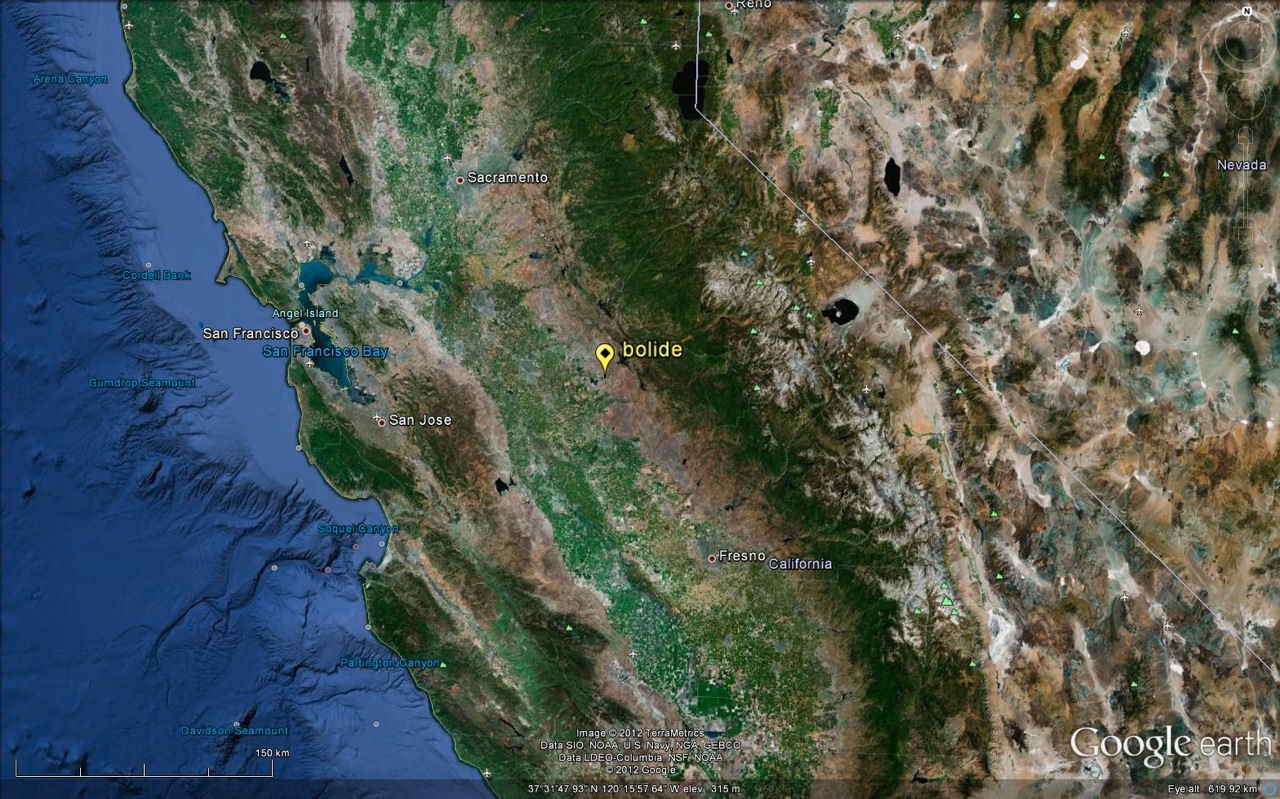
FIREBALL DECODED: On Sunday morning,
April 22nd, just as the Lyrid meteor shower was
dying down, a spectacular fireball exploded over
California's Sierra Nevada mountain range. The loud
explosion rattled homes from central California
to Reno, Nevada, and beyond. According to Bill Cooke,
head of NASA's Meteoroid Envronment Office, the
source of the blast was a meteoroid about the size
of a minivan.

 With image-tweaking services like Instagram turning our everyday photos into vintage snapshots, it seems like photography itself is taking a step back in time. A new camera prototype turns that idea completely on its head by producing a text description of each photo you shoot, rather than capturing an actual image. It's called the Descriptive Camera, and it just might be the next big thing in photography.