Tuesday, September 22, 2020

Autumnal Equinox: Fall Begins Tuesday Morning

    http://buhlplanetarium.tripod.com/pix/graphics/solsticeimage008.png
This diagram shows the position of the Earth, in relation to the Sun, at the time of the Autumnal Equinox, as well as the other equinox and solstices of the year.
(Image Source: ©1999, Eric G. Canali, former Floor Operations Manager of the original Buhl Planetarium and Institute of Popular Science (a.k.a. Buhl Science Center - Pittsburgh's science and technology museum from 1939 to 1991) and Founder of the South Hills Backyard Astronomers amateur astronomy club; permission granted for only non-profit use with credit to author.) 

By Glenn A. Walsh

Reporting for SpaceWatchtower


The Autumnal Equinox, the beginning of the season of Autumn or Fall in the Northern Hemisphere of Earth, begins Tuesday morning. In Earth's Southern Hemisphere, this equinox marks the astronomical beginning of the season of Spring.

The September Equinox occurs Tuesday Morning, 2020 September 22 at 9:31 a.m. Eastern Daylight Saving Time (EDT) / 13:31 Coordinated Universal Time (UTC).

On the day of the Equinox, the Sun appears directly overhead at local Noon on the Equator. At the moment of Equinox, the Northern and Southern Hemispheres of Earth are illuminated equally. And, the time of Equinox is the only time when the Earth Terminator (dividing line on Earth between daylight and darkness) is perpendicular to the Equator.

This, and the reason for seasons on Earth in the first place, is due to the fact that Earth rotates on its axis, which is tilted at an approximate 23.44-degree angle from the plane of the Earth's orbit around the Sun. As the Earth revolves around the Sun, this axial tilt causes one hemisphere of the planet to receive more direct solar radiation during that hemisphere's season of Summer and much less direct solar radiation a half-year later during that hemisphere's season of Winter. As mentioned, during an Equinox (about half-way between Summer and Winter, and about half-way between Winter and Summer) both planetary hemispheres receive an equal amount of solar radiation.


Although "Equinox" in Latin means equal-night, the day of the Equinox does not actually have an equal amount of daylight and nightfall, as it appears on the Earth's surface. If the Sun was just a pin-point of light in our sky, as all other stars appear, day and night would be equal.


But, because the Sun is a disk, part of the Sun has risen above the horizon before the center of the Sun (which would be the pin-point of light); so there are extra moments of light on the Equinox. Likewise, part of the Sun is still visible, after the center of the Sun has set.


Additionally, the refraction of sunlight by our atmosphere causes sunlight to appear above the horizon, before sunrise and after sunset.


September 25 will mark the Equilux ("equal-light"), the actual day with equal hours and minutes of the Sun above the horizon, and equal hours and minutes of the Sun below the horizon. The Equilux occurs twice each year, approximately 3-to-4 days before the Vernal Equinox, when Spring begins,  and 3-to-4 days after the Autumnal Equinox.


An urban legend that has been making the rounds for decades has it that eggs can be stood on their ends only during an Equinox, whether the Vernal Equinox in the Spring or the Autumnal Equinox in the Fall. This is completely false. Depending greatly on the size and shape of the particular egg, eggs can be stood on their ends any day of the year! Astronomy has nothing to do with whether an egg can stand on its end. If an egg can stand on its end on the Equinox (and, due to the shape and size of some eggs, this is not even possible), it can stand the same way any other day of the year.

In the last few years, with the help of the Internet and Social Media, another urban legend has become prevalent. Now it is claimed that brooms can stand, on their own, on their bristles, only on an Equinox day. This is also false. Again, as with eggs, if a broom can stand on its bristles by itself (this usually only works with newer brooms, with more even bristles) on an Equinox, it can do so any day of the year!

September 22 is also designated as the annual Falls Prevention Awareness Day for this year.


Internet Links to Additional Information ---

Autumnal Equinox: Link >>> http://scienceworld.wolfram.com/astronomy/AutumnalEquinox.html


Season of Autumn or Fall: Link >>> http://en.wikipedia.org/wiki/Autumn

Equinox: Link >>> http://en.wikipedia.org/wiki/Equinox


Equilux: Link >>> https://darkskydiary.wordpress.com/2010/03/20/equinox-equilux-and-twilight-times/


Earth's Seasons: Link >>> http://en.wikipedia.org/wiki/Season

Tilt of a planet's axis: Link >>> http://en.wikipedia.org/wiki/Axial_tilt

Urban legend of eggs and brooms standing on their own, only on an Equinox:
Link >>> http://www.snopes.com/science/equinox.asp

Falls Prevention Awareness Day: Link >>> http://www.ncoa.org/improve-health/center-for-healthy-aging/falls-prevention/falls-prevention-awareness.html


Source: Glenn A. Walsh Reporting for SpaceWatchtower, a project of Friends of the Zeiss.
              Tuesday, 2020 September 22.

                             Like This Post?  Please Share!

           More Astronomy & Science News - SpaceWatchtower Twitter Feed:
            Link >>> https://twitter.com/spacewatchtower

        Astronomy & Science Links: Link >>> http://buhlplanetarium.tripod.com/#sciencelinks

                Want to receive SpaceWatchtower blog posts in your in-box ?
                Send request to < spacewatchtower@planetarium.cc >.

gaw

Glenn A. Walsh, Informal Science Educator & Communicator:
< http://buhlplanetarium2.tripod.com/weblog/spacewatchtower/gaw/ >
Electronic Mail: < gawalsh@planetarium.cc >
Project Director, Friends of the Zeiss: < http://buhlplanetarium.tripod.com/fotz/ >
SpaceWatchtower Editor / Author: < http://spacewatchtower.blogspot.com/ >
Formerly Astronomical Observatory Coordinator & Planetarium Lecturer, original Buhl Planetarium & Institute of Popular Science (a.k.a. Buhl Science Center), Pittsburgh's science & technology museum from 1939 to 1991.
Formerly Trustee, Andrew Carnegie Free Library and Music Hall, Pittsburgh suburb of Carnegie, Pennsylvania.
Author of History Web Sites on the Internet --
* Buhl Planetarium, Pittsburgh:
  < http://www.planetarium.cc >
* Adler Planetarium, Chicago:
  < http://adlerplanetarium.tripod.com >
* Astronomer, Educator, Optician John A. Brashear:
  < http://johnbrashear.tripod.com >
* Andrew Carnegie & Carnegie Libraries:
  < http://www.andrewcarnegie.cc >

Friday, September 18, 2020

Mystery Solved! Oldest U.S. Planetarium Projector Found & Recovered

                                Photo of Zeiss II
 Planetarium Projector at the Adler Planetarium
 in 1933
1933 photograph of the Zeiss II Planetarium Projector used from 1930 to 1969 at the Adler Planetarium in Chicago. This projector was replaced by a Zeiss VI in January of 1970.
(Image Sources: Adler Planetarium and Friends of the Zeiss)
By Glenn A. Walsh
Reporting for SpaceWatchtower

A 50-year mystery has been solved! America's oldest planetarium projector, the Zeiss II / III Planetarium Projector operated at Chicago's Adler Planetarium from 1930 to 1969, has been found and recovered.

The author of this blog-post, Glenn A. Walsh, is proud to have assisted in the resolution of this mystery.

On 1930 May 12, Adler Planetarium opened in Chicago as the first major planetarium in the Western Hemisphere, a Zeiss Mark II from the Carl Zeiss Optical Works in Jena, Germany. Before World War II, four more Zeiss II Planetarium Projectors would find their way to America:

  • Philadelphia: Fels Planetarium, Franklin Institute (1933)
  • Los Angeles: Griffith Observatory (1935)
  • New York City: Hayden Planetarium, American Museum of Natural History (1935)
  • Pittsburgh: Buhl Planetarium & Institute of Popular Science (1939)

The modern mechanical, projection planetarium was developed in Germany, with the first public showing on 1923 October 21 at the Deutsches Museum in Munich. This was the Zeiss Mark I, designed by the Carl Zeiss Optical Works.

Adler Planetarium operated their Zeiss II Planetarium Projector from 1930 until 1961. Then, this projector was upgraded from a Zeiss II to a Zeiss III.

According to Mike Smail, Director of Theaters and Digital Experience at Adler Planetarium, “In 1961, Adler upgraded their projector, adding the two collars or ruffs at the base of each starball that held individual projectors for the 42 brightest stars, an upgraded Moon projector, and new chromium-coated, photo-engraved star plates (replacing the original hand-punched copper plates).” Mr. Smail's statement was made during his presentation, “There and Back Again: 90 Years of Adler's Zeiss Mark II”, during the “History of Planetaria – What to Preserve and How” webinar, sponsored by the International Planetarium Society (IPS) History of the Planetarium Working Group on Thursday Morning, 2020 September 3.

It should be noted that all Zeiss III projectors are upgraded Zeiss II projectors. The Zeiss IV Planetarium Projector was the first all-new projector produced by Carl Zeiss, following World War II.

The Zeiss II / III last operated at Adler Planetarium on 1969 December 31. It, then, took two weeks to dismantle the Zeiss II / III, to prepare to be sent to Jackson, Mississippi. It took a couple more weeks to install the new Zeiss VI Planetarium Projector before it began presenting shows to the general public.

The Zeiss II / III was sent to Jackson, Mississippi for a yet-to-be built, new planetarium theater. So, it appeared that this historic projector would get a new life educating the citizens of Mississippi, as the citizens of nearby Baton Rouge, Louisiana were being educated by another historic Zeiss II / III projector used originally by the Griffith Observatory in Los Angeles.

However, the Russell C. Davis Planetarium in Downtown Jackson opened in 1978, but with a different projector: the Minolta S-IV Planetarium Projector. This was the beginning, of what would be, a 50-year mystery regarding the fate of Adler Planetarium's historic Zeiss II / III Planetarium Projector.

The Russell C. Davis Planetarium had determined that the cost of rehabilitating Adler's 1930 projector was significantly more than the cost of a brand new projector from a different vendor. So, once Adler's historic Zeiss II / III Planetarium Projector left Mississippi, it took a convoluted route ending-up in a barn in central Ohio some years later. But for most of the 50 years, most people had no idea where the projector was located; the Ohio purchaser kept a low-profile and did very little with the projector.

About 20 years ago, planetarium historians Glenn A. Walsh and Brent Sullivan, with assistance from Gary Lazich, started looking for Adler's historic Zeiss II / III Planetarium Projector. Through research, including telephone and electronic mail interviews with people who had involvement with the Adler Zeiss Projector, a narrative started to be assembled showing what may have happened to the projector, although there were conflicting stories that were difficult to reconcile. Mr. Walsh compiled all of the stories on his History of Adler Planetarium Internet web-site, and he asked web-site readers to contact him if they had additional information. After April of 2008, no further information was received.

Mike Smail, during his September 3 presentation, announced that the Adler Planetarium had found and recovered the historic Zeiss II / III Planetarium Projector. He, then, provided a summary of what had happened to the projector over these 50 years (1970 to 2020).

Mr. Smail explained: “As previously mentioned, the Davis Planetarium opened in 1978, but with a Minolta S-IV projector at its core. Why not the Zeiss? When the team in Jackson investigated the actual costs of re-constructing and updating the Zeiss, they found it would be upwards of $230,000. And when they reached out to planetarium manufacturers for bid quotes, they received an offer from Viewlex (then Minolta’s US Distributor) that was about $100,000 less than Zeiss repair costs. Viewlex also offered Jackson $30,000 in trade-in for the Adler’s Zeiss. I can’t say I blame them for that choice, and they got 35 good years out of that new projector. Adler’s Zeiss then found itself shipped to Viewlex’s Long Island warehouse space, where it sat for the next year or two.

“In 1980, Viewlex Audio-Visual Inc. went bankrupt. The freight and storage company that owned their warehouse began calling up Zeiss planetariums around the country, looking for someone willing to pay $10,000 to purchase Adler’s Zeiss. One of their calls was to Sam Mims, one of the two Planetarium Curators at the Louisiana Arts and Science Center in Baton Rouge. Realizing the danger of this historic artifact being scrapped, Sam got a few investors together including his father and his co-curator Wayne Coskrey, and agreed to purchase the projector. Sam visited New York, inspected the projector, and that, coupled with freight company records confirmed that this was the Adler’s Zeiss. After finalizing the sales contract, the projector was then shipped to a warehouse in Baton Rouge, Louisiana.

“At this time, the Louisiana Arts and Science Center's planetarium was also a Zeiss Model III, having originally been installed as a Model II in Los Angeles’ Griffith Observatory. But Sam and Wayne didn’t have plans to use the Adler Zeiss for spare parts, they wanted to get it in the hands of someone who could put it to immediate use, or preserve its historical value. The Baton Rouge group ran ads in Astronomy, Sky & Telescope, and even the Planetarian (IPS quarterly journal) magazines looking for a buyer.

“By 1987, they found a buyer. Don Greider, a solar engineer from Mechanicsburg, Ohio arranged to purchase Adler’s Zeiss with the goal of re-assembling it in his workshop. That was the last time anybody saw, or heard about the Adler Zeiss for over 20 years.”
When Adler Planetarium inadvertently made national headlines in 2008, when a Presidential candidate confused funding a new planetarium projector for an overhead projector, Don Greider heard about the controversy on National Public Radio (NPR). He called Adler Planetarium, offering to help provide replacement parts for Adler's Zeiss VI projector, which was nearly 40 years old. He also mentioned that he had, in storage, Adler's original Zeiss II / III projector.
Mr. Smail continued, “This led to a series of phone calls, and even an in-person visit over the next few years, but by the end of 2012, Don had dropped out of communication.
“On February 17 of this year (2020), I received a voicemail, forwarded from the museum’s main line. It was Don Greider’s son, Ken. He was making arrangements to clear out the barn, and wanted to know if we were interested in purchasing our Zeiss. On February 29, a small group from Adler drove out to the Greider farm, southwest of Mechanicsburg, Ohio in an attempt to verify that it was Adler’s Zeiss, and to inspect the condition of the parts. So what did we find?
"We discovered a number of sealed crates containing portions of a Zeiss Model III Planetarium Projector, as well as a wide range of ancillary components that were part of a Zeiss Planetarium projection system. We also identified a series of shipping labels that traced out the projector's journey from Chicago to Mechanicsburg. In the packing material surrounding the North planet cage were pieces of the December 21, 1969 (coincidentally, date of the Winter Solstice) Chicago Tribune, further confirming that this was the Adler's long-lost Zeiss.

“After a bit of back and forth, we settled on a price, and purchased our Zeiss back from the Greider family. We made a second trip to the farm in mid-June, to pack up as many of the small pieces as we could fit in our Adler van. The third and final trip was at the end of June; it was to oversee the removal of the final four crates.” All of the crates were then shipped, by truck, to Adler’s off-site storage warehouse in Chicago.

Mr. Smail concluded his presentation saying, “We’ll soon be starting the process of determining how we approach restoration and public awareness of the projector, with the eventual goal to restore and reassemble the projector for display at the Adler Planetarium.”

During his prepared remarks, Mr. Smail also said, “If you’re one of the folks like me who try to stay up on planetarium history, you may know much of what I’ve already said, thanks to the incredible research compiled by Glenn Walsh, Brent Sullivan, and Gary Lazich and stored on Glenn's planetarium history website.”

Through the 1980s and early 1990s, Mr. Walsh had been a lecturer in The Buhl Planetarium and Institute of Popular Science (a.k.a. Buhl Science Center, Pittsburgh's science and technology museum from 1939 to 1991), using Buhl's historic Zeiss II Planetarium Projector. He was also Astronomical Observatory Coordinator, in charge of Buhl's astronomical observatory using the historic 10-inch Siderostat-type Refractor Telescope.

Brent Sullivan is a planetarium collector and restorer. He has also been Director of Acquisitions and Restorations of the private Planetarium Projector & Space Museum in Big Bear Lake, California.

Gary Lazich was Manager of the Russell C. Davis Planetarium in Jackson, Mississippi.

In 1994, Mr. Walsh started a grass-roots effort to prevent an Adler-type mystery from happening to another historic Zeiss Projector: the Zeiss II Planetarium Projector which had operated in Pittsburgh's Buhl Planetarium from 1939 to 1994. This is the only Zeiss II Planetarium Projector which had never had any major modifications from its 1939 installation.


Shortly after Adler Planetarium opened in 1930, several members of the Amateur Astronomers Association of Pittsburgh (AAAP – which had been established the previous year) visited Chicago to see this new way of explaining astronomy to the general public. As soon as they returned home, they immediately started lobbying to build a planetarium in Pittsburgh.

In 1935, the Buhl Foundation (then, the nation's 13th largest philanthropic foundation) announced that they would build a planetarium in memory of Henry Buhl, Jr., who had owned one of Pittsburgh's major department stores, Boggs and Buhl. The Buhl Planetarium and Institute of Popular Science opened in 1939. AAAP co-founder Leo Scanlon (who, in November of 1930, had constructed the world's first all-aluminum astronomical observatory dome) was one of the first two Buhl Planetarium lecturers.

In 1995, Mr. Walsh petitioned Pittsburgh City Council for a special public hearing on the proposed sale of the historic Zeiss II Planetarium Projector, which is legally owned by the City of Pittsburgh. At the conclusion of the 1995 May 18 public hearing, City Council decided the historic instrument should remain in Pittsburgh. Today, Buhl Planetarium's historic Zeiss II Planetarium Projector is on public display in the first-floor Atrium Gallery of Pittsburgh's Carnegie Science Center (located one mile southwest of the original Buhl Planetarium building, on the North Shore of the Ohio River).

Special Thanks: Mike Smail, Director of Theaters & Digital Experience, Adler Planetarium, Chicago

Internet Links to Additional Information ---

History of Adler Planetarium: Link >>> http://adlerplanetarium.tripod.com/

Original Research Regarding Mystery of Disappearance of Adler Planetarium's Zeiss II / III:
Link >>> http://buhlplanetarium.tripod.com/adler/mystery.html

Webinar Remarks of Mike Smail: "There and Back Again: 90 Years of Adler's Zeiss Mark II":
Link >>> http://buhlplanetarium.tripod.com/adler/09032020_Walsh_text.html

Recovery: Adler Zeiss II / III Planetarium Projector -- Photos:
Link >>> http://buhlplanetarium.tripod.com/adler/pix/zeissiii/recovery.html

International Planetarium Society (IPS): Link >>> https://www.ips-planetarium.org/

IPS History of the Planetarium Working Group:
Link >>> https://www.ips-planetarium.org/page/historywg

Related Blog Posts ---

"75th Anniversary of America's 5th Major Planetarium." Fri., 2014 Oct. 24.

Link >>> http://spacewatchtower.blogspot.com/2014/10/75th-anniversary-of-americas-5th-major.html


"100 Years Ago: Planetarium Concept Born." Mon., 2014 Feb. 24.

Link >>> http://spacewatchtower.blogspot.com/2014/02/100-years-ago-planetarium-concept-born.html


Source: Glenn A. Walsh Reporting for SpaceWatchtower, a project of Friends of the Zeiss.
               Friday, 2020 September 18.

                             Like This Post?  Please Share!

           More Astronomy & Science News - SpaceWatchtower Twitter Feed:
            Link >>> https://twitter.com/spacewatchtower

        Astronomy & Science Links: Link >>> http://buhlplanetarium.tripod.com/#sciencelinks

                Want to receive SpaceWatchtower blog posts in your in-box ?
                Send request to < spacewatchtower@planetarium.cc >.

gaw

Glenn A. Walsh, Informal Science Educator & Communicator:
< http://buhlplanetarium2.tripod.com/weblog/spacewatchtower/gaw/ >
Electronic Mail: < gawalsh@planetarium.cc >
Project Director, Friends of the Zeiss: < http://buhlplanetarium.tripod.com/fotz/ >
SpaceWatchtower Editor / Author: < http://spacewatchtower.blogspot.com/ >
Formerly Astronomical Observatory Coordinator & Planetarium Lecturer, original Buhl Planetarium & Institute of Popular Science (a.k.a. Buhl Science Center), Pittsburgh's science & technology museum from 1939 to 1991.
Formerly Trustee, Andrew Carnegie Free Library and Music Hall, Pittsburgh suburb of Carnegie, Pennsylvania.
Author of History Web Sites on the Internet --
* Buhl Planetarium, Pittsburgh:
  < http://www.planetarium.cc >
* Adler Planetarium, Chicago:
  < http://adlerplanetarium.tripod.com >
* Astronomer, Educator, Optician John A. Brashear:
  < http://johnbrashear.tripod.com >
* Andrew Carnegie & Carnegie Libraries:
  < http://www.andrewcarnegie.cc >

Tuesday, September 1, 2020

Astro-Calendar: 2020 Sept. / Sept. 2 Full Moon NOT Harvest Moon

    
This year, 2020, is one of the somewhat rare years (usually once every three years) when the September Full Moon, which occurs on Wednesday, 2020 September 2 at 1:22 a.m. EDT / 5:22 UTC, is NOT the annual Harvest Moon. The Harvest Moon will occur the first day of next month, Thursday, 2020 October 1 at 5:05 p.m. EDT / 21:05 UTC. Occurring in the late Summer or early Autumn, in September or October in the Northern Hemisphere, the Harvest Moon provides farmers with additional light in the early evening, during the very busy harvest time.  The Harvest Moon has the same characteristics in the Southern Hemisphere, when it occurs in March or April. The Harvest Moon is considered the Full Moon closest to the Autumnal Equinox (usually two weeks before or after the Equinox), the beginning of the season of Autumn / Fall, which will occur this year on Tuesday, 2020 September 22 at 9:31 a.m. EDT / 13:31 UTC. While there are 20 days between the September Full Moon and the September Equinox, there are only 9 days from the September Equinox to the October Full Moon. Hence, the annual Harvest Moon occurs in October this year!
(Image Sources: Wikipedia.org, By Tomruen - Own work, CC BY-SA 4.0, https://commons.wikimedia.org/w/index.php?curid=53147136)

Astronomical Calendar for 2020 September ---
Link >>> buhlplanetarium4.tripod.com/astrocalendar/2020.html#sep

 Related Blog Post ---

"Astro-Calendar: 2020 August / 1st SpaceX Crew Dragon Splash-down Aug. 2."

Saturday, 2020 Aug. 1.

Link >>> https://spacewatchtower.blogspot.com/2020/08/astro-calendar-2020-august-1st-spacex.html


Source: Friends of the Zeiss.
              Tuesday, 2020 September 1.

                             Like This Post?  Please Share!

            More Astronomy & Science News - SpaceWatchtower Twitter Feed:
            Link >>> https://twitter.com/spacewatchtower

        Astronomy & Science Links: Link >>> http://buhlplanetarium.tripod.com/#sciencelinks

                Want to receive SpaceWatchtower blog posts in your in-box ?
                Send request to < spacewatchtower@planetarium.cc >.

gaw

Glenn A. Walsh, Informal Science Educator & Communicator:
< http://buhlplanetarium2.tripod.com/weblog/spacewatchtower/gaw/ >
Electronic Mail: < gawalsh@planetarium.cc >
Project Director, Friends of the Zeiss: < http://buhlplanetarium.tripod.com/fotz/ >
SpaceWatchtower Editor / Author: < http://spacewatchtower.blogspot.com/ >
Formerly Astronomical Observatory Coordinator & Planetarium Lecturer, original Buhl Planetarium & Institute of Popular Science (a.k.a. Buhl Science Center), Pittsburgh's science & technology museum from 1939 to 1991.
Formerly Trustee, Andrew Carnegie Free Library and Music Hall, Pittsburgh suburb of Carnegie, Pennsylvania.
Author of History Web Sites on the Internet --
* Buhl Planetarium, Pittsburgh:
  < http://www.planetarium.cc >
* Adler Planetarium, Chicago:
  < http://adlerplanetarium.tripod.com >
* Astronomer, Educator, Optician John A. Brashear:
  < http://johnbrashear.tripod.com >
* Andrew Carnegie & Carnegie Libraries:
  < http://www.andrewcarnegie.cc >

Wednesday, August 26, 2020

1st U.S. Female Professional Astronomer: Leading Women's Suffragist

                                                                 
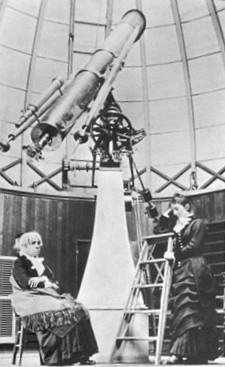
Photograph of Maria Mitchell (on left), circa 1877, in the Vassar College Observatory. America's first female, professional astronomer, she was also a leading 19th century women's suffragist. The telescope was a Fitz 12 and 3/8-inch refractor, the fourth largest telescope in the world when installed in 1863.
(Image Sources: Wikipedia.org, By Eva March Tappan - Heroes of Progress: Stories of Sucessful Americans (page 59), Public Domain, https://commons.wikimedia.org/w/index.php?curid=3257406)

By Glenn A. Walsh
Reporting for SpaceWatchtower

Today, we celebrate the annual Women's Equality Day. But this year marks a special Women's Equality Day. Today is the centennial of the certification of the 19th Amendment to the United States Constitution, which prohibits the Federal Government and the states from denying the right to vote to U.S. citizens on the basis of sex. And, today we remember a leading women's suffragist of the 19th century, who was America's first female, professional astronomer.

Maria Mitchell, Professor of Astronomy at Vassar College and discoverer of Miss Mitchell's Comet, was our nation's first female, professional astronomer. She also helped found, and was the second President of, the Association for the Advancement of Women. And, she was an early and strong advocate for education for girls and young women, particularly science and mathematics education.

Born 202 years and 25 days ago (1818 August 1) in Nantucket, Massachusetts, Maria Mitchell was born to a father (William Mitchell) who was a school-teacher, school-principal, and amateur astronomer and a mother (Lydia Coleman Mitchell) who worked at a library. She was raised in the Quaker faith, which valued education for both boys and girls. Her father taught his ten children (she was the third-born) all about nature and astronomy, while her mother helped provide access to the two libraries where she was employed.

At age 12, Maria Mitchell helped her father use solar eclipse timing observations to calculate the position of their home. Two years later, sailors trusted her navigational calculations for their long whaling expeditions.

After completing a Unitarian school for young ladies at age 16, she became a teaching assistant at the school before opening her own school in 1835. In her school, she developed experimental teaching techniques, as well as admitting non-white students, a controversial move as the local public school was still segregated.

Beginning in 1836, Maria Mitchell spent 20 years as the first librarian of the Nantucket Atheneum. As the institution had limited hours, she also assisted her father with astronomical observations and geographical calculations for the U.S. Coast Survey.

She and her father used a 4-inch equatorial telescope, provided by the U.S. Coast Survey, mounted in a small observatory on the roof of the Pacific Bank Building; her father was also a bank cashier. They used the telescope to find nebulae and double stars, as well as producing latitudes and longitudes by calculating the altitudes of stars and the culminations and occultations of the Moon. She also continued her education.

Maria Mitchell started to practice the Unitarian faith in 1843. She then became a committed abolitionist, refusing even to wear clothes made from Southern cotton. She also started to gain an interest in the women's rights movement, befriending women's suffragists including Elizabeth Cady Stanton.

Maria Mitchell discovered Comet 1847 VI (later, officially known as C/1847 T1), using a Dolland 3-inch refractor telescope (46-inch focal length) at 10:50 p.m. on 1847 October 1. She was the first American and third woman to discover a comet.

At the time, our young nation did not have much of a reputation, among European scientists, for scientific investigation and discovery. Hence, such a discovery by an American was nearly as uncommon as such a discovery by a woman. With her comet discovery, she soon became an international celebrity, being the subject of numerous newspaper and magazine articles.

When the comet discovery was officially recognized, on 1848 February 11, it became known as Miss Mitchell's Comet. Maria Mitchell was honored for the discovery at the Seneca Falls Convention, the first women's rights convention, which occurred on July 19 and 20 in 1848. She was considered an excellent role model for women in science.

Later in 1848, King Christian VIII of Denmark awarded Maria Mitchell a gold medal prize for the comet discovery. This award had been established by King Frederick VI to honor the “first discoverer” of telescopic comets, comets too faint to be seen with naked-eyes (one-power). The only previous women to discover comets were German astronomers Caroline Herschel and Maria Margarethe Kirch.

In 1849, Maria Mitchell began working as a “computer” for the U.S. Coast Survey at the U.S. Nautical Almanac Office. She tracked the movements of the planets, particularly Venus. The tables of planetary positions she compiled helped sailors in navigation.

In 1865, Maria Mitchell was appointed the first professor of the newly-founded (1861) Vassar Female College (now Vassar College) in Poughkeepsie, New York, located in the Hudson River Valley north of New York City, by college founder Matthew Vassar. Vassar Female College was only the second degree-granting institution of higher education for women in America, established soon after the 1855 founding of Elmira College, America's first degree-granting institution of higher education for women.

Maria Mitchell became the first Vassar Female College Professor, even though she, herself, did not have a college degree. During her tenure of more than 20 years, Vassar College enrolled more students in astronomy and mathematics than were enrolled in those subjects at Harvard University!

In addition to being Professor of Astronomy, she was also named the first Director of the Vassar College Observatory. The primary instrument of the observatory, a 12 and 3/8-inch refracting telescope produced by celebrated telescope-maker Henry Fitz, was the fourth largest telescope in the world when it was installed in 1863. It was exceeded in size only by 15-inch refractors at Harvard College and in Russia, and by a 13-inch Fitz refractor at the Allegheny Observatory (installed just two years earlier). Maria Mitchell was Observatory Director and Professor of Astronomy until 1888, about a year before her death.

While at Vassar College, she edited the astronomical column in Scientific American Magazine. She also wrote seven articles for Great Britain's Royal Society Catalog, and in Silliman's Journal (better known as the American Journal of Science, the longest-running U.S. scientific journal) she published three articles detailing her astronomical observations.

Maria Mitchell's unconventional teaching techniques included small classes and individualized attention to students, as well as not recording grades or absences. Lessons included mathematics and technology of the day. She realized the career options for female students were limited, at that time. However, she once said, “I cannot expect to make astronomers, but I do expect that you will invigorate your minds by the effort at healthy modes of thinking. When we are chafed and fretted by small cares, a look at the stars will show us the littleness of our own interests”.

With the Vassar College Observatory, Maria Mitchell started an astronomical research program including photography of the planets and their moons. Although she had started recording sunspots by eye-sight in 1868, she and her students started photographing sunspots daily in 1873. These were the first regular photographs of the Sun, which allowed her to hypothesize that sunspots were cavities on the Sun's surface, rather than clouds in the solar atmosphere as was previously conjectured.

She also studied nebulae, double stars, and solar eclipses. She developed theories regarding the orbiting of stars in double star systems and the influence of distance and chemical composition in star color variation.

For the solar eclipse of 1878 July 29, Maria Mitchell and five assistants took observations from Denver, using a 4-inch telescope. Her efforts led to the success of the Vassar College science and astronomy programs, with 25 of her students going on to be featured in Who's Who in America.

In 1873, after returning from a trip to Europe, Maria Mitchell joined the national women's movement and helped to found the Association for the Advancement of Women (AAW), dedicated to educational reform and the advancement of women in higher education. She was the second AAW president in 1875 and 1876. After her presidency, she formed an AAW special Committee on Science, which she headed until her death in 1889.

She taught at Vassar College until 1888, retiring, due to ill health, one year before her death; she never married. She and the one other female professor succeeded in gaining salary increases, when learning the greater salaries of their male colleagues.

Maria Mitchell was the first woman elected a Fellow of the American Academy of Arts and Sciences in 1848. In 1850, she joined the American Association for the Advancement of Science. She was among the first women elected to the American Philosophical Society in 1869. She received honorary degrees from Hanover College, Columbia University, and Rutgers Female College.

Maria Mitchell died of a brain disease, at the age of 70, on 1889 June 28 in the Boston suburb of Lynn, Massachusetts; she is buried in Nantucket next to her parents. The Maria Mitchell Association was established in her memory in Nantucket, to promote the sciences and preserve Miss Mitchell's work. The Association owns the Maria Mitchell Observatory, a second observatory, natural history museum, aquarium, science library, and Maria Mitchell's Home Museum.

One of Maria Mitchell's favorite quotes: "We especially need imagination in science. It is not all mathematics, nor all logic, but it is somewhat beauty and poetry."

Internet Links to Additional Information ---

Women's Equality Day: Link >>> https://en.wikipedia.org/wiki/Women's_Equality_Day

More information on Maria Mitchell -
Link 1 >>> https://www.biography.com/scientist/maria-mitchell
Link 2 >>> https://www.mariamitchell.org/about/about-maria-mitchell
Link 3 >>> https://www.womenshistory.org/education-resources/biographies/maria-mitchell
Link 4 >>> https://www.amightygirl.com/blog?p=25283
Link 5 >>> https://www.britannica.com/biography/Maria-Mitchell
Link 6 >>> https://en.wikipedia.org/wiki/Maria_Mitchell
Link 7 >>> https://www.nature.com/articles/d41586-018-05458-6

Maria Mitchell Association: Link >>> https://www.mariamitchell.org/

Miss Mitchell's Comet -
Link 1 >>> https://www.thevintagenews.com/2017/09/21/miss-mitchells-comet-was-discovered-by-a-female-astronomer-in-1847/
Link 2 >>> https://en.wikipedia.org/wiki/C/1847_T1

Vassar College Observatory: Link >>> https://en.wikipedia.org/wiki/Vassar_College_Observatory

Maria Mitchell Observatory: Link >>> https://en.wikipedia.org/wiki/Maria_Mitchell_Observatory

Related Blog Posts ---

"Female Astrophysicist Helped Build 1st Atomic Bomb." Thur., 2020 Aug. 6.

Link >>> https://spacewatchtower.blogspot.com/2020/08/female-astrophysicist-helped-build-1st.html?showComment=1597427681414


"Astronomical Calendar: 2013 August." Thur., 2013 Aug. 1.

Image of America's first professional woman astronomer, Maria Mitchell, whose 195th birthday is August 1 of 2013.

Link >>> https://spacewatchtower.blogspot.com/2013/08/astronomical-calendar-2013-august.html


Source: Glenn A. Walsh Reporting for SpaceWatchtower, a project of Friends of the Zeiss.
              Wednesday, 2020 August 26.

                             Like This Post?  Please Share!

           More Astronomy & Science News - SpaceWatchtower Twitter Feed:
            Link >>> https://twitter.com/spacewatchtower

        Astronomy & Science Links: Link >>> http://buhlplanetarium.tripod.com/#sciencelinks

                Want to receive SpaceWatchtower blog posts in your in-box ?
                Send request to < spacewatchtower@planetarium.cc >.

gaw

Glenn A. Walsh, Informal Science Educator & Communicator:
< http://buhlplanetarium2.tripod.com/weblog/spacewatchtower/gaw/ >
Electronic Mail: < gawalsh@planetarium.cc >
Project Director, Friends of the Zeiss: < http://buhlplanetarium.tripod.com/fotz/ >
SpaceWatchtower Editor / Author: < http://spacewatchtower.blogspot.com/ >
Formerly Astronomical Observatory Coordinator & Planetarium Lecturer, original Buhl Planetarium & Institute of Popular Science (a.k.a. Buhl Science Center), Pittsburgh's science & technology museum from 1939 to 1991.
Formerly Trustee, Andrew Carnegie Free Library and Music Hall, Pittsburgh suburb of Carnegie, Pennsylvania.
Author of History Web Sites on the Internet --
* Buhl Planetarium, Pittsburgh:
  < http://www.planetarium.cc >
* Adler Planetarium, Chicago:
  < http://adlerplanetarium.tripod.com >
* Astronomer, Educator, Optician John A. Brashear:
  < http://johnbrashear.tripod.com >
* Andrew Carnegie & Carnegie Libraries:
  < http://www.andrewcarnegie.cc >
Monday, August 10, 2020

Annual Perseid Meteor Shower Peaks Tue. Night / Early Wed. Morning

    
A short, cropped video-clip of a Perseids meteoroid (at the bright head of the "shooting-star" trail) entering the Earth's atmosphere in slow-motion (x0.1). The meteoroid measured about 0.39-inch / 10 milimeters. This video, aimed at the Constellation Camelopardalis, was taken from Berlin on 2019 August 14.
(Image Sources: Wikipedia.org, By Bautsch - Own work, CC0, https://commons.wikimedia.org/w/index.php?curid=81371519)

By Glenn A. Walsh
Reporting for SpaceWatchtower

This year's Perseid Meteor Shower, which peaks Tuesday evening / early Wednesday morning, is considered the best meteor shower of the year. And, this peak could stretch into Wednesday evening / early Thursday morning.

The peak of the Perseid Meteor Shower, this year, actually occurs Wednesday Morning, 2020 August 12 at 9:00 a.m. Eastern Daylight Saving Time (EDT) / 13:00 Coordinated Universal Time (UTC). However, the best time to watch most meteor showers, including this year's Perseids, is always between local midnight and dawn, when the Earth is rotating into the meteor shower.

At the peak time, sometimes up-to 50-to-100 meteors could possibly be seen per-hour, if observing conditions are ideal. Depending on your location, weather conditions, and the condition of your eye-sight, seeing 50-to-60 meteors per-hour would be more likely.

As most meteors are often dim, it is best to view a meteor shower away from city lights, which cause a brightening of the sky at night, and hence, the dimmest meteors are often missed. And, you want to go out ahead of time, before you start actual viewing of meteors, to get your eyes accustomed to the dark sky. Dark-adapting your eyes for meteor watching could take up-to one half-hour.

For the Perseid Meteor Shower at this time, the Moon will be in a Waning Crescent Phase, having just passed the primary lunar phase of Last Quarter the previous day (Tuesday, 2020 August 11) at 12:45 p.m. EDT / 16:45 UTC. Although the Moon will be visible for most of the early Wednesday morning hours, there should not be quite as much reflected sunlight from the Moon to obscure the dimmer meteors. Try not to look directly at the Moon, so it does not hinder your dark-adapted eye-sight.

Actually, some meteors from the Perseid Meteor Shower can be seen as early as mid-July and as late as late August (~July 17 to August 24); but they are few and far between. Most Perseid meteors can be seen three-to-five days before and three-to-five days after the peak time, which is considered, approximately, between August 9 and 14 each year.

Viewers in the Northern Hemisphere are fortunate that the Perseid Meteor Shower arrives during the Summer month of August, when temperatures are comfortable for night-time viewing. However, some locations (such as in the mountains) could be cooler in the early-morning hours. So, be sure to check your local weather forecast (with NOAA Weather Radio, local radio or television, or the Internet) and bring a sweater or jacket with you if your location has a cooler forecast.

Be aware that sometimes August can be very humid with poor seeing conditions. And, the closer to the horizon, the worse the seeing conditions could be.

Binoculars and telescopes are not very useful for finding meteors. Meteors streak across the sky in a very brief period of time, too short to aim binoculars or a telescope. So, the best way to view a meteor shower is to lie on the ground (perhaps on a blanket, sheet, or beach-towel—or possibly in a reclining beach or lawn-chair), in an area with a good view of the entire sky (with few obstructions such as buildings, trees or hills, perhaps at a higher elevation), and keep scanning the entire sky with your naked-eyes (one-power).

Meteor showers appear to emanate from a radiant point in the sky. For the Perseid Meteor Shower, the radiant appears to be within the Constellation Perseus, named for the hero of Greek mythology. However, you should not, necessarily, be looking only at Perseus, when looking for meteors in this shower. Meteors can appear in any part of the sky at any time. In fact, looking towards Perseus may not result in finding the best meteors, as meteors coming from the apparent radiant may be seen for a shorter time in the sky.

A meteor shower normally consists of dust particles related to a comet. Each time a comet approaches the Sun, the comet loses dust particles following the melting of ice on the comet. These dust particles, called meteoroids, continue to follow the same orbit as the comet and form a meteoroid stream. Each year, as the Earth orbits the Sun, the Earth passes through several of these meteoroid streams, becoming Earth's meteor showers.

The Earth's gravity then attracts many of these meteoroids to fall to Earth, and they are viewed by people as meteors, as they burn-up, often high in the atmosphere. Most are extremely small and burn-up completely. From time-to-time, larger particles enter the atmosphere and create brilliant displays known as fire-balls. If these particles are large enough, they may not completely burn-up and land on Earth as a meteorite.

Meteors can be seen any night of the year, although they are not predictable and are rare outside of one of the annual meteor showers. The vast majority of meteors that can be seen during the Perseid Meteor Shower originate from the Comet Swift-Tuttle, which has an orbital period of 133 years, leaving behind a trail of dust and grit. Comet Swift-Tuttle was discovered in 1862 and last returned for viewing in 1992.

Comet Swift-Tuttle measures about 16 miles / 25 kilometers across, much larger than the object that is thought to have fallen to Earth which resulted in the extinction of the dinosaurs (about 6 miles / 10 kilometers across) approximately 66 million years ago (after living on Earth for about 165 million years!).

Comet Swift-Tuttle will make a very close approach to the Earth in the year A.D. 4479. Scientists are now studying whether some day Comet Swift-Tuttle could impact the Earth. Comet Swift–Tuttle has been described as "the single most dangerous object known to humanity".

So, the time for viewing is right, and the less moonlight is great. And, of course, with the warm weather most of us experience in the Northern Hemisphere, this time of year, what could be better for viewing meteors?

Of course, meteor showers, like all celestial observations, are weather-permitting. Even a few clouds could obscure quite a few meteors.

If the weather in your area does not permit direct viewing outdoors of this meteor shower, it is possible (but not guaranteed) you may be able to use Google, Yahoo, Bing, Lycos, or your favorite Internet search engine to find special web-casts of the meteor shower at one or more sites on the Internet.

A cautionary note for those who find it necessary to watch the meteor shower on the Internet. The video camera, used for each web-cast, can only aim at one part of the sky at a time. Hence, do not expect to see as many meteors as you might see with your own eyes outside. Outdoors, you can easily scan the entire sky for meteors, while a camera aimed at one area of the sky will only be able to see the meteors that enter that particular field-of-view.

Internet Links  to Additional Information ----

Perseid Meteor Shower: Link >>> https://en.wikipedia.org/wiki/Perseids

Comet Swift-Tuttle: Link >>> https://en.wikipedia.org/wiki/Comet_Swift%E2%80%93Tuttle

Constellation Perseus: Link >>> https://en.wikipedia.org/wiki/Perseus_%28constellation%29

Meteor Shower: Link >>> https://en.wikipedia.org/wiki/Meteor_shower

Meteor: Link >>> https://en.wikipedia.org/wiki/Meteoroid#Meteor

Meteoroid: Link >>> https://en.wikipedia.org/wiki/Meteoroid

Meteorite: Link >>> https://en.wikipedia.org/wiki/Meteoroid#Meteorites

Fifth largest fragment of the meteorite which struck Barringer Meteor Crater near Winslow, Arizona, which was displayed (1939 to 1991) at the original Buhl Planetarium and Institute of Popular Science (a.k.a. Buhl Science Center), Pittsburgh's science and technology museum from 1939 to 1991. Today, this meteorite is displayed on the second floor of Pittsburgh's Carnegie Science Center, next to the Henry Buhl, Jr. Planetarium:
Link >>> http://buhlplanetarium2.tripod.com/Buhlexhibits.htm#meteorite

Related Blog-Posts ---

"Tonight's 'Meteor Outburst' w/Web-Casts: 150 Years After Comet-Meteor Shower Link Found." Thur., 2016 Aug. 11.

Link >>> https://spacewatchtower.blogspot.com/2016/08/tonights-meteor-outburst-wweb-casts-150.html


"Great Perseid Meteor Shower Peaks Wed. Night w/ Web-Casts." Wed., 2015 Aug. 12.

Link >>> https://spacewatchtower.blogspot.com/2015/08/great-perseid-meteor-shower-peaks-wed.html


"Perseid Meteor Shower Peaks in Sky & Web-Casts." Tue., 2014 Aug. 12.

Link >>> https://spacewatchtower.blogspot.com/2014/08/perseid-meteor-shower-peaks-in-sky-web.html


"Perseid Meteor Shower Peaks Sun., Mon. Nights." Sat., 2013 Aug. 10.

Link >>> https://spacewatchtower.blogspot.com/2013/08/perseid-meteor-shower-peaks-sun-mon.html


Source: Glenn A. Walsh Reporting for SpaceWatchtower, a project of Friends of the Zeiss.
              Monday, 2020 August 10.

                             Like This Post?  Please Share!

           More Astronomy & Science News - SpaceWatchtower Twitter Feed:
            Link >>> https://twitter.com/spacewatchtower

        Astronomy & Science Links: Link >>> http://buhlplanetarium.tripod.com/#sciencelinks

                Want to receive SpaceWatchtower blog posts in your in-box ?
                Send request to < spacewatchtower@planetarium.cc >.

gaw

Glenn A. Walsh, Informal Science Educator & Communicator:
< http://buhlplanetarium2.tripod.com/weblog/spacewatchtower/gaw/ >
Electronic Mail: < gawalsh@planetarium.cc >
Project Director, Friends of the Zeiss: < http://buhlplanetarium.tripod.com/fotz/ >
SpaceWatchtower Editor / Author: < http://spacewatchtower.blogspot.com/ >
Formerly Astronomical Observatory Coordinator & Planetarium Lecturer, original Buhl Planetarium & Institute of Popular Science (a.k.a. Buhl Science Center), Pittsburgh's science & technology museum from 1939 to 1991.
Formerly Trustee, Andrew Carnegie Free Library and Music Hall, Pittsburgh suburb of Carnegie, Pennsylvania.
Author of History Web Sites on the Internet --
* Buhl Planetarium, Pittsburgh:
  < http://www.planetarium.cc >
* Adler Planetarium, Chicago:
  < http://adlerplanetarium.tripod.com >
* Astronomer, Educator, Optician John A. Brashear:
  < http://johnbrashear.tripod.com >
* Andrew Carnegie & Carnegie Libraries:
  < http://www.andrewcarnegie.cc >

Thursday, August 6, 2020

Female Astrophysicist Helped Build 1st Atomic Bomb

                           Leona Woods.jpeg
           Photograph of Leona Woods Marshall at the University of Chicago on 1946 December 2.
(Image Sources: Wikipedia.org, By Argonne National Laboratory - Leona Woods Marshall Libby, Uranium People, pp. 182-183, Public Domain, https://commons.wikimedia.org/w/index.php?curid=25600002)

By Glenn A. Walsh
Rep. 5orting for SpaceWatchtower

Today marks 75 years since the first use of nuclear weapons in war-time, the culmination of the American Manhattan Project (named for the Manhattan District of the U.S. Army Corp of Engineers). It was at 8:16 a.m. Japan Standard Time (JST) on the morning of 1945 August 6 [Aug. 5, 7:16 p.m. Eastern War Time (EWT) / Aug. 5, 23:16 Coordinated Universal Time (UTC)] that the United States dropped the first atomic bomb on Hiroshima, Japan.

One of the very few female scientists who worked on the Manhattan Project went on to become a researcher in high-energy physics, astrophysics, cosmology, and diatomic molecular spectroscopy.

Leona Woods, later known as Leona Woods Marshall Libby, was the youngest (at age 23) and only female member of Enrico Fermi's team at the University of Chicago that built and experimented with the world's first artificial nuclear reactor. During the experimentation, Leona Woods was instrumental in the construction and then utilization of Geiger counters for analysis. When the first nuclear reactor went critical on 1942 December 2, she was the only woman present.

Leona Woods worked with Enrico Fermi on the Manhattan Project until 1943. Then in 1944, Leona Woods Marshall, with her first husband John Marshall (who was the great-great-great-grandson of US Supreme Court Justice John Marshall), moved to Hanford, Washington to work with the nuclear reactor creating plutonium for the Manhattan Project.

They helped solve the problem of xenon-135 "poisoning" at the  plutonium production site, which had stopped production. Leona Marshall also supervised the construction and operation of Hanford's plutonium production reactors.

She had been selected for the Manhattan Project due to her expertise in creating vacuums needed for boron trifluoride counters, for measuring neutrons and creating a nuclear chain reaction.

Leona Woods is considered the most accomplished of the few women working on the Manhattan Project. She had graduated high school in 1934 at age 14 and earned a B.S. degree in chemistry from the University of Chicago in 1938 at age 19.

Leona Woods completed her graduate work in chemistry in 1942. Her graduate supervisor was the future Nobel Laureate Robert S. Mulliken (who had been taught at the University of Chicago by Nobel Laureate Robert A. Millikan).

After World War II, she became a fellow at Erico Fermi's Institute of Nuclear Studies at the University of Chicago. In 1957 after a separation from her husband, she went to work at the Institute for Advanced Study at Princeton University in Princeton, New Jersey; at the time she was a single mother. The next year she became a fellow at the Brookhaven National Laboratory on New York's Long Island.

At New York University, she became an associate professor of atomic and nuclear physics in 1962.

From 1964 to 1970, she was a research professor in astrophysics and cosmology, as well as high-energy physics, at the University of Colorado. She also became a staff member at the RAND Corporation, a position she maintained until 1976.

In 1966, she divorced John Marshall and married Nobel Laureate Willard Libby. Willard Libby won the 1960 Nobel Prize in Chemistry for his contributions to the team that developed radio-carbon-14 dating, a process which revolutionized archeology and paleontology.

In 1973, Leona Woods Marshall Libby joined her husband at the University of California at Los Angeles as a visiting professor of environmental studies, engineering, engineering archaeology, mechanical aerospace, and nuclear engineering. Like her husband, she was a strong advocate for food irradiation as a way to kill harmful bacteria; she supported relaxing regulations on the use of food irradiation.

Over her life-time, she published more than 200 scientific papers. This included papers and books on early atomic research and environmental issues, as well as astrophysics topics.

In 1982, she edited Willard Libby's papers and published, with Rainer Berger, The Life Work of Nobel Laureate Willard Libby. Her husband had died two years earlier.

A 1969 paper she wrote was titled, Creation of an Atmosphere for the Moon, which she wrote for the RAND Corporation. In 1980, she wrote The Upside Down Cosmology and the Lack of Solar Neutrinos. She also published a paper titled, Venusian Geography.

Her last paper, produced in 1984, was on quasi-stellar objects or quasars.

She died at age 67, of an anesthesia-induced stroke, on 1986 November 10. She had been born on 1919 August 9.

Leona Woods Marshall Libby always felt that developing the atomic bomb was necessary, particularly since the Germans were working on the same project. She was also very concerned with the realistic expectation of a great loss of American soldiers and sailors had an invasion of Japan been considered necessary.

Regarding the advancement of nuclear science, she once said, “You can’t stop it. How can you stop it? You’re going to tell a guy like [Muammar] Gaddafi, ‘Don’t buy that bomb from the Israelis,’ or wherever you’re going to buy it? You can tell him, and he’s going to do—I mean you cannot stop the wheels. That’s my view. And again, the do-gooders and the crying on shoulders, these guys have got blue-eyed optimism that is not useful.”

Internet Links to Additional Information ---

More on Leona Woods Marshall Libby:

Oral History Interview (1986) - Leona Woods Marshall Libby:

Related Blog Posts ---

"1st U.S. Female Professional Astronomer: Leading Women's Suffragist."

 Wed., 2020 Aug. 26.

Link >>> https://spacewatchtower.blogspot.com/2020/08/1st-us-female-professional-astronomer.html


"Requirement for World War II D-Day: Full Moon !" Thur., 2019 June 6.

Link >>> https://spacewatchtower.blogspot.com/2019/06/requirement-for-world-war-ii-d-day-full.html


"Astronomy & World War II." Sun., 2014 Sept. 7.

Link >>> https://spacewatchtower.blogspot.com/2014/09/astronomy-world-war-ii.html


Source: Glenn A. Walsh Reporting for SpaceWatchtower, a project of Friends of the Zeiss.
              Thursday, 2020 August 6.

                             Like This Post?  Please Share!

           More Astronomy & Science News - SpaceWatchtower Twitter Feed:
            Link >>> https://twitter.com/spacewatchtower

        Astronomy & Science Links: Link >>> http://buhlplanetarium.tripod.com/#sciencelinks

                Want to receive SpaceWatchtower blog posts in your in-box ?
                Send request to < spacewatchtower@planetarium.cc >.

gaw

Glenn A. Walsh, Informal Science Educator & Communicator:
< http://buhlplanetarium2.tripod.com/weblog/spacewatchtower/gaw/ >
Electronic Mail: < gawalsh@planetarium.cc >
Project Director, Friends of the Zeiss: < http://buhlplanetarium.tripod.com/fotz/ >
SpaceWatchtower Editor / Author: < http://spacewatchtower.blogspot.com/ >
Formerly Astronomical Observatory Coordinator & Planetarium Lecturer, original Buhl Planetarium & Institute of Popular Science (a.k.a. Buhl Science Center), Pittsburgh's science & technology museum from 1939 to 1991.
Formerly Trustee, Andrew Carnegie Free Library and Music Hall, Pittsburgh suburb of Carnegie, Pennsylvania.
Author of History Web Sites on the Internet --
* Buhl Planetarium, Pittsburgh:
  < http://www.planetarium.cc >
* Adler Planetarium, Chicago:
  < http://adlerplanetarium.tripod.com >
* Astronomer, Educator, Optician John A. Brashear:
  < http://johnbrashear.tripod.com >
* Andrew Carnegie & Carnegie Libraries:
  < http://www.andrewcarnegie.cc >

Saturday, August 1, 2020

Astro-Calendar: 2020 August / 1st SpaceX Crew Dragon Splash-down Aug. 2


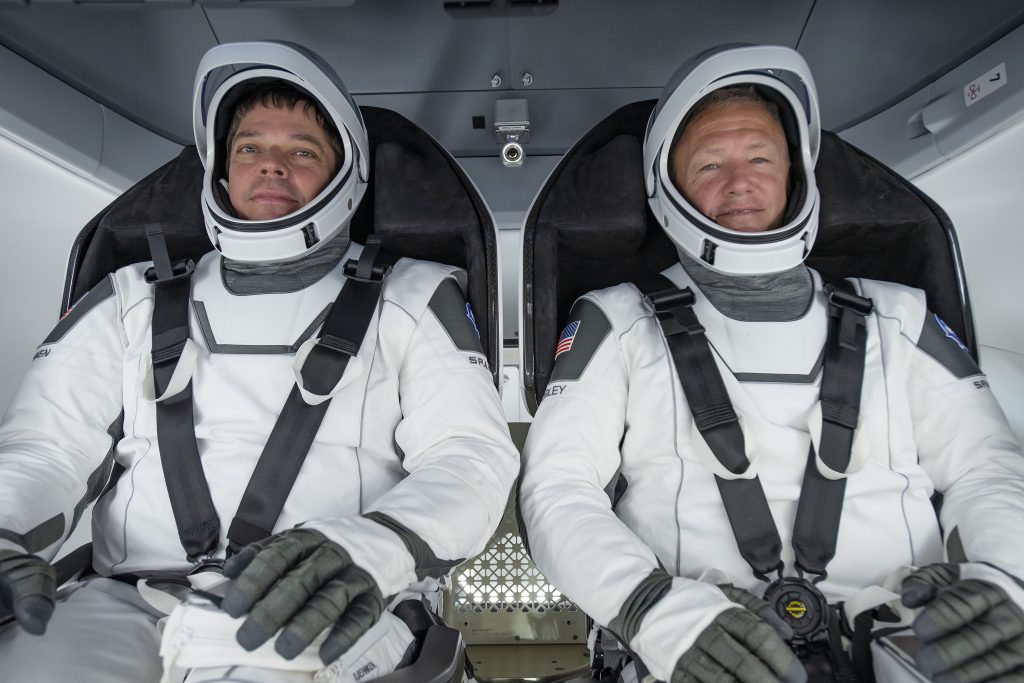
NASA astronauts Robert Behnken and Douglas Hurley (shown during a pre-flight test on 2020 March 30) will return to Earth on the SpaceX Crew Dragon on Sunday Afternoon, August 2, weather-permitting. The first splash-down of a crewed American spacecraft, since the Apollo-Soyuz Test Project on 1975 July 24, is planned to occur on the Crew Dragon Demo-2 flight, after leaving the International Space Station (ISS) on the evening of Saturday, August 1.
More Information & Video Coverage of the Return to Earth including Undocking from the Space Station & Spash-down: 
Link >>> http://buhlplanetarium4.tripod.com/astrocalendar/2020.html#spacex2
(Image Source: NASA)

Astronomical Calendar for 2020 August ---
Link >>> http://buhlplanetarium4.tripod.com/astrocalendar/2020.html#aug

 Related Blog Post ---

"Astro-Calendar: 2020 July / 50 Years of Video Calling."

Wednesday, 2020 July 1.

Link >>> https://spacewatchtower.blogspot.com/2020/07/astro-calendar-2020-july-50-years-of.html


Source: Friends of the Zeiss.
              Saturday, 2020 August 1.

                             Like This Post?  Please Share!

            More Astronomy & Science News - SpaceWatchtower Twitter Feed:
            Link >>> https://twitter.com/spacewatchtower

        Astronomy & Science Links: Link >>> http://buhlplanetarium.tripod.com/#sciencelinks

                Want to receive SpaceWatchtower blog posts in your in-box ?
                Send request to < spacewatchtower@planetarium.cc >.

gaw

Glenn A. Walsh, Informal Science Educator & Communicator:
< http://buhlplanetarium2.tripod.com/weblog/spacewatchtower/gaw/ >
Electronic Mail: < gawalsh@planetarium.cc >
Project Director, Friends of the Zeiss: < http://buhlplanetarium.tripod.com/fotz/ >
SpaceWatchtower Editor / Author: < http://spacewatchtower.blogspot.com/ >
Formerly Astronomical Observatory Coordinator & Planetarium Lecturer, original Buhl Planetarium & Institute of Popular Science (a.k.a. Buhl Science Center), Pittsburgh's science & technology museum from 1939 to 1991.
Formerly Trustee, Andrew Carnegie Free Library and Music Hall, Pittsburgh suburb of Carnegie, Pennsylvania.
Author of History Web Sites on the Internet --
* Buhl Planetarium, Pittsburgh:
  < http://www.planetarium.cc >
* Adler Planetarium, Chicago:
  < http://adlerplanetarium.tripod.com >
* Astronomer, Educator, Optician John A. Brashear:
  < http://johnbrashear.tripod.com >
* Andrew Carnegie & Carnegie Libraries:
  < http://www.andrewcarnegie.cc >