Monday, July 24, 2023

Webb Space Telescope: Data Doubles Age of Universe?

undefined

Digitized Sky Survey image of the oldest known star, with a well-determined age, in our Milky Way Galaxy. Star HD 140283, better known as Methuselah, may be about 14.6 billion years old. (Image Sources: European Space Agency, NASA, Hubble Space Telescope, Wikipedia.org, By ESA/Hubble, CC BY 4.0, https://commons.wikimedia.org/w/index.php?curid=25275489)

By Glenn A. Walsh

Reporting for SpaceWatchtower

A provocative new study, from the University of Ottawa, proposes that data from the James Webb Space Telescope may nearly double the age of the Universe, previously calculated by scientists.

In 2021, astronomers calculated the age of the Universe at about 13.797 billion years. This came from use of a cosmological model known as the Lambda-CDM Concordance Model.

The University of Ottawa now hypothesizes that the true age of the Universe may be closer to 26.7 billion years!

The James Webb Space Telescope data has found some of the most distant galaxies observed by the telescope are surprisingly mature, if they were actually only a half-billion years old. While these galaxies have been estimated to have formed about 300 million years after the Big Bang, their maturity is consistent with billions of years of cosmic evolution.

The “Big Bang”, which scientists contend created our Universe, is the physical theory scientists use to explain how our Universe expanded from an initial state of high density and temperature to its current state.

Scientists have also been puzzled by ancient stars, such as Methuselah (HD 140283), that appear to be older than the estimated age of the Universe, as originally calculated. While a study from 2013, using data from the Hubble Space Telescope, estimated the age of this star to be about 14.6 billion years-old, later studies have estimated the star's age at 12 or 13.7 billion years old.

For many years, scientists have used two guide-posts to measure the age of the Universe:

  • Astronomical Red-shift of light, coming from distant galaxies, indicating the speed the galaxies are moving away from us. Hubble's Law states that galaxies are moving away from Earth at speeds proportional to their distance from Earth;

  • Elapsed time since the Big Bang, considering the cooling time of the observed Cosmic Background Radiation and extrapolating backwards from measurements of the expansion rate of the Universe.

Rajendra Gupta, author of the University of Ottawa study, says "Our newly-devised model stretches the galaxy formation time by several billion years, making the universe 26.7 billion years old, and not 13.7 as previously estimated”. Dr. Gupta is Adjunct Professor of Physics in the Faculty of Science at the University of Ottawa. His scientific paper, “JWST early Universe observations and Lambda-CDM cosmology”, has been published in the journal, Monthly Notices of the Royal Astronomical Society.

Twentieth century Swiss Astronomer Fritz Zwicky proposed a “tired light theory” where the Red-shift of light coming from distant galaxies is not due to their speed from moving away from the Earth. He hypothesized that this Red-shift is the result of the gradual loss of energy of the light's photons after traveling vast distances through the Cosmos. This theory did not receive much acceptance in the scientific community because astronomical observations conflicted with the theory.

Now, Dr. Gupta has found that "by allowing this theory to coexist with the expanding universe, it becomes possible to reinterpret the redshift as a hybrid phenomenon, rather than purely due to expansion."

Dr. Gupta also proposes to use “Coupling Constants” as another way to explain a possible older-than-suspected Universe. Hypothesized by 20th century English Theoretical Physicist Paul Dirac (considered to be one of the founders of Quantum Mechanics and Quantum Electrodynamics), Coupling Constants are fundamental physical constants that govern the interactions between particles. Dr. Dirac believed that these constants may have varied over great lengths of time.

Dr. Gupta believes that by allowing these constants to evolve, the formation of early galaxies observed by the James Webb Space Telescope at high Red-shifts may have taken several billion years, rather than just a few million years. He believes that this is a more feasible interpretation of the data, for the advanced level of development and mass observed in these ancient galaxies.

Additionally, Dr. Gupta suggests a revision in the “Cosmological Constant”, which uses Dark Energy as the 'push' responsible for the accelerating expansion of the Universe. He proposes a new constant that accounts for the evolution of the Coupling Constants.

This could help explain the puzzle of small galaxy sizes in the early Universe. This modification of the Cosmological Model may allow for more accurate future observations.

Internet Links to Additional Information ---

Science Journal Abstract --- R Gupta, JWST early Universe observations and ΛCDM cosmology, Monthly Notices of the Royal Astronomical Society (2023)

Link >>>  https://academic.oup.com/mnras/advance-article-abstract/doi/10.1093/mnras/stad2032/7221343?redirectedFrom=fulltext&login=false

The Big Bang: Link >>> https://en.wikipedia.org/wiki/Big_Bang

James Webb Space Telescope:

Link >>> https://en.wikipedia.org/wiki/James_Webb_Space_Telescope

Hubble Space Telescope: Link >>> https://en.wikipedia.org/wiki/Hubble_Space_Telescope 

Star HD 140283, Methuselah: Link >>>     https://en.wikipedia.org/wiki/HD_140283 

Swiss Astronomer Fritz Zwicky: Link >>> https://en.wikipedia.org/wiki/Fritz_Zwicky

English Theoretical Physicist Paul Dirac: Link >>> https://en.wikipedia.org/wiki/Paul_Dirac

Related Blog-Posts ---


"Finally! Live-Stream: Christmas Launch of Next Great Space Telescope." Fri., 2021 Dec. 24.

Link >>> https://spacewatchtower.blogspot.com/2021/12/finally-live-stream-christmas-launch-of.html


"Free: NASA Webb Space Telescope Science Guide on iTunes." Thur., 2012 Dec. 27.

Link >>> http://spacewatchtower.blogspot.com/2012/12/free-nasa-webb-space-telescope-science.html


Source: Glenn A. Walsh Reporting for SpaceWatchtower, a project of Friends of the Zeiss          

               Monday, 2023 July 24.


                             Like This Post?  Please Share!

           More Astronomy & Science News - SpaceWatchtower Twitter Feed:
            Link >>> https://twitter.com/spacewatchtower

        Astronomy & Science Links: Link >>> http://buhlplanetarium.tripod.com/#sciencelinks

                Want to receive SpaceWatchtower blog posts in your in-box ?
                Send request to < spacewatchtower@planetarium.cc >.

gaw

Glenn A. Walsh, Informal Science Educator & Communicator                                                               (For more than 50 years! - Since Monday Morning, 1972 June 12):
Link >>> http://buhlplanetarium2.tripod.com/weblog/spacewatchtower/gaw/
Electronic Mail: < gawalsh@planetarium.cc >
Project Director, Friends of the Zeiss: Link >>> http://buhlplanetarium.tripod.com/fotz/
SpaceWatchtower Editor / Author: Link >>> http://spacewatchtower.blogspot.com/
Formerly Astronomical Observatory Coordinator & Planetarium Lecturer, original Buhl Planetarium & Institute of Popular Science (a.k.a. Buhl Science Center), America's fifth major planetarium and Pittsburgh's science & technology museum from 1939 to 1991.
Formerly Trustee, Andrew Carnegie Free Library and Music Hall, Pittsburgh suburb of Carnegie, Pennsylvania, the fourth of only five libraries where both construction and endowment funded by famous industrialist & philanthropist Andrew Carnegie.
Author of History Web Sites on the Internet --
* Buhl Planetarium, Pittsburgh: Link >>>  http://www.planetarium.cc  Buhl Observatory: Link >>>  http://spacewatchtower.blogspot.com/2016/11/75th-anniversary-americas-5th-public.html
* Adler Planetarium, Chicago: Link >>> http://adlerplanetarium.tripod.com
* Astronomer, Educator, Optician John A. Brashear: Link >>> http://johnbrashear.tripod.com
* Andrew Carnegie & Carnegie Libraries: Link >>> http://www.andrewcarnegie.cc

 * Other Walsh-Authored Blog & Web-Sites: Link >>> https://buhlplanetarium.tripod.com/gawweb.html

Monday, July 3, 2023

Earth Farthest from Sun for Year: Thursday

The perihelion (green) and aphelion (orange) points of the inner planets of the Solar System

This diagram shows the Aphelions (green points) and Perihelions (orange points) for our Solar System's inner planets. Seen here from the Northern Ecliptic Pole, the planets move couter-clockwise. The blue portion of the orbits are north of the Ecliptic Plane; the pink portion of the orbits are south of the Ecliptic Plane. (Image Sources: Wikipedia.org, By / Original: User:Danial79 / Vectorization: Mrmw - Own work based on: Inner Planet Orbits.jpg:, CC0, https://commons.wikimedia.org/w/index.php?curid=92300694)

By Glenn A. Walsh

Reporting for SpaceWatchtower

The week of American Independence Day is often one of the hottest weeks of the year, with many people taking the holiday as an opportunity for a vacation. However, it is not hot because of a close distance between the Earth and the Sun.

Although the Summer months in the Northern Hemisphere are known for the year's warmest weather, the Earth is actually at the point in its orbit farthest from the Sun (astronomically known as the point of Aphelion) around July 5. This Thursday afternoon, just two days after American Independence Day on July 4 and a couple weeks after the Summer Solstice on June 21, will mark Aphelion for 2023, the location in Earth's annual orbit around the Sun where our planet is farthest from the Sun for the entire year!

This year, Earth Aphelion will occur on Thursday Afternoon, 2023 July 6 at 4:06 p.m. Eastern Daylight Saving Time (EDT) / 20:06 Coordinated Universal Time [UTC – International time used by scientists; previously referred to as Greenwich Mean Time (GMT) or Greenwich Civil Time (GCT)]. At that moment, Earth will be the farthest from the Sun for the whole year: 94,506,364.705 statute miles / 152,093,251 kilometers.

For A.D. 2023, the season of Summer began at Earth's Northern Hemisphere's Summer Solstice (and the season of Winter began at the Southern Hemisphere's Winter Solstice) at the moment of the June Solstice: Wednesday Morning, 2023 June 21 at 10:58 a.m. EDT / 14:58 UTC. Summer will continue until the Autumnal Equinox when Autumn / Fall commences in the Northern Hemisphere (and Spring begins in the Southern Hemisphere) on Saturday Morning, 2023 September 23 at 2:50 a.m. EDT / 6:50 UTC.

The Earth's closest approach to the Sun (Perihelion) each year is around January 2, shortly after the Winter Solstice on or near December 21. Approximately a half-year's time between Earth Perihelion and Earth Aphelion, the difference in distance between the Sun and Earth varies by about 3.2 million statute miles / 5.1499008 million kilometers.

This year, Earth Perihelion occurred on 2023 January 4 at 11:17 a.m. Eastern Standard Time (EST) / 16:17 UTC. At that time, the Earth was 91,403,034 statute miles / 147,098,924 kilometers from the Sun. Earth Perihelion next year will occur on 2024 January 2 at 7:38 p.m. EST / January 3 at 0:38 UTC; distance from Earth to Sun: 91,404, 095 statute miles / 147,100,631.8 kilometers.

In general, the distance from the Earth to the Sun is not the major factor determining the heat of Summer or the cold of Winter. This is true, despite the fact that Earth receives about 7 per-cent more solar radiation from the Sun during the time of Earth Perihelion in January, than at the time of Earth Aphelion in July.

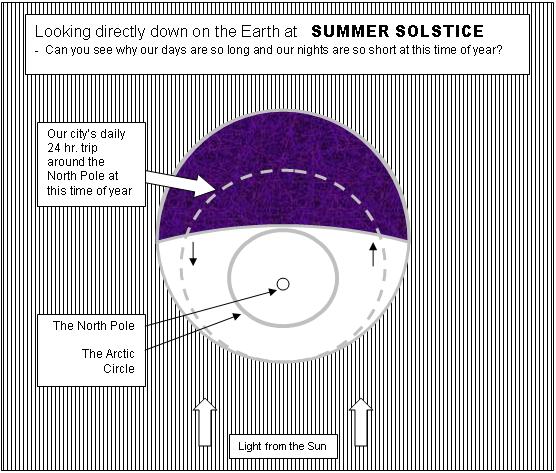
Solar radiation, and hence the heat from the Sun, depends on the length of daylight and the angle of the Sun above the horizon. The tilt of the planet's axis, about 23.44 degrees toward the Sun, determines the additional and more direct solar radiation received by a planet's Northern or Southern Hemisphere, and hence, the warmer season of the respective hemisphere.

While the Sun does have motions (the Sun rotates on its own axis about once every 27 Earth days; our Solar System revolves around the center of the Milky Way Galaxy once every 225 million-to-250 million Earth years), it is actually the motion of the Earth tilted on its axis, away from the plane of the ecliptic (Earth's orbital plane around the Sun), while revolving around the Sun, that causes the Earth's seasons.

The Earth's Perihelion in January, and Aphelion in July, are due to the elliptical nature of the Earth's orbit around the Sun. Perihelion and Aphelion would not occur if the Earth's orbit was a true circle.

The dates of Earth Perihelion and Earth Aphelion are not fixed. Due to the Earth's Precession of the Equinoxes, these days shift forward approximately one day every 58 years. About 800 years ago, the Earth Perihelion was on the date of the Winter Solstice, around December 21; Earth Perihelion will be on the Vernal Equinox, the beginning of Spring around March 20, about 4,300 years from now. Earth's Axial Precession (often described as a "wobble" in the Earth's orientation, like a spinning top or a gyroscope) gradually changes the orientation of the Earth's Rotational Axis, which completes one rotational cycle once every 25,772 years.

Because Earth is farther from the Sun during our Spring and Summer seasons, people in Earth's Northern Hemisphere actually benefit from a few extra days of warmth (on average), than the number of days in the Autumn and Winter seasons of the year. When Earth is closer to the Sun, the Earth travels faster in its elliptical orbit around the Sun (during the Autumn and Winter months); and, when Earth is farther than average from the Sun (during the Spring and Summer seasons) the Earth travels a little more slowly --- again, this refers to the Northern Hemisphere. Hence, the Spring and Summer seasons, in the Northern Hemisphere, have a few more days than the Autumn and Winter seasons.

In fact, Jay Pasachoff, Field Memorial Professor of Astronomy at Williams College in Williamstown, Massachusetts and author of widely-used, college astronomy text-books, has precisely calculated the duration of each season, in the Northern Hemisphere:

  • Summer: 93 days, 15 hours

  • Spring: 92 days, 19 hours

  • Autumn / Fall: 89 days, 20 hours

  • Winter: 89 days, 0 hours 

No matter whether in the Northern Hemisphere or the Southern Hemisphere, the days of Summer always have the most hours and minutes of daylight (the length of time between Sunrise and Sunset) each year, while the days of Winter always have the least number of hours and minutes of daylight for the year. The exact number of hours and minutes of daylight, for a particular location, depends on the locale's geographic Latitude on the Earth. Astronomers, amateur ("ham") radio operators, and long-distance radio enthusiasts (“radio DXers”), all of whom mostly depend on non-daylight hours to ply their craft, often prefer the days of Winter.

Interestingly, the climate of a locale in the Southern Hemisphere is, on average, slightly milder than a location at the same latitude in the Northern Hemisphere, because the Southern Hemisphere has significantly more ocean water and much less land. Water warms-up and cools-down more slowly than does land. The only exception is the Antarctic Continent, which is colder than the Northern Hemisphere's Arctic region, possibly because most of the Arctic region is covered with water (although, often frozen water on the surface, but liquid water beneath the ice) while Antarctica is mostly a land mass.

When considering the tides of Earth's oceans, High Tides and Low Tides are affected by both the gravity of the Sun and the gravity of the Moon. This is particularly true at or near the times of the Full Moon and New Moon primary Moon phases, when the gravitational pull of the Sun and the Moon are combined. However, being much closer to the Earth, the Moon's gravitation is much more influential than that of the Sun.

This is even more true this month, since the Sun is farthest from the Earth on July 6. Also, this month's Full Moon occurs on July 3 at 7:39 a.m. EDT / 11:39 UTC, and the Moon is closest to the Earth (Lunar Perigee) for the month on July 4 at 6:00 p.m. EDT / 22:00 UTC at a distance of 223,786.2 statute miles / 360,149 kilometers. Due to the closeness of this Full Moon (known as the Buck Moon, Hay Moon, Thunder Moon, and because July is the month astronauts first set foot on the Moon some refer to it as the Apollo Moon) to the Earth this month, some people refer to this Full Moon as a so-called "Super-Moon", the first of four consecutive "Super-Moons" in 2023. So, during the first week of July, the Moon will appear a little brighter, and the ocean tides will be a little stronger than normal.

The bright Star Spica (Alpha Virginis) is now visible in the morning sky (weather-permitting). The brightest star in the Constellation Virgo the Virgin and the 16th brightest star in Earth's night sky (Apparent Visual Magnitude: + 0.97), Spica may have helped develop one of civilization's early calendars. A calendar of ancient Armenia used the year's first sighting of Spica in the dawn sky, a few days before the Summer Solstice, to mark the beginning of the New Year for this particular calendar. The development of this calendar somewhat coincided with the beginning of agriculture in Armenia.

Interestingly, Spica is about 247 Light-Years away from Earth , which means that the light we see coming from Spica began its trip from the star 247 years ago. And, 247 years ago was when Amerca's Declaration of Independence was ratified by the Second Continental Congress in 1776!

Like clock-work, a well-known asterism (pattern of stars in the sky, not officially recognized as a constellation) of three stars shaped as a triangle is visible nearly overhead around local midnight during the Summer months (weather-permitting). And logically, as Star Trek's Mr. Spock might say, this asterism is known as the Summer Triangle!

Three of the brightest stars in the Summer sky constitute the Summer Triangle ---

  1. Vega (Alpha Lyrae - brightest star in the Constellation Lyra the Harp); brightest of the three stars and closest to the zenith (highest point in the sky);

  2. Altair (Alpha Aquilae - denotes the eagle eye and brightest star in the Constellation Aquila the Eagle); second brightest star of the trio;

  3. Deneb (Alpha Cygni - denotes the tail star, is the brightest star in the Constellation Cygnus the Swan, and is the “head” star of the asterism known as the Northern Cross).

The term Summer Triangle was popularized in the 1950s by American author H.A. Rey and British astronomer Patrick Moore, although constellation guidebooks mention this triangle of stars as far back as 1913. And, during World War II, military navigators referred to this asterism as the “Navigator's Triangle.”

Regardless of city light pollution, the three bright stars of the Summer Triangle should be visible to nearly everyone in Earth's Northern Hemisphere (weather-permitting). So, just look overhead late-evening or early-morning throughout the Summer for these annual visitors to our Summer sky!

Internet Links to Additional Information ---

 Apehilion & Perihelion:

Link 1 >>> https://www.timeanddate.com/astronomy/perihelion-aphelion-solstice.html

Link 2 >>> https://en.wikipedia.org/wiki/Apsis#Perihelion_and_aphelion

Axial Tilt: >>> https://en.wikipedia.org/wiki/Axial_tilt

Related Blog-Posts ---

"Summer Begins Mid-Day Wednesday at Solstice." Mon., 2023 June 19.


"Winter Begins at Solstice Wed.; Ursid Meteors Peak Thur." Mon., 2022 Dec. 19.

Source: Glenn A. Walsh Reporting for SpaceWatchtower, a project of Friends of the Zeiss          

               Monday, 2023 July 3.


                             Like This Post?  Please Share!

           More Astronomy & Science News - SpaceWatchtower Twitter Feed:
            Link >>> https://twitter.com/spacewatchtower

        Astronomy & Science Links: Link >>> http://buhlplanetarium.tripod.com/#sciencelinks

                Want to receive SpaceWatchtower blog posts in your in-box ?
                Send request to < spacewatchtower@planetarium.cc >.

gaw

Glenn A. Walsh, Informal Science Educator & Communicator                                                               (For more than 50 years! - Since Monday Morning, 1972 June 12):
Link >>> http://buhlplanetarium2.tripod.com/weblog/spacewatchtower/gaw/
Electronic Mail: < gawalsh@planetarium.cc >
Project Director, Friends of the Zeiss: Link >>> http://buhlplanetarium.tripod.com/fotz/
SpaceWatchtower Editor / Author: Link >>> http://spacewatchtower.blogspot.com/
Formerly Astronomical Observatory Coordinator & Planetarium Lecturer, original Buhl Planetarium & Institute of Popular Science (a.k.a. Buhl Science Center), America's fifth major planetarium and Pittsburgh's science & technology museum from 1939 to 1991.
Formerly Trustee, Andrew Carnegie Free Library and Music Hall, Pittsburgh suburb of Carnegie, Pennsylvania, the fourth of only five libraries where both construction and endowment funded by famous industrialist & philanthropist Andrew Carnegie.
Author of History Web Sites on the Internet --
* Buhl Planetarium, Pittsburgh: Link >>>  http://www.planetarium.cc  Buhl Observatory: Link >>>  http://spacewatchtower.blogspot.com/2016/11/75th-anniversary-americas-5th-public.html
* Adler Planetarium, Chicago: Link >>> http://adlerplanetarium.tripod.com
* Astronomer, Educator, Optician John A. Brashear: Link >>> http://johnbrashear.tripod.com
* Andrew Carnegie & Carnegie Libraries: Link >>> http://www.andrewcarnegie.cc

 * Other Walsh-Authored Blog & Web-Sites: Link >>> https://buhlplanetarium.tripod.com/gawweb.html

Monday, June 19, 2023

Summer Begins Mid-Day Wednesday at Solstice

By Glenn A. Walsh

Reporting for SpaceWatchtower

Late Wednesday morning, Summer begins in the Northern Hemisphere of Earth, while at the same time, Winter begins in the Southern Hemisphere.

For A.D. 2023, the season of Summer begins at Earth's Northern Hemisphere's Summer Solstice (and the season of Winter begins at the Southern Hemisphere's Winter Solstice) at the moment of the June Solstice: Wednesday Morning, 2023 June 21 at 10:58 a.m. Eastern Daylight Saving Time (EDT) / 14:58 Coordinated Universal Time [UTC – International time used by scientists; previously referred to as Greenwich Mean Time (GMT) or Greenwich Civil Time (GCT)]. Summer will continue until the Autumnal Equinox when the season of Autumn / Fall commences: Saturday Morning, 2023 September 23 at 2:50 a.m. EDT / 6:50 UTC.

In Meteorology (Weather Science), the convention is to start a season on the first day of a calendar month. So, Meteorological Summer runs from June 1 to August 31.

In Etymology, the word Solstice comes from the Latin terms Sol (Sun) and Sistere (to stand still). In ancient times, Astronomers / Astrologers / Priests recognized that on one day of the year (in the Northern Hemisphere, on or near the day we now call June 21), the Sun would appear to stand-still as Sol reaches its highest point in the sky for the entire year. The motion of the Sun's apparent path in the sky (what is known astronomically, today, as the Sun's Declination) would cease on this day, before appearing to reverse direction.

Although the Summer months in the Northern Hemisphere are known for the year's warmest weather, the Earth is actually at the point in its orbit farthest from the Sun (astronomically known as the point of Aphelion) around July 5. The Earth's closest approach to the Sun (Perihelion) each year is around January 2. Hence, in general, the distance from the Earth to the Sun is not the major factor determining the heat of Summer or the cold of Winter.

This year, Earth Aphelion will occur on Thursday Afternoon, 2023 July 6 at 4:00 p.m. EDT / 20:00 UTC. At that moment, Earth will be the farthest from the Sun for the whole year: 94,506,364.705 statute miles / 152,093,251 kilometers.

However, because Earth is farther from the Sun during our Spring and Summer seasons, people in Earth's Northern Hemisphere actually benefit from a few extra days of warmth (on average), than the number of days in the Autumn and Winter seasons of the year. When Earth is closer to the Sun, the Earth travels faster in its elliptical orbit around the Sun (during the Autumn and Winter months); and, when Earth is farther than average from the Sun (during the Spring and Summer seasons) the Earth travels a little more slowly --- again, this refers to the Northern Hemisphere. Hence, the Spring and Summer seasons, in the Northern Hemisphere, have a few more days than the Autumn and Winter seasons.

In fact, Jay Pasachoff, Field Memorial Professor of Astronomy at Williams College in Williamstown, Massachusetts and author of widely-used, college astronomy text-books, has precisely calculated the duration of each season, in the Northern Hemisphere:

* Summer: 93 days, 15 hours

* Spring: 92 days, 19 hours

* Autumn / Fall: 89 days, 20 hours

* Winter: 89 days, 0 hours 

Solar radiation, and hence the heat from the Sun, depends on the length of daylight and the angle of the Sun above the horizon. The tilt of the planet's axis toward the Sun determines the additional and more direct solar radiation received by a planet's Northern or Southern Hemisphere, and hence, the warmer season of the respective hemisphere.

While the Sun does have motions (the Sun rotates on its own axis about once every 27 Earth days; our Solar System revolves around the center of the Milky Way Galaxy once every 225 million-to-250 million Earth years), it is actually the motion of the Earth tilted on its axis, away from the plane of the ecliptic (Earth's orbital plane around the Sun), while revolving around the Sun, that causes the Earth's seasons.

As of Noon today (June 19), Earth's Axial Tilt or Mean Obliquity: 23.43623° or 23°26'10.4".

Hence, as the Earth arrives at the point in its orbit around the Sun, when the north polar axis is most directly inclined toward the Sun, this marks the Summer Solstice in the Northern Hemisphere and the Winter Solstice in the Southern Hemisphere.

Alternately, the Winter Solstice in the Northern Hemisphere (the Winter Solstice is always on or near, what we now refer to as, December 21) occurs when the Earth reaches the point in its orbit when the North Pole is most directly inclined away from the Sun (and, the South Pole is most directly inclined toward the Sun). And, conversely, at this time Summer begins in the planet's Southern Hemisphere.

For Earth observers at precisely 23°26′10.9″ / 23.43637° North Latitude at the moment of the June Solstice, the Sun will appear to shine directly overhead. The line around the Earth at 23°26'10.9″ / 23.43637° North Latitude is known as the Tropic of Cancer (a.k.a. Northern Tropic). Likewise, at 23°26′10.9″ / 23.43637°) South Latitude is located the Tropic of Capricorn (a.k.a. Southern Tropic), where the Sun appears directly overhead at the moment of the December Solstice.

However, as the tilt of the Earth is dynamic, and changes minutely over the years, the location of the Tropic lines also change. Currently, these Tropic lines are moving north at the rate of 0.47 arc-seconds / 49.21 feet / 15 meters per year.

The names Tropic of Cancer and Tropic of Capricorn were coined in the last centuries B.C., when the Sun would appear in the Constellation Cancer the Crab on the June Solstice and in the Constellation Capricornus the Horned Goat on the December Solstice. However today, hours after the June Solstice, the Sun enters the Constellation Gemini the Twins, 30 degrees from Cancer. And at the December Solstice, the Sun is now in the Constellation Sagittarius the Archer.

This is due to “Precession of the Equinoxes” of Earth, which is analogous to the wobbling of a spinning top. In the case of the Earth, this 25,772-year wobble causes observers to view the Sun in different parts of the sky over the centuries, at the same time of year while remaining in the same geographical location. As the Earth wobbles over the centuries, the North Pole Star also changes. Currently, Polaris is our North Pole Star; around A.D. 13,700, Vega will be our North Pole Star, due to the Precession of the Equinoxes.

No matter which hemisphere, the day of the Summer Solstice always has the most hours and minutes of daylight (the length of time between Sunrise and Sunset) for the year, while the Winter Solstice always has the least number of hours and minutes of daylight for the year. The exact number of hours and minutes of daylight, for a particular location, depends on the locale's geographic Latitude on the Earth. Astronomers, amateur ("ham") radio operators, and long-distance radio enthusiasts (“radio DXers”), all of whom mostly depend on non-daylight hours to ply their craft, often prefer the days closer to the Winter Solstice.

The Vernal Equinox, when the season of Spring begins in the Northern Hemisphere (and the season of Autumn begins in the Southern Hemisphere), occurs between the Winter and Summer Solstices when the Earth reaches the point in its orbit around the Sun when the Earth's axis is inclined neither toward nor away from the Sun. Likewise, when the Earth reaches the point in its orbit around the Sun, between the Summer and Winter Solstices, when the Earth's axis is inclined neither toward nor away from the Sun, this is known as the Autumnal Equinox (beginning of Fall or Autumn) in the Northern Hemisphere; at this time Spring begins in the Southern Hemisphere. And, half-way between the beginning points of each season are Cross-Quarter Days, each related to traditional holidays: Groundhog Day (February 2), May Day (May 1), Lammas Day (traditionally, the first harvest festival of the year on August 1), and Halloween (October 31).

In ancient times, the Summer Solstice was known as Mid-Summer Day, in early calendars observed around June 24. At that time, May 1 to August 1 (i.e. the two Cross-Quarter Days) was considered the season of Summer. Such early European celebrations were pre-Christian in origin. Many will associate this ancient holiday with the famous William Shakespeare play, “A Midsummer Night's Dream.” Some speculate that the play was written for the Queen of England, to celebrate the Feast Day of Saint John.

As with the Roman Catholic Church's decision to Christianize the pagan Winter Solstice festivals with the introduction of Christmas Day on December 25 (by an early calendar, December 25 was reckoned as the Winter Solstice), the Church began to associate the Mid-Summer festivals with the Nativity of Saint John the Baptist on June 24. In the Christian Bible, the Gospel of Saint Luke implies that Saint John was born six months before the birth of Jesus, although no specific birth dates are given.

The most famous celebration of the Summer Solstice occurs each year at the Stonehenge pre-historic monument in England. Constructed between 3,000 B.C. and 1,600 B.C. in three phases, the actual purpose of the landmark is still unclear. However, it seems to have been associated with burials, originally. It was also used as a type of astronomical observatory, particularly for observing the Sun, which was important to help early cultures make annual decisions regarding agriculture.

Stonehenge is known as a way for pre-historic peoples to mark both the Summer and Winter Solstices. From inside the monument, a viewer facing northeast can watch the Sun rise (weather-permitting) above a stone outside the main circle of rocks, known as the Heel Stone, on the day of the Summer Solstice in the Northern Hemisphere. Although today, due to serious erosion of the stones, visitors on the Summer Solstice can only walk around the landmark from a short distance away during this annual event.

Although not as prominent as Stonehenge, a calendar ring using smaller rocks was also constructed at Nabta Playa in southern Egypt, perhaps as early as 7,000 years ago! As with Stonehenge, some stones aligned with Sunrise on the day of the Summer Solstice.

Today, a Stonehenge-like event occurs each year at the University of Wyoming (UW) Art Museum in Laramie, Wyoming, free-of-charge to the general public. At 12:00 Noon Mountain Daylight Saving Time (MDT) / 2:00 p.m. EDT / 18:00 UTC on the day of the Summer Solstice, visitors can see a single beam of sunlight shine through a solar tube in the ceiling of the UW Art Museum's Rotunda Gallery; the beam of sunlight then shines onto a 1923 Peace Silver Dollar embedded in the floor of the Museum's Rotunda Gallery. Visitors are encouraged to arrive at the museum by 11:30 a.m. MDT / 1:30 p.m. EDT / 17:30 UTC, to view this rather unique architectural feature.

The bright Star Spica (Alpha Virginis), the brightest star in the Constellation Virgo the Virgin and the 16th brightest star in Earth's night sky (Apparent Visual Magnitude: + 0.97), may have helped develop another one of civilization's early calendars. A calendar of ancient Armenia used the year's first sighting of Spica in the dawn sky, a few days before the Summer Solstice, to mark the beginning of the New Year for this particular calendar. The development of this calendar somewhat coincided with the beginning of agriculture in Armenia.

Like clock-work, a well-known asterism (pattern of stars in the sky, not officially recognized as a constellation) of three stars shaped as a triangle is visible nearly overhead around local midnight during the Summer months (weather-permitting). And logically, as Star Trek's Mr. Spock might say, this asterism is known as the Summer Triangle!

Three of the brightest stars in the Summer sky constitute the Summer Triangle ---

  1. Vega (Alpha Lyrae - brightest star in the Constellation Lyra the Harp); brightest of the three stars and closest to the zenith (highest point in the sky);

  2. Altair (Alpha Aquilae - denotes the eagle eye and brightest star in the Constellation Aquila the Eagle); second brightest star of the trio;

  3. Deneb (Alpha Cygni - denotes the tail star, is the brightest star in the Constellation Cygnus the Swan, and is the “head” star of the asterism known as the Northern Cross).

The term Summer Triangle was popularized in the 1950s by American author H.A. Rey and British astronomer Patrick Moore, although constellation guidebooks mention this triangle of stars as far back as 1913. And, during World War II, military navigators referred to this asterism as the “Navigator's Triangle.”

Regardless of city light pollution, the three bright stars of the Summer Triangle should be visible to nearly everyone in Earth's Northern Hemisphere (weather-permitting). So, just look overhead late-evening or early-morning throughout the Summer for these annual visitors to our Summer sky!

Internet Links to Additional Information ---

Summer Solstice: 
Link 1 >>> http://scienceworld.wolfram.com/astronomy/SummerSolstice.html 
Link 2 >>> http://en.wikipedia.org/wiki/Summer_solstice  

Season of Summer: Link >>> http://en.wikipedia.org/wiki/Summer  

History of Mid-Summer: Link >>> http://en.wikipedia.org/wiki/Midsummer
 

Summer "Solstice Day" Annual Free-of-Charge Day (With Snowballs !), 1985 to 1991, at the original Buhl Planetarium and Institute of Popular Science (a.k.a. Buhl Science Center), Pittsburgh's science and technology museum from 1939 to 1991:  
Link >>> http://spacewatchtower.blogspot.com/2015/06/snowballs-on-first-day-of-summer.html

Stonehenge: Link >>> https://en.wikipedia.org/wiki/Stonehenge

News Release - University of Wyoming Stonehenge-type event:
Link >>> https://www.uwyo.edu/uw/news/2018/06/uw-art-museum-to-celebrate-summer-solstice-june-21.html

Star Spica: Link >>> https://en.wikipedia.org/wiki/Spica

Precession of the Equinoxes: Link >>> https://en.wikipedia.org/wiki/Axial_precession 

Tropic of Cancer: Link >>> https://en.wikipedia.org/wiki/Tropic_of_Cancer 

Tropic of Capricorn: Link >>> https://en.wikipedia.org/wiki/Tropic_of_Capricorn 

Summer Triangle: Link >>> https://en.wikipedia.org/wiki/Summer_Triangle

 
Source:
 Glenn A. Walsh Reporting for SpaceWatchtower, a project of Friends of the Zeiss          

               Monday, 2023 June 19.


                             Like This Post?  Please Share!

           More Astronomy & Science News - SpaceWatchtower Twitter Feed:
            Link >>> https://twitter.com/spacewatchtower

        Astronomy & Science Links: Link >>> http://buhlplanetarium.tripod.com/#sciencelinks

                Want to receive SpaceWatchtower blog posts in your in-box ?
                Send request to < spacewatchtower@planetarium.cc >.

gaw

Glenn A. Walsh, Informal Science Educator & Communicator                                                               (For more than 50 years! - Since Monday Morning, 1972 June 12):
Link >>> http://buhlplanetarium2.tripod.com/weblog/spacewatchtower/gaw/
Electronic Mail: < gawalsh@planetarium.cc >
Project Director, Friends of the Zeiss: Link >>> http://buhlplanetarium.tripod.com/fotz/
SpaceWatchtower Editor / Author: Link >>> http://spacewatchtower.blogspot.com/
Formerly Astronomical Observatory Coordinator & Planetarium Lecturer, original Buhl Planetarium & Institute of Popular Science (a.k.a. Buhl Science Center), America's fifth major planetarium and Pittsburgh's science & technology museum from 1939 to 1991.
Formerly Trustee, Andrew Carnegie Free Library and Music Hall, Pittsburgh suburb of Carnegie, Pennsylvania, the fourth of only five libraries where both construction and endowment funded by famous industrialist & philanthropist Andrew Carnegie.
Author of History Web Sites on the Internet --
* Buhl Planetarium, Pittsburgh: Link >>>  http://www.planetarium.cc  Buhl Observatory: Link >>>  http://spacewatchtower.blogspot.com/2016/11/75th-anniversary-americas-5th-public.html
* Adler Planetarium, Chicago: Link >>> http://adlerplanetarium.tripod.com
* Astronomer, Educator, Optician John A. Brashear: Link >>> http://johnbrashear.tripod.com
* Andrew Carnegie & Carnegie Libraries: Link >>> http://www.andrewcarnegie.cc

 * Other Walsh-Authored Blog & Web-Sites: Link >>> https://buhlplanetarium.tripod.com/gawweb.html


Wednesday, June 14, 2023

Add Your Name to Poem to be Launched to Jupiter Moon Europa

Europa in natural color.png

Europa, one of the first two moons of Jupiter to be discovered by famous astronomer Galileo Galilei. This image is in natural color.

(Image Sources: NASA, Jet Propulsion Laboratory, Wikipedia.org, By NASA/JPL-Caltech/SwRI/MSSS/Kevin M. Gill - File:Europa - PJ45-2.png from https://www.missionjuno.swri.edu/junocam/processing?id=13844, CC BY 3.0, https://commons.wikimedia.org/w/index.php?curid=125306643)

By Glenn A. Walsh

Reporting for SpaceWatchtower

NASA is inviting everyone to add their name to a poem that will be launched aboard the Europa Clipper, the latest U.S. unmanned spacecraft which will study Jupiter's icy moon Europa. Etched on the probe as a “Message In A Bottle” will be the poem, "In Praise of Mystery: A Poem for Europa", written by U.S. Poet Laureate Ada Limon (Internet link to the poem transcript near the end of this blog-post).

The Europa Clipper is scheduled to launch from NASA's Kennedy Space Center (Launch Complex 39A) in Florida in mid-to-late October of next year. The tentative launch date is 2024 October 10 (with a 21-day launch window until October 30), with orbital insertion expected 2030 April 11. To reach Europa, the spacecraft will travel 1.8 billion miles / 2.89 billion kilometers.

To add your name to a microchip which will be included on the spacecraft, you must register at the special NASA Internet web-site by 11:59 p.m. Eastern Standard Time (EST) on Sunday, 2023 December 31 / 4:59 Coordinated Universal Time (UTC) on Monday, 2024 January 1. Internet link to NASA web-site for public registration of names on the Europa Clipper can be found near the end of this blog-post.

One of 95 confirmed moons or natural satellites orbiting Jupiter, Europa was one of the first of two moons discovered circling another planet. It was famous astronomer Galileo Galilei who spotted Europa, along with Jupiter moon Io, on 1610 January 8.

It was also observed about the same time by German astronomer Simon Marius, which led to a dispute regarding who was the true discoverer. Although Marius did not report his discovery until a day after Galileo reported the discovery, Marius actually gave the mythological names to the four Galilean Moons. The moon Europa is named after Europa, a Phoenician noblewoman in Greek mythology, daughter of the King of Tyre.

Discovery of Europa and Io, along with Jupiter moons Callisto and Ganymede a few days later (these four moons are known as the Galilean Moons), was a monumental discovery, proving that some planetary objects orbited other planets besides the Earth. This definitively illustrated that the Copernican model of the Solar System is the correct model.

Galileo made this discovery at the University of Padua in Italy. He used the first astronomical refracting telescope, of a 20-power magnification.

Europa is the sixth closest moon to Jupiter, the sixth largest moon in the Solar System, and the smallest of the four Galilean Moons. Europa is just a little smaller than Earth's Moon.

Europa is composed of silicate rock and an iron-nickel core with a water-ice crust and a very thin atmosphere made-up mostly of Oxygen (O2). With the smoothest surface of any solid object in the Solar System, the hypothesis is that Europa has a sub-ice liquid ocean, which could harbor extraterrestrial life.

Tidal Heating, from close proximity to the largest planet in the Solar System, is thought to keep the sub-surface ocean in a liquid state. Eruptions of water vapor plumes, similar to those seen on Saturn's moon Enceladus, have been observed on Europa by the Hubble Space Telescope and the Galileo space probe. It is thought that probes to Europa can sample water from these plumes for composition and possible life, without having to land on the surface and drill into the ice sheet.

The Europa Clipper is not designed to orbit Europa. Scientists have determined this would be too dangerous due to the strong radiation belts emanating from Jupiter which could seriously damage equipment systems on-board the spacecraft.

Instead, the Europa Clipper will enter a very elliptical orbit around Jupiter, which brings the spacecraft close to Europa at a certain portion of the orbit. The Europa Clipper is scheduled to make 44 close fly-bys of the surface of the planetary body. This will allow the space probe to make scientific measurements and observations, while giving it more time to send the data back to Earth during the greater length of time when the radiation belts are not affecting the equipment.

Originally scheduled to launch aboard a NASA Space Launch System (SLS) super heavy-lift rocket (the same rocket set to send astronauts back to the Moon this decade), NASA received permission from the U.S. Congress to use a commercial launch vehicle instead. So, a SpaceX Falcon Heavy rocket will launch the Europa Clipper. The 5.5-year trajectory to the Jovian system will include two gravity-assist maneuvers to provide greater energy for the long trek: with Mars in February of 2025 and with Earth in December of 2026.

The goals of the Europa Clipper mission are to determine if Europa could be inhabited by extraterrestrial life and to scout for appropriate landing sites for a future Europa landing space probe. While examining the water plumes for possible life, scientists will be looking specifically for the three main requirements of life: liquid water (H2O), appropriate chemistry, and energy.

The three objectives scientists will be studying during this mission ---

  • Ice Shell and confirmation that a sub-surface ocean exists;

  • Ocean composition;

  • Geology and characteristics of surface features.

Internet Link to Poem, "In Praise of Mystery: A Poem for Europa":

Link >>> https://www.loc.gov/programs/poetry-and-literature/poet-laureate/poet-laureate-projects/a-poem-for-europa/

Internet Link to “Message In A Bottle” Public Registration for the Poem, "In Praise of Mystery: A Poem for Europa" on NASA's Europa Clipper spacecraft:

Link >>> https://europa.nasa.gov/message-in-a-bottle/sign-on/

 Internet Links to Additional Information ---

Jupiter Moon Europa: Link >>> https://en.wikipedia.org/wiki/Europa_(moon)

Europa Clipper Space Probe -

Link 1 (NASA) >>> https://www.jpl.nasa.gov/missions/europa-clipper 

Link 2 >>> https://en.wikipedia.org/wiki/Europa_Clipper

Tidal Heating: Link >>> https://en.wikipedia.org/wiki/Tidal_heating

Galileo Galilei: Link >>> https://en.wikipedia.org/wiki/Galileo_Galilei

Simon Marius: Link >>> https://en.wikipedia.org/wiki/Simon_Marius

More Poetry Regarding Astronomy & the Space Sciences:

Link >>> https://buhlplanetarium.tripod.com/poetry/

Related Blog-Posts ---

"Laser-Powered Sub to Explore Jupiter Moon Europa ?" Sun., 2018 Oct. 7.

Link >>> http://spacewatchtower.blogspot.com/2018/10/laser-powered-sub-to-explore-jupiter.html


"Deadline to Add Name to NASA Mars Lander: Tuesday Night." Sun., 2015 Sept. 6.

Link >>> http://spacewatchtower.blogspot.com/2015/09/deadline-to-add-name-to-nasa-mars.html

Source: Glenn A. Walsh Reporting for SpaceWatchtower, a project of Friends of the Zeiss          

               Tuesday, 2023 June 14.


                             Like This Post?  Please Share!

           More Astronomy & Science News - SpaceWatchtower Twitter Feed:
            Link >>> https://twitter.com/spacewatchtower

        Astronomy & Science Links: Link >>> http://buhlplanetarium.tripod.com/#sciencelinks

                Want to receive SpaceWatchtower blog posts in your in-box ?
                Send request to < spacewatchtower@planetarium.cc >.

gaw

Glenn A. Walsh, Informal Science Educator & Communicator                                                               (For more than 50 years! - Since Monday Morning, 1972 June 12):
Link >>> http://buhlplanetarium2.tripod.com/weblog/spacewatchtower/gaw/
Electronic Mail: < gawalsh@planetarium.cc >
Project Director, Friends of the Zeiss: Link >>> http://buhlplanetarium.tripod.com/fotz/
SpaceWatchtower Editor / Author: Link >>> http://spacewatchtower.blogspot.com/
Formerly Astronomical Observatory Coordinator & Planetarium Lecturer, original Buhl Planetarium & Institute of Popular Science (a.k.a. Buhl Science Center), America's fifth major planetarium and Pittsburgh's science & technology museum from 1939 to 1991.
Formerly Trustee, Andrew Carnegie Free Library and Music Hall, Pittsburgh suburb of Carnegie, Pennsylvania, the fourth of only five libraries where both construction and endowment funded by famous industrialist & philanthropist Andrew Carnegie.
Author of History Web Sites on the Internet --
* Buhl Planetarium, Pittsburgh: Link >>>  http://www.planetarium.cc  Buhl Observatory: Link >>>  http://spacewatchtower.blogspot.com/2016/11/75th-anniversary-americas-5th-public.html
* Adler Planetarium, Chicago: Link >>> http://adlerplanetarium.tripod.com
* Astronomer, Educator, Optician John A. Brashear: Link >>> http://johnbrashear.tripod.com
* Andrew Carnegie & Carnegie Libraries: Link >>> http://www.andrewcarnegie.cc

 * Other Walsh-Authored Blog & Web-Sites: Link >>> https://buhlplanetarium.tripod.com/gawweb.html
Monday, June 5, 2023

NASA Laser Com-Link Doubles Satellite Data Speed

undefined

 Artist's rendering of a NASA laser communications link aboard the International Space Station. (Image Sources: NASA, Jet Propulsion Laboratory, Wikipedia.org, By NASA/Jet Propulsion Laboratory - NASA&#039;s OPALS to Beam Data From Space Via Laser, Public Domain, https://commons.wikimedia.org/w/index.php?curid=33293907)

By Glenn A. Walsh

Reporting for SpaceWatchtower

NASA, the Massachusetts Institute of Technology (MIT) and other institutions have doubled the rate of data down-loads from an Earth satellite launched last year. A space laser now allows data from the satellite to be received at a rate of 200 gigabytes per second, which doubles the rate of 100 gigabytes per second reached last year.

For the advance of scientific research, Jason Mitchell, an aerospace engineer with NASA's Space Communications and Navigation Program, says of the new milestone “more data means more discoveries”.

During a satellite's typical 5-minute pass overhead, the new data rate will allow the transmission of more than 2 terabytes of data. This is the equivalent of 1,000 high-definition motion pictures.

Within a month of reaching orbit in June of 2022, the laser com-link reached 100 gigabytes per second which is 100 times faster than Internet speeds using fiber optics in most cities and more than 1,000 times faster than traditional satellite radio data speeds.

This advancement comes from the TeraByte InfraRed Delivery (TBIRD) System, which was launched into Earth orbit in May of last year on NASA's Pathfinder Technology Demonstrator 3 (PTD-3) satellite, which uses an infrared laser. TBIRD and PTD-3 were launched from the Cape Canaveral Space Force Station in Florida on 2022 May 25, via SpaceX's Transporter-5 launch vehicle.

The PTD-3 satellite is a ~26.45-pound / 12-kilogram Cube-Sat. The satellite is described as the size of 2 cereal boxes stacked on top of each other. TBIRD is just the size of a tissue box.

This new laser communications system should help with data coming from experiments on the International Space Station (ISS). Currently, much of this data must be returned to Earth via storage drives on cargo spacecraft, due to limitations on down-link rates. TBIRD can particularly help with data regarding Earth climate and resources, as well as astronomy and astrophysics data.

One problem that scientists had to overcome was the technical problems of laser communications. Laser beams tend to distort when traveling from space, due to atmospheric effects and weather conditions. This can cause power loss and data loss.

Scientists have developed an “Automatic Repeat Request” (ARQ) protocol to control the data transmission. A low data rate up-link signal from the ground station alerts the satellite to re-transmit a certain block of data. To increase efficiency, the protocol lets the satellite know which specific data blocks need to be re-sent, so the whole transmission does not have to be repeated.

Another problem with laser beams is their tendency to form narrower beams than radio signals. TBIRD provides the satellite with the proper orientation information, so the laser beam is directed to a specific ground station.

TBIRD can support multiple channels through wavelength separation. This is how TBIRD reached 200 gigabytes per second by using two 100 gigabytes per second channels.

This new laser communications technology can have several new applications:

  • Imaging Black Holes with the Event Horizon Telescope;

  • Satellites in geostationary orbit;

  • Missions to the Moon and eventually Mars and other Solar System destinations;

  • Atmospheric data links: building-to-building and mountaintop-to mountaintop (where the laying of fiber optic cable is not feasible due to technical or financial reasons).

Internet Links to Additional Information ---

Laser Communication in Space:

Link >>> https://en.wikipedia.org/wiki/Laser_communication_in_space

NASA News Release - TeraByte InfraRed Delivery (TBIRD) System:

Link >>> https://www.nasa.gov/feature/goddard/2022/cubesat-set-to-demonstrate-nasas-fastest-laser-link-from-space

MIT TeraByte InfraRed Delivery (TBIRD) System:

Link >>> https://www.ll.mit.edu/sites/default/files/other/doc/2023-02/TVO_Technology_Highlight_12_TBird.pdf

NASA Pathfinder Technology Demonstrator:

Link>>> https://www.nasa.gov/directorates/spacetech/small_spacecraft/Pathfinder_Technology_Demonstrator/

Source: Glenn A. Walsh Reporting for SpaceWatchtower, a project of Friends of the Zeiss          

               Monday, 2023 June 5.


                             Like This Post?  Please Share!

           More Astronomy & Science News - SpaceWatchtower Twitter Feed:
            Link >>> https://twitter.com/spacewatchtower

        Astronomy & Science Links: Link >>> http://buhlplanetarium.tripod.com/#sciencelinks

                Want to receive SpaceWatchtower blog posts in your in-box ?
                Send request to < spacewatchtower@planetarium.cc >.

gaw

Glenn A. Walsh, Informal Science Educator & Communicator                                                               (For more than 50 years! - Since Monday Morning, 1972 June 12):
Link >>> http://buhlplanetarium2.tripod.com/weblog/spacewatchtower/gaw/
Electronic Mail: < gawalsh@planetarium.cc >
Project Director, Friends of the Zeiss: Link >>> http://buhlplanetarium.tripod.com/fotz/
SpaceWatchtower Editor / Author: Link >>> http://spacewatchtower.blogspot.com/
Formerly Astronomical Observatory Coordinator & Planetarium Lecturer, original Buhl Planetarium & Institute of Popular Science (a.k.a. Buhl Science Center), America's fifth major planetarium and Pittsburgh's science & technology museum from 1939 to 1991.
Formerly Trustee, Andrew Carnegie Free Library and Music Hall, Pittsburgh suburb of Carnegie, Pennsylvania, the fourth of only five libraries where both construction and endowment funded by famous industrialist & philanthropist Andrew Carnegie.
Author of History Web Sites on the Internet --
* Buhl Planetarium, Pittsburgh: Link >>>  http://www.planetarium.cc  Buhl Observatory: Link >>>  http://spacewatchtower.blogspot.com/2016/11/75th-anniversary-americas-5th-public.html
* Adler Planetarium, Chicago: Link >>> http://adlerplanetarium.tripod.com
* Astronomer, Educator, Optician John A. Brashear: Link >>> http://johnbrashear.tripod.com
* Andrew Carnegie & Carnegie Libraries: Link >>> http://www.andrewcarnegie.cc

 * Other Walsh-Authored Blog & Web-Sites: Link >>> https://buhlplanetarium.tripod.com/gawweb.html