Sunday, August 28, 2022

UPDATE: Live-Stream: NASA Artemis I to Orbit Moon - Launch Perhaps Nov. 16


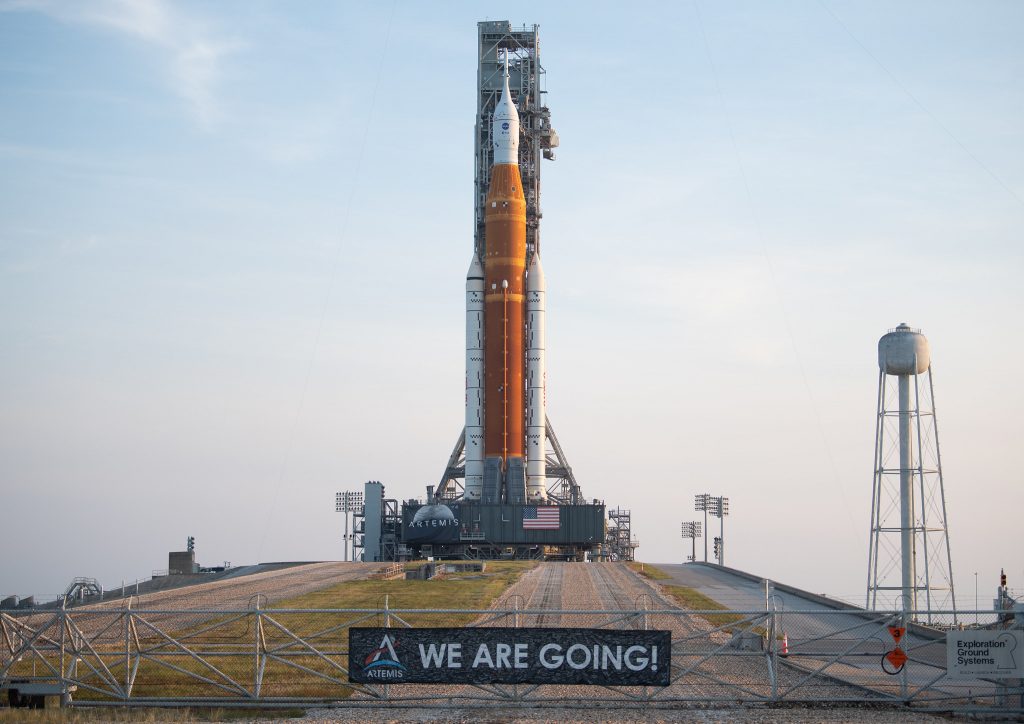
NASA's Artemis I spacecraft arrived at Launch Pad 39B (previously used by Apollo 10 in 1969), at Florida's Kennedy Space Center, on August 17. (Image Source: NASA)

UPDATE 10 (2022 Nov. 8) - NASA is now planning a night-time launch of the Artemis I mission on November 16, with a 2-hour launch window that begins at 1:04 a.m. EST / 6:04 UTC, due to Tropical Storm Nicole which may hit the Florida Space Coast as early on November 9, perhaps as a Category 1 Hurricane.

More Information: Link >>> https://blogs.nasa.gov/artemis/tag/artemis-i/

UPDATE 9 (2022 Oct. 17) - NASA is now planning a night-time launch of the Artemis I mission on November 14, with a 69-minute launch window that begins at 12:07 a.m. EST / 5:07 UTC.

More Information: Link >>> https://blogs.nasa.gov/artemis/tag/artemis-i/

UPDATE 8 (2022 Oct. 1) - NASA is now planning to launch the Artemis I mission within a launch window of November 12 to 27.

More Information: Link >>> https://blogs.nasa.gov/artemis/2022/09/30/teams-confirm-no-damage-to-flight-hardware-focus-on-november-for-launch/

UPDATE 7 (2022 Sept. 26) - Due to the strengthening of Hurricane Ian in the Gulf of Mexico, NASA has decided to move the Space Launch System (SLS) rocket and the Orion space capsule, of the Artemis I mission, back to the Vehicle Assembly Building (VAB) to best protect the rocket and space capsule. It could be several weeks before another launch attempt.

More Information: Link >>> https://blogs.nasa.gov/artemis/2022/09/26/nasa-to-roll-artemis-i-rocket-and-spacecraft-back-to-vab-tonight/

UPDATE 6 (2022 Sept. 24) - NASA has waved-off the September 27 launch of the Artemis I mission, due to the approach of Tropical Storm Ian to Florida. A decision to move the rocket back to the Vehicle Assembly Building (VAB) will be made on September 25. If the Artemis / Space Launch System rocket is moved back to the VAB, it could be several weeks before another launch attempt.

More Information: Link >>> https://blogs.nasa.gov/artemis/2022/09/24/artemis-i-managers-wave-off-sept-27-launch-preparing-for-rollback/ 

UPDATE 5 (2022 Sept. 15) - NASA has adjusted the target launch date for the Artemis I mission to September 27, with October 2 as a back-up date.

More Information: Link >>> https://blogs.nasa.gov/artemis/2022/09/12/nasa-adjusts-dates-for-artemis-i-cryogenic-demonstration-test-and-launch-progress-at-pad-continues/

UPDATE 4 (2022 Sept. 8) - NASA has announced that the Artemis I mission may be launched on September 23 or September 27.

More Information: Link >>> https://spacenews.com/nasa-preparing-for-late-september-artemis-1-launch-attempt/

UPDATE 3 (2022 Sept. 3) - NASA scrubbed the second launch attempt of the Artemis I mission at 11:17 a.m. Eastern Daylight Saving Time (EDT) / 15:17 Coordinated Universal Time (UTC) on Saturday Morning, 2022 September 3; the launch attempt had been scheduled at 2:17 p.m. EDT / 18:17 UTC. Engineers encountered a liquid hydrogen (H) leak while loading the propellant into the Space Launch System rocket's core stage. Multiple troubleshooting efforts to address the leak did not fix the issue.

NASA will probably need to return Artemis I to the Vehicle Assembly Building for inspection and maintenance. This would delay the launch of Artemis I by several weeks, at the least.

More Information: Link >>> https://www.cnn.com/2022/09/03/world/nasa-artemis-1-saturday-launch-scn/index.html

UPDATE 2 (2022 Aug. 31) - NASA announced that the second launch attempt for the Artemis I mission would be Saturday Afternoon, 2022 September 3 at 2:17 p.m. Eastern Daylight Saving Time (EDT) / 18:17 Coordinated Universal Time (UTC). Engineers will start the chill-down procedure for the engines 30-to-45 minutes earlier in the countdown, a procedure that was successful during earlier tests at NASA's  Stennis Space Center in Mississippi.

For Live-stream coverage of Artemis I launch and mission hightlights, Internet Link to NASA-TV located near the end of this blog-post.

More Information: Link >>> https://www.msn.com/en-us/news/technology/take-2-nasa-aims-for-saturday-launch-of-new-moon-rocket/ar-AA11i3VK?ocid=msedgntp&cvid=d9b7ab357bed4aa8b6562703a4d73c43

UPDATE (2022 Aug. 30) - Launch of the historic Artemis I mission was scrubbed by NASA at 8:34 a.m. Eastern Daylight Saving Time (EDT) / 12:34 Coordinated Univeral Time (UTC) on Monday Morning, 2022 August 29. One of the 4 RS-25 Space Launch System (SLS) rocket engines (engine 3) had not cooled to the proper temperature range, in order to allow super-cold propellant to begin flowing through the engine. Each engine must be thermally conditioned for the super-cold propellant, for the engine to operate properly.  Engineers are now evaluating data gathered from the launch attempt, to determine what needs to be done for a future successful launch.

Although no alternative date and time have been confirmed for a second launch attempt, NASA has stated that a launch could take place at the beginning of a 2-hour window beginning at 12:48 p.m. EDT / 16:48 UTC on Friday AfternNASAoon, 2022 September 2.

After Friday, a launch could also take place at the beginning of a 2-hour window beginning at 5:12 p.m. EDT / 21:12 UTC on Labor Day, Monday Afternoon, 2022 September 5.

More Information: Link >>> https://www.msn.com/en-us/news/technology/nasa-scrubs-first-test-flight-of-moon-rocket-after-engine-fault/ar-AA11dVx2?ocid=msedgntp&cvid=442cf21a13027aefd78736e98a39817e

By Glenn A. Walsh

Reporting for SpaceWatchtower

After several delays, the first launch in NASA's Artemis Space Program is scheduled for Monday, Morning. This test mission, called Artemis I, will include no human crew but will fly beyond the Moon before returning to Earth.

Live coverage of the launch and other mission highlights will be provided on NASA Television, the NASA Telephone App, and the NASA Internet Web-site. The launch of Artemis I is currently scheduled at the beginning of the first 2-hour launch window, which opens at 8:33 a.m. Eastern Daylight Saving Time (EDT) / 12:33 Coordinated Universal Time (UTC) on Monday Morning, 2022 August 29. Back-up launch dates are September 2 and September 5.

Internet Link to NASA-TV located near the end of this blog-post.

Currently, meteorologists are studying the potential impact that 3 lightning strikes, yesterday on the launch pad's 2 lightning protection towers, may have on Monday's launch. Electromagnetic environment experts will determine if any constraints on vehicle or ground systems were violated.

Artemis I consists of NASA's new Moon rocket, called the Space Launch System (SLS) and the new Orion space capsule. As a test mission, this mission could end prematurely if major problems are experienced.

We’re going to stress it and test it. We’re going make it do things that we would never do with a crew on it in order to try to make it as safe as possible,” NASA Administrator Bill Nelson told The Associated Press on Wednesday.

The primary mission of Artemis I is a proof-of-coneept mission. NASA states on their Internet Web-site: “The primary goals for Artemis I are to demonstrate Orion’s systems in a spaceflight environment and ensure a safe re-entry, descent, splashdown, and recovery prior to the first flight with crew on Artemis II.”

The Artemis I mission is scheduled to last 42 days, 3 hours, and 20 minutes. In that amount of time, the Orion spacecraft is expected to travel 1.3 million miles / 2.09 kilometers. On the launch pad, the combined Orion space capsule and SLS rocket stand as tall as a 32-story building.

Major payloads aboard Artemis I include 10 small and low-cost Cube-Sat satellites to be deployed during the mission. Also, mannequins will take the place of live crew members in the Orion capsule, including "Captain Moonikin Campos" (named after Arturo Campos, an engineer who played a major role in resolving the emergency that occurred during the Apollo 13 mission), alongside NASA's Snoopy (the famous beagle from the Peanuts comic-strip) and the European Space Agency's Shaun the Sheep. In cooperation with the German Aerospace Center (DLR) and the Israel Space Agency (ISA), a Matroshka AstroRad Radiation Experiment (MARE) will take place during the mission, which will measure tissue radiation doses aboard Artemis 1 and test the effectiveness of the AstroRad radiation vest.

For 6 days, Artemis I will be in a distant retrograde orbit of the Moon. While at one point this orbit will bring the spacecraft within about 60 miles / 96.56 kilometers of the lunar surface, the orbit will also take the spacecraft well beyond the Moon.

The cost of the Artemis I mission is $4 billion. The estimated cost of the Artemis Program up until a possible 2025 lunar landing is $93 billion. This includes cost-over-runs from several years of delays.

The Orion space capsule is designed to hold a maximum of 6 astronauts; but, again, the Artemis I test mission will hold no human crew. Orion is a partially re-usable spacecraft with a Crew Module and an European Service Module. It utilizes solar panels for electrical power, an automated docking system, and glass cockpit interfaces similar to the Boeing 787 Dreamliner jet aircraft.

Orion can be sustained for 21 days while not docked to a space station and can last up to 6 months while docked at a space station. As Artemis I is a test mission and carries no crew, the Orion capsule will actually remain in Outer Space for 6 weeks, to test all aspects of the spacecraft as well as all contingencies.

The Space Launch System (SLS), the heaviest rocket ever produced by NASA, will be the vehicle used to lift the Orion capsule from Earth to the Moon. As NASA's successor to the Space Shuttle, the SLS is meant to be NASA's primary rocket for Deep Space missions with astronauts going to the Moon, Mars, Asteroid Belt, and possibly beyond.

Unlike the Space Shuttle, the Orion spacecraft will return to Earth using parachutes and splashdown in an ocean, as did the Apollo Moon missions. The Artemis I Orion capsule, utilizing a heat shield, is scheduled to splashdown in the Pacific Ocean on Monday, 2022 October 10.

Before astronauts can land on the Moon, a small space station, called the Lunar Gateway, will be placed in orbit around the Moon. The Lunar Gateway Space Station is a cooperative project of NASA, European Space Agency (ESA), Japan Aerospace Exploration Agency (JAXA), and Canadian Space Agency (CSA). As the Lunar Gateway Space Station has yet to be built, Artemis I tests will not include space station dockings.

A solar-powered communications hub, the Lunar Gateway Space Station will serve as a transfer station where astronauts from Earth will transfer to a shuttle-craft for the trek to the Moon's surface. The Lunar Gateway Space Station will also be a short-term habitation module and science laboratory, as well as a holding area for rovers and other robots. Last year, NASA awarded a $2.9 billion contract to Elon Musk's SpaceX, to produce a lunar lander spacecraft for the Artemis III mission.

If all goes well with the. Artemis I mission, astronauts will board Artemis II for a loop around the Moon in 2024. And, if that goes well, Artemis III will land astronauts on the Moon, probably near the Moon's South Pole, at the end of 2025 or in 2026, including the first female astronaut and the first astronaut of-color. 

Internet Link to NASA-TV Live Coverage of Artemis I Launch & Mission:

Link >>> https://www.nasa.gov/nasalive

Internet Links to Additional Information ---

Artemis 1 -

Link 1 (NASA) >>> https://www.nasa.gov/specials/artemis-i/ 

Link 2 >>> https://en.wikipedia.org/wiki/Artemis_1

Orion Space Capsule: Link >>> https://en.wikipedia.org/wiki/Orion_(spacecraft) 

Space Launch System (SLS) Rocket: Link >>> https://en.wikipedia.org/wiki/Space_Launch_System

Lunar Gateway Space Station: Link >>> https://en.wikipedia.org/wiki/Lunar_Gateway 

Related Blog-Posts ---

"Public Comments Due May 31: NASA Plans to Explore Moon & Mars." Mon., 2022 May 23.


"Roll-Out Thur.: NASA's New Moon Rocket / Fly Your Name Around Moon on Artemis I." Tue., 2022 March 15.

Link >>> https://spacewatchtower.blogspot.com/2022/03/roll-out-nasas-new-moon-rocket-thur-fly.html

Source: Glenn A. Walsh Reporting for SpaceWatchtower, a project of Friends of the Zeiss          

               Sunday, 2022 August 28.


                             Like This Post?  Please Share!

           More Astronomy & Science News - SpaceWatchtower Twitter Feed:
            Link >>> https://twitter.com/spacewatchtower

        Astronomy & Science Links: Link >>> http://buhlplanetarium.tripod.com/#sciencelinks

                Want to receive SpaceWatchtower blog posts in your in-box ?
                Send request to < spacewatchtower@planetarium.cc >.

gaw

Glenn A. Walsh, Informal Science Educator & Communicator                                                             (For more than 50 years! - Since Monday Morning, 1972 June 12):
Link >>> http://buhlplanetarium2.tripod.com/weblog/spacewatchtower/gaw/
Electronic Mail: < gawalsh@planetarium.cc >
Project Director, Friends of the Zeiss: Link >>> http://buhlplanetarium.tripod.com/fotz/
SpaceWatchtower Editor / Author: Link >>> http://spacewatchtower.blogspot.com/
Formerly Astronomical Observatory Coordinator & Planetarium Lecturer, original Buhl Planetarium & Institute of Popular Science (a.k.a. Buhl Science Center), Pittsburgh's science & technology museum from 1939 to 1991.
Formerly Trustee, Andrew Carnegie Free Library and Music Hall, Pittsburgh suburb of Carnegie, Pennsylvania.
Author of History Web Sites on the Internet --
* Buhl Planetarium, Pittsburgh: Link >>>  http://www.planetarium.cc  Buhl Observatory: Link >>>  http://spacewatchtower.blogspot.com/2016/11/75th-anniversary-americas-5th-public.html
* Adler Planetarium, Chicago: Link >>> http://adlerplanetarium.tripod.com
* Astronomer, Educator, Optician John A. Brashear: Link >>> http://johnbrashear.tripod.com
* Andrew Carnegie & Carnegie Libraries: Link >>> http://www.andrewcarnegie.cc

* Other Walsh-Authored Blog & Web-Sites: Link >>> https://buhlplanetarium.tripod.com/gawweb.html

Monday, August 8, 2022

Active Perseid Meteor Shower Peaks Fri., Sat.

           https://buhlplanetarium3.tripod.com/CSC-Meteorite.JPG

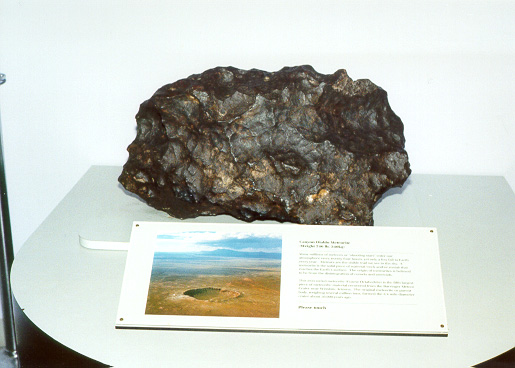
The vast majority of meteors that are visible during meteor showers are usually quite small, even though they often make a bright spectacle when entering Earth's atmosphere. However, some meteors which actually land on Earth, sometimes creating a crater, can be quite large. The above photograph shows the fifth largest fragment of the meteorite which created Meteor Crater near Winslow, Arizona, on public display at Pittsburgh's Carnegie Science Center. Owned by the City of Pittsburgh, this meteorite was originally acquired for, and displayed at, the original Buhl Planetarium and Institute of Popular Science (a.k.a. Buhl Science Center), Pittsburgh's science and technology museum from 1939 to 1991.

More Information: Link >>> https://buhlplanetarium2.tripod.com/Buhlexhibits.htm#meteorite

(Image Source: Friends of the Zeiss' History of Buhl Planetarium Internet Web-site)

By Glenn A. Walsh

Reporting for SpaceWatchtower

The annual Perseid Meteor Shower, which peaks late this week, is considered the best meteor shower of the year by NASA and most astronomers. Although, a near-Full Moon this year will make viewing the dimmer meteors a challenge.

Astronomically, the peak of the Perseid Meteor Shower comes this year during the late-night and early-morning hours of Friday and Saturday, 2022 August 12 and 13. The best time to watch most meteor showers, including this year's Perseids, is always between local midnight and dawn, when the Earth is rotating into the meteor shower.

So, the best time to view this year's Perseid Meteor Shower is late Thursday night / early Friday morning and late Friday night / early Saturday morning. It is possible this peak of the Perseids could stretch into late Saturday night / early Sunday morning.

At the peak time, sometimes up-to 50-to-100 meteors could possibly be seen per-hour, if observing conditions are ideal. Depending on your location (including elevation and number of obstructions to sky viewing, such as hills, trees, and buildings), weather conditions, Moon phase, and the condition of your eye-sight, seeing 40-to-60 meteors per-hour would be more likely.

As most meteors are often dim, it is best to view a meteor shower away from city lights, which cause a brightening of the sky at night, and hence, the dimmest meteors are often missed. And, you want to go out ahead of time, before you start actual viewing of meteors, to get your eyes accustomed to the dark sky. Dark-adapting your eyes for meteor watching could take up-to one half-hour.

Also, after your eyes are dark-adapted, do not look at your cellular telephone while looking for meteors. The light you see from your telephone could disrupt your dark-adapted night-vision.

For the peak of the Perseid Meteor Shower this year, the Moon will have just passed the bright Full Moon Phase. Hence, the dimmer meteors will be more challenging to find in a sky brightened by Moon-light.

The Moon will have passed the Primary Lunar Phase of Full Moon on Thursday Evening, 2022 August 11 at 9:36 p.m. Eastern Daylight Saving Time (EDT) / Friday Morning, 2022 August 12 at 1:36 Coordinated Universal Time (UTC). So,reflected sunlight from the Moon could obscure the dimmer meteors. Try not to look directly at the Moon, so it does not hinder your dark-adapted eye-sight.

Actually, some meteors from the Perseid Meteor Shower can be seen as early as mid-July and as late as late August (~July 17 to August 24); but they are few and far-between. Most Perseid meteors can be seen three-to-five days before and three-to-five days after the peak time, which is considered, approximately, between August 9 and 14 each year; again, the absolute peak is August 11 to 13.

Viewers in the Northern Hemisphere are fortunate that the Perseid Meteor Shower arrives during the Summer month of August, when temperatures are comfortable for night-time viewing. However, some locations (such as in the mountains) could be cooler in the early-morning hours. So, be sure to check your local weather forecast (with NOAA Weather-Radio, local forecasts on radio, television or local newspapers, Internet, or your smart-telephone or smart-speaker) and bring a sweater or jacket with you if your location has a cooler weather forecast.

Be aware that sometimes August can be very humid with poor seeing conditions. And, the closer to the horizon, the worse the seeing conditions could be.

Binoculars and telescopes are not very useful for finding meteors. Meteors streak across the sky in a very brief period of time, too short to aim binoculars or a telescope. So, the best way to view a meteor shower is to lie on the ground (perhaps on a blanket, sheet, or beach-towel—or possibly in a reclining beach or lawn-chair), in an area with a good view of the entire sky (with few obstructions such as buildings, trees, or hills, perhaps at a higher elevation), and keep scanning the entire sky with your naked-eyes (one-power).

Meteor showers appear to emanate from a radiant point in the sky. For the Perseid Meteor Shower, the radiant appears to be within the Constellation Perseus, named for the hero of Greek mythology (hence, the name Perseid Meteor Shower). However, you should not, necessarily, be looking only at Perseus, when looking for meteors in this shower.

Meteors can appear in any part of the sky at any time. In fact, looking towards Perseus may not result in finding the best meteors, as meteors coming from the apparent radiant may be seen for a shorter time in the sky, with much shorter sky streaks.

A meteor shower normally consists of dust particles related to a comet. Each time a comet approaches the Sun, the comet loses dust particles following the melting of ice on the comet. These dust particles, called meteoroids, continue to follow the same orbit as the comet and form a meteoroid stream. Each year, as the Earth orbits the Sun, the Earth passes through several of these meteoroid streams, becoming Earth's meteor showers.

The Earth's gravity then attracts many of these meteoroids to fall to Earth, and they are viewed by people as meteors, as they burn-up, often high in the atmosphere. Most are extremely small and burn-up completely. From time-to-time, larger particles enter the atmosphere and create brilliant displays known as fire-balls or bolides. If these particles are large enough, they may not completely burn-up and land on Earth as a meteorite, perhaps even creating a crater on Earth if the meteorite is large and heavy enough.

Many museums and science centers display meteorites to the general public. From 1939 to 1991, the original Buhl Planetarium and Institute of Popular Science (a.k.a. Buhl Science Center - Pittsburgh's science and technology museum from 1939 to 1991) displayed the fifth largest fragment of the meteorite that formed Barringer Meteor Crater near Winslow, Arizona. Owned by the City of Pittsburgh, this large meteorite is now displayed on the second floor of Pittsburgh's Carnegie Science Center, outside the entrance to the Henry Buhl, Jr. Planetarium. Meteorites are also on display in the Hillman Hall of Minerals and Gems at Pittsburgh's Carnegie Museum of Natural History.

Meteors can be seen any night of the year, although they are not predictable and are rare outside of one of the annual meteor showers. The vast majority of meteors that can be seen during the Perseid Meteor Shower originate from Comet Swift-Tuttle, which has an orbital period of 133 years, leaving behind a trail of dust and grit. Comet Swift-Tuttle was discovered in 1862 and last returned for Earth viewing in 1992.

Comet Swift-Tuttle measures about 16 statute miles / 25 kilometers across, much larger than the object that is thought to have fallen to Earth which resulted in the extinction of the dinosaurs (about 6 statute miles / 10 kilometers across) approximately 66 million years ago (after the dinosaurs had lived on Earth for about 165 million years!).

Comet Swift-Tuttle will make a very close approach to the Earth in the year A.D. 4479. Scientists are now studying whether some day Comet Swift-Tuttle could impact the Earth. Comet Swift–Tuttle has been described as "the single most dangerous object known to humanity".

There are two additional meteor showers, which both peaked at the end of July, with some meteors still visible in mid-August.

The Southern Delta Aquariid meteor shower peaked at 8:00 a.m. EDT / 12:00 UTC on Sunday Morning, 2022 July 30; these meteors are visible each year between July 12 and August 23. It is not certain which comet originated the Southern Delta Aquariids. This is considered a strong meteor shower, with 15-to-20 meteors visible per-hour, around the peak of shower; fewer would now be visible per-hour.

The evening of 2022 July 29 / early-morning of July 30 saw the peak of the Alpha Capracornid meteor shower. The official peak also occurred around 8:00 a.m. EDT / 12:00 UTC on Sunday Morning, 2022 July 30. At the peak time, 5 meteors per-hour are expected, making the Alpha Capracornids a minor meteor shower; of course, now there would be fewer Alpha Capracornids visible per-hour. The Alpha Capracornids, which originated as remnants of Comet 169P / NEAT, are visible each year from July 3 to August 15.

Another minor meteor shower may be visible to some between August 28 and September 5 each year; the peak is expected August 31 / September 1. The peak for this meteor shower is about 5:00 a.m. EDT / 9:00 UTC on Thursday Morning, 2022 September 1. The Aurigid Meteor Shower is believed to have originated as remnants of Comet Kless (C / 1911 N1). Astronomers do not know the composition of this meteoric debris. So, it is uncertain how the meteors from this shower may interact with the Earth's atmosphere, and hence, scientists are unsure how visible this shower may be each year.

So in mid-August, the time for viewing is right. And, of course, with the warm weather most of us experience in the Northern Hemisphere, this time of year, what could be better for viewing meteors?

Of course, meteor showers, like all celestial observations, are weather-permitting. Even a few clouds could obscure quite a few meteors.

If the weather in your area does not permit direct viewing of this meteor shower outdoors, it is possible (but not guaranteed) you may be able to use Google, Yahoo, Bing, Lycos, or your favorite Internet search engine to find special, Live-stream Web-casts of the meteor shower at one or more sites on the Internet.

A cautionary note for those who find it necessary to watch the meteor shower on the Internet. The video camera, used for each Live-stream Web-cast, can only aim at one part of the sky at a time. Hence, do not expect to see as many meteors as you might see with your own eyes outside. Outdoors, you can easily scan the entire sky for meteors, while a camera aimed at one area of the sky will only be able to see the meteors that enter that particular field-of-view.

Internet Links  to Additional Information ----

Perseid Meteor Shower: Link >>> https://en.wikipedia.org/wiki/Perseids

Comet Swift-Tuttle: Link >>> https://en.wikipedia.org/wiki/Comet_Swift%E2%80%93Tuttle

Constellation Perseus: Link >>> https://en.wikipedia.org/wiki/Perseus_%28constellation%29

South Delta Aquariid Meteor Shower: Link >>>  https://en.wikipedia.org/wiki/Southern_Delta_Aquariids 

Alpha Capracornid Meteor Shower: Link >>> https://en.wikipedia.org/wiki/Alpha_Capricornids 

Aurigid Meteor Shower:

Link 1 >>> https://astronomyforbeginners.wordpress.com/2007/08/24/aurigid-meteor-shower-astronomy-for-beginners/ 

Link 2 >>> https://en.wikipedia.org/wiki/Aurigids

Meteor Shower: Link >>> https://en.wikipedia.org/wiki/Meteor_shower

Meteor: Link >>> https://en.wikipedia.org/wiki/Meteoroid#Meteor

Meteoroid: Link >>> https://en.wikipedia.org/wiki/Meteoroid

Meteorite: Link >>> https://en.wikipedia.org/wiki/Meteoroid#Meteorites

Fifth largest fragment of the meteorite which struck Barringer Meteor Crater near Winslow, Arizona, which was displayed (1939 to 1991) at the original Buhl Planetarium and Institute of Popular Science (a.k.a. Buhl Science Center), Pittsburgh's science and technology museum from 1939 to 1991. Today, this meteorite is displayed on the second floor of Pittsburgh's Carnegie Science Center, next to the Henry Buhl, Jr. Planetarium:
Link >>> http://buhlplanetarium2.tripod.com/Buhlexhibits.htm#meteorite

Related Blog-Posts ---

Perseid Meteor Shower Peaks Wed., Thur." Mon., 2021 Aug. 9.

Link >>> http://spacewatchtower.blogspot.com/2021/08/perseid-meteor-shower-peaks-wed-thur.html


Annual Perseid Meteor Shower Peaks Tue. Night / Early Wed. Morning." Mon., 2020 Aug. 10.

Link >>> http://spacewatchtower.blogspot.com/2020/08/annual-perseid-meteor-shower-peaks-tue.html 


"Tonight's 'Meteor Outburst' w/Web-Casts: 150 Years After Comet-Meteor Shower Link Found." Thur., 2016 Aug. 11.

Link >>> https://spacewatchtower.blogspot.com/2016/08/tonights-meteor-outburst-wweb-casts-150.html


"Great Perseid Meteor Shower Peaks Wed. Night w/ Web-Casts." Wed., 2015 Aug. 12.

Link >>> https://spacewatchtower.blogspot.com/2015/08/great-perseid-meteor-shower-peaks-wed.html


"Perseid Meteor Shower Peaks in Sky & Web-Casts." Tue., 2014 Aug. 12.

Link >>> https://spacewatchtower.blogspot.com/2014/08/perseid-meteor-shower-peaks-in-sky-web.html


"Perseid Meteor Shower Peaks Sun., Mon. Nights." Sat., 2013 Aug. 10.

Link >>> https://spacewatchtower.blogspot.com/2013/08/perseid-meteor-shower-peaks-sun-mon.html

Source: Glenn A. Walsh Reporting for SpaceWatchtower, a project of Friends of the Zeiss          

               Monday, 2022 August 8.


                             Like This Post?  Please Share!

           More Astronomy & Science News - SpaceWatchtower Twitter Feed:
            Link >>> https://twitter.com/spacewatchtower

        Astronomy & Science Links: Link >>> http://buhlplanetarium.tripod.com/#sciencelinks

                Want to receive SpaceWatchtower blog posts in your in-box ?
                Send request to < spacewatchtower@planetarium.cc >.

gaw

Glenn A. Walsh, Informal Science Educator & Communicator                                                             (For more than 50 years! - Since Monday Morning, 1972 June 12):
Link >>> http://buhlplanetarium2.tripod.com/weblog/spacewatchtower/gaw/
Electronic Mail: < gawalsh@planetarium.cc >
Project Director, Friends of the Zeiss: Link >>> http://buhlplanetarium.tripod.com/fotz/
SpaceWatchtower Editor / Author: Link >>> http://spacewatchtower.blogspot.com/
Formerly Astronomical Observatory Coordinator & Planetarium Lecturer, original Buhl Planetarium & Institute of Popular Science (a.k.a. Buhl Science Center), Pittsburgh's science & technology museum from 1939 to 1991.
Formerly Trustee, Andrew Carnegie Free Library and Music Hall, Pittsburgh suburb of Carnegie, Pennsylvania.
Author of History Web Sites on the Internet --
* Buhl Planetarium, Pittsburgh: Link >>>  http://www.planetarium.cc  Buhl Observatory: Link >>>  http://spacewatchtower.blogspot.com/2016/11/75th-anniversary-americas-5th-public.html
* Adler Planetarium, Chicago: Link >>> http://adlerplanetarium.tripod.com
* Astronomer, Educator, Optician John A. Brashear: Link >>> http://johnbrashear.tripod.com
* Andrew Carnegie & Carnegie Libraries: Link >>> http://www.andrewcarnegie.cc

* Other Walsh-Authored Blog & Web-Sites: Link >>> https://buhlplanetarium.tripod.com/gawweb.html
Wednesday, July 27, 2022

Citizen Science: Help NASA Find Martian Clouds & Exo-Planets


Clouds drifting over “Mont Mercou,” a cliff face on Mars studied by the NASA Curiosity Mars Rover. This is a combination of several images, color-corrected, from just after sunset on 2021 March 19. 
 (Image Sources: NASA, Jet Propulsion Laboratory, California Institute of Technology)

By Glenn A. Walsh

Reporting for SpaceWatchtower

Two Citizen Science projects, recently announced by NASA, could help scientists find clouds on Mars and find planets orbiting other stars. And, prizes are even being offered for successful submissions in the Exo-planet search project!

Cloudspotting on Mars

Using the Citizen Science Platform Zooniverse, the new Citizen Science project Cloudspotting on Mars could help scientists understand a fundamental mystery about Mars’ atmosphere: according to a NASA news release, “why the planet’s (Mars) atmosphere is just 1% as dense as Earth’s even though ample evidence suggests the planet (Mars) used to have a much thicker atmosphere...”

“The air pressure is so low that liquid water simply vaporizes from the planet’s surface into the atmosphere. But billions of years ago, lakes and rivers covered Mars, suggesting the atmosphere must have been thicker then.”

NASA asks members of the general public to sort through data collected by NASA's Mars Reconnaissance Orbiter (MRO) to identify Martian clouds. Like Earth, Mars has clouds made of water-ice (H2O).

But, due to the much colder environment, Mars also has clouds composed of carbon dioxide (CO2 – similar to “dry ice”). By learning more about how all of these clouds form, scientists hope to better understand the structure of the Martian atmosphere.

We want to learn what triggers the formation of clouds – especially water ice clouds, which could teach us how high water vapor gets in the atmosphere – and during which seasons,” said Marek Slipski, a postdoctoral researcher at NASA’s Jet Propulsion Laboratory (JPL) in Pasadena, California.

Using 16 years of data, compiled by the Climate Sounder instrument (which studies the atmosphere in infrared light) aboard the Mars Reconnaissance Orbiter spacecraft, Citizen Scientists are best equipped to identify the significant cloud “arches” in the data. While scientists have tried using computer algorithms to identify these cloud arches, they have found that it is much easier, and more reliable, for humans to spot the Martian cloud arches data by eye.

Go to the following Internet link to find out how you can participate in the Cloudspotting on Mars project:

Link >>> https://www.zooniverse.org/projects/marek-slipski/cloudspotting-on-mars/classify

Ultralight Starshade Structural Design Challenge

This is a different type of Citizen Science project. And, the top five submissions will share a prize purse of $7,000!

With the great success of the Sun-shield on the James Webb Space Telescope, NASA is now looking for ways to extend such protection to Earth-bound telescopes. In this case, the Earth-bound telescopes would be shaded from light coming from distant stars, in the hope that the much dimmer light from planets circling those stars could be found.

The Hybrid Observatory for Earth-like Exo-planets (HOEE) project would reinvigorate ground-based telescopes, which may have been considered inferior to the new space telescopes that have been launched in recent decades. An Ultralight Starshade, launched into Earth orbit, would be a key component to making such Hybrid Observatory system a reality.

According to a NASA news release: “The Ultralight Starshade Structural Design Challenge asks participants to develop a lightweight starshade structure that could be used as part of the HOEE concept. The ideal design would allow for compact packaging and successful deployment once in its Earth orbit. It must also have the lowest possible mass so that chemical thrusters can keep it aligned during observations and propulsion systems can change its orbit to observe different targets – all while using as little fuel as possible.”

The hybrid observatory might help us answer some of the most pressing questions about extraterrestrial life,” said Dr. John Mather, senior astrophysicist at NASA’s Goddard Space Flight Center in Greenbelt, Maryland, and senior project scientist for the James Webb Space Telescope. “Observing many systems would help answer the question of why configurations like our own are rare and why none is quite like home. It is truly exciting that the public can be part of this revolutionary effort. I can’t wait to see what ideas they bring to the table.”

As previously mentioned, the Ultralight Starshade Structural Design Challenge has a combined prize purse of $7,000. The individual prizes are:

First Place - $3,000

Second Place - $2,000

Third Place - $1,000

Fourth Place - $750

Fifth Place - $250

The DEADLINE to submit an entry in the Ultralight Starshade Structural Design Challenge is Monday Evening, 2022 August 22 at 11:59 p.m. Eastern Daylight Saving Time (EDT) / Tuesday Morning, 2022 August 23 at 3:59 Coordinated Universal Time (UTC).

Challenge finalists will be announced on 2022 August 29. The 5 winners will be announced on 2022 September 5.

Go to the following Internet link to find out how you can submit an entry in the Ultralight Starshade Structural Design Challenge:

Link >>> https://grabcad.com/challenges/nasa-challenge-ultralight-starshade-structural-design

Internet Links to Additional Information ---

NASA News Release - "Help NASA Scientists Find Clouds on Mars"

Link >>> https://www.nasa.gov/feature/jpl/help-nasa-scientists-find-clouds-on-mars

NASA News Release - "NASA Seeks Public's Designs to Throw Shade in Space"

Link >>> https://www.nasa.gov/feature/nasa-seeks-public-s-designs-to-throw-shade-in-space

Mars: Link >>> https://en.wikipedia.org/wiki/Mars

Mars Reconnaissance Orbiter -

Link 1 >>> https://mars.nasa.gov/mro/

Link 2 >>> https://en.wikipedia.org/wiki/Mars_Reconnaissance_Orbiter

Exo-Planet: Link >>> https://en.wikipedia.org/wiki/Exoplanet

Hybrid Observatory for Earth-like Exo-planets (HOEE):

Link >>> https://www.nasa.gov/directorates/spacetech/niac/2022/Hybrid_Observatory_for_Earth_like_Exoplanets/

Source: Glenn A. Walsh Reporting for SpaceWatchtower, a project of Friends of the Zeiss          

               Wednesday, 2022 July 27.


                             Like This Post?  Please Share!

           More Astronomy & Science News - SpaceWatchtower Twitter Feed:
            Link >>> https://twitter.com/spacewatchtower

        Astronomy & Science Links: Link >>> http://buhlplanetarium.tripod.com/#sciencelinks

                Want to receive SpaceWatchtower blog posts in your in-box ?
                Send request to < spacewatchtower@planetarium.cc >.

gaw

Glenn A. Walsh, Informal Science Educator & Communicator                                                             (For more than 50 years! - Since Monday Morning, 1972 June 12):
Link >>> http://buhlplanetarium2.tripod.com/weblog/spacewatchtower/gaw/
Electronic Mail: < gawalsh@planetarium.cc >
Project Director, Friends of the Zeiss: Link >>> http://buhlplanetarium.tripod.com/fotz/
SpaceWatchtower Editor / Author: Link >>> http://spacewatchtower.blogspot.com/
Formerly Astronomical Observatory Coordinator & Planetarium Lecturer, original Buhl Planetarium & Institute of Popular Science (a.k.a. Buhl Science Center), Pittsburgh's science & technology museum from 1939 to 1991.
Formerly Trustee, Andrew Carnegie Free Library and Music Hall, Pittsburgh suburb of Carnegie, Pennsylvania.
Author of History Web Sites on the Internet --
* Buhl Planetarium, Pittsburgh: Link >>>  http://www.planetarium.cc  Buhl Observatory: Link >>>  http://spacewatchtower.blogspot.com/2016/11/75th-anniversary-americas-5th-public.html
* Adler Planetarium, Chicago: Link >>> http://adlerplanetarium.tripod.com
* Astronomer, Educator, Optician John A. Brashear: Link >>> http://johnbrashear.tripod.com
* Andrew Carnegie & Carnegie Libraries: Link >>> http://www.andrewcarnegie.cc

* Other Walsh-Authored Blog & Web-Sites: Link >>> https://buhlplanetarium.tripod.com/gawweb.html

Tuesday, July 19, 2022

NASA Delays VIPER Moon Rover Launch to 2024

Artist's rendering of what the NASA VIPER Rover would look like during lunar night. (Image Sources: NASA, Wikipedia.org, By NASA - https://www.nasa.gov/feature/new-viper-lunar-rover-to-map-water-ice-on-the-moon, Public Domain, https://commons.wikimedia.org/w/index.php?curid=83402525)

By Glenn A. Walsh

Reporting for SpaceWatchtower

Monday (2022 July 18), NASA announced a one-year delay in the launch of the VIPER Rover, that would search for water-ice in craters near the Moon's South Pole. NASA has ordered additional tests on the Moon Lander, called Griffin. Both VIPER and Griffin are manufactured by Astrobotic Technology of Pittsburgh.

Originally scheduled for launch in November of 2023, VIPER and Griffin are now scheduled for launch in November of 2024. They will be launched aboard a SpaceX Falcon Heavy rocket. The VIPER mission is part of NASA's Commercial Lunar Payload Services (CLPS) initiative.

NASA requested the one year delay in the VIPER mission, to allow additional ground testing of the Griffin Lunar Lander. The additional testing is to reduce the risks to the VIPER mission, by this completely new lander spacecraft. Consequently, NASA will provide Astrobotic with an additional $67.8 million , for a new total project cost of  $320.4 million.

Earlier this month, NASA briefly lost contact with another mission headed toward the Moon. The CAPSTONE lunar orbiter (a 12-unit cubsat launched by private company Rocket Lab) will test and verify the lunar orbital stability, in anticipation of the planned Lunar Gateway Space Station (which will be used by astronauts on their way to the Moon). After losing contact with CAPSTONE for one day, on July 5, NASA officials may want to be even more careful with the much larger and more expensive VIPER.

Through CLPS, NASA has tasked U.S. companies to perform a very challenging technological feat – to successfully land and operate on the Moon,” said Joel Kearns, deputy associate administrator for exploration in NASA's Science Mission Directorate in Washington, in a news release. “VIPER is NASA’s largest and most sophisticated science payload to be delivered to the Moon through CLPS, and we've implemented enhanced lander testing for this particular CLPS surface delivery.”

NASA considers VIPER, as well as other CLPS missions, as a fundamental part of the mission to send men and women back to the Moon via the Artemis spacecraft. CLPS payloads will provide the foundation of information needed to explore the Moon and environs.

The primary mission of VIPER (Volatiles Investigating Polar Exploration Rover) is to prospect for resources at and near the Moon's South Pole. In particular, VIPER will be looking for water-ice that may be found in areas of craters which are permanently shaded from sunlight. Future missions could use such water (H2O) for drinking, producing oxygen (O2), and rocket fuel.

The South Pole of the Moon has been a great interest to NASA, ever since it was determined that water-ice may exist in the permanently shaded areas of craters in or near the South Pole. However, even after the completion of the first manned missions to the Moon, a lot was still unknown about the Moon's South Pole.

About 40 years ago, American Lunar Society Founder Francis G. Graham (today he is Professor Emeritus of Physics at Kent State University) participated in a national research project to better map the area near the Moon's South Pole. As part of the project, he took photographs of the Moon's South Pole area using the historic 10-inch Siderostat-type Refractor Telescope at the original Buhl Planetarium and Institute of Popular Science (a.k.a. Buhl Science Center), Pittsburgh's science and technology museum from 1939 to 1991.

Later this year, Astrobotic will be launching another mission to the Moon. Iris, a small rover built by Pittsburgh's Carnegie Mellon University (CMU), will be the smallest, first American, first university-built, and first student-built rover on the Earth's Moon.

A commercial spin-off from CMU, Astrobotic will open a Moonshot Museum on Pittsburgh's Lower North Side in October. This new museum will be located adjacent to Astrobotic's manufacturing facility. In addition to STEM (Science, Technology, Engineering, and Mathematics) education for young people, this museum will allow the general public to watch Moon rovers being constructed.


Internet Links to Additional Information ---

NASA VIPER Rover -

NASA CAPSTONE Lunar Orbiter: Link >>> https://en.wikipedia.org/wiki/CAPSTONE
 
NASA Lunar Gateway Space Station: Link >>> https://en.wikipedia.org/wiki/Lunar_Gateway

NASA Artemis Program: Link >>> https://en.wikipedia.org/wiki/Artemis_program

Related Blog-Posts ---

"CMU to Build 1st Univ.-Based Space Mission Control." Mon., 2022 April 18.


"Library to be Established on the Moon !" Mon., 2018 May 21.

Source: Glenn A. Walsh Reporting for SpaceWatchtower, a project of Friends of the Zeiss          

               Tuesday, 2022 July 19.


                             Like This Post?  Please Share!

           More Astronomy & Science News - SpaceWatchtower Twitter Feed:
            Link >>> https://twitter.com/spacewatchtower

        Astronomy & Science Links: Link >>> http://buhlplanetarium.tripod.com/#sciencelinks

                Want to receive SpaceWatchtower blog posts in your in-box ?
                Send request to < spacewatchtower@planetarium.cc >.

gaw

Glenn A. Walsh, Informal Science Educator & Communicator                                                             (For more than 50 years! - Since Monday Morning, 1972 June 12):
Link >>> http://buhlplanetarium2.tripod.com/weblog/spacewatchtower/gaw/
Electronic Mail: < gawalsh@planetarium.cc >
Project Director, Friends of the Zeiss: Link >>> http://buhlplanetarium.tripod.com/fotz/
SpaceWatchtower Editor / Author: Link >>> http://spacewatchtower.blogspot.com/
Formerly Astronomical Observatory Coordinator & Planetarium Lecturer, original Buhl Planetarium & Institute of Popular Science (a.k.a. Buhl Science Center), Pittsburgh's science & technology museum from 1939 to 1991.
Formerly Trustee, Andrew Carnegie Free Library and Music Hall, Pittsburgh suburb of Carnegie, Pennsylvania.
Author of History Web Sites on the Internet --
* Buhl Planetarium, Pittsburgh: Link >>>  http://www.planetarium.cc  Buhl Observatory: Link >>>  http://spacewatchtower.blogspot.com/2016/11/75th-anniversary-americas-5th-public.html
* Adler Planetarium, Chicago: Link >>> http://adlerplanetarium.tripod.com
* Astronomer, Educator, Optician John A. Brashear: Link >>> http://johnbrashear.tripod.com
* Andrew Carnegie & Carnegie Libraries: Link >>> http://www.andrewcarnegie.cc

* Other Walsh-Authored Blog & Web-Sites: Link >>> https://buhlplanetarium.tripod.com/gawweb.html

Thursday, July 14, 2022

1st James Webb Space Telescope Images Released by NASA

an undulating, translucent star-forming region in the Carina Nebula is shown in this Webb image, hued in ambers and blues; foreground stars with diffraction spikes can be seen, as can a speckling of background points of light through the cloudy nebula

This stunning, infra-red image of the Carina Nebula was one of the first images received from the newly-activated James Webb Space Telescope (JWST). This huge, swirling cloud of dust and gas is both a stellar nursery and home to some of the brightest and most active stars in the Milky Way Galaxy. (Image Sources: NASA, European Space Agency, Canadian Space Agency, Space Telescope Science Institute)

By Glenn A. Walsh

Reporting for SpaceWatchtower

This week, NASA has released the first full-color images from the new James Webb Space Telescope (JWST).

The James Webb Space Telescope (JWST), which is much larger than the Hubble Space Telescope, is designed to seek stars and galaxies shortly after the “Big Bang”, the creation of our Universe approximately 13.8 billion years ago. The Hubble Space Telescope (HST), along with most traditional terrestrial telescopes, observe using visible light. The JWST is designed to use the infrared portion of the electromagnetic spectrum to search where visible light telescopes cannot.

The scientists have been pleasantly surprised at how well the JWST is operating, with some gorgeous first images, including the image of the Carina Nebula at the beginning of this blog-post.

Internet links to additional First Images from the James Webb Space Telescope are located near the end of this blog-post.

As one NASA scientist, Jane Rigby, put it at a Tuesday news conference: I had the very emotional reaction of ‘Oh my goodness, it works. And it works better than we thought.” Astrophysicist Jane Rigby works at the Goddard Space Flight Center in Greenbelt, Maryland and is Operations Project Scientist for the JWST.

In addition to the images released to the public, 13 research projects have already begun using JWST. This research ranges from objects in our own Solar System to exo-planets (planets orbiting other stars), the evolution of stars, black holes, and galaxies, and intergalactic space.

JWST has already made one discovery regarding exo-planet WASP-96b, which was not made with ground-based telescopes or with the Hubble Space Telescope. Scientists at the Space Telescope Science Institute in Baltimore were quite surprised when the readings from JWST indicated that this exo-planet has water, probably water vapor in the atmosphere as it is very close to its host star. There was also evidence of clouds in the atmosphere. The study of exo-planet atmospheres was included in the design of JWST.

Due to the very close proximity of exo-planet WASP-96b to its host star, the planet is unlikely to have any life. However, exo-planets that might be life-bearing candidates will likely be found in the future with JWST, even if life on a particular planet cannot be proven at such a great distance.

One minor disappointment was when scientists realized that one of the hexagonal mirrors had been damaged more than expected by a micro-meteoroid strike in late May. NASA officials have taken steps to ensure that the distortion from the damaged mirror is barely noticeable. NASA is considering what other steps can be taken to ameliorate the cosmic dust and micro-meteoroids that are encountered by JWST.

Over the last few decades, NASA has had much success with the Space Shuttle, International Space Station, Hubble Space Telescope (albeit, after an optics correction), several missions to Mars, and the New Horizons mission to Pluto and beyond. The James Webb Space Telescope took a lot of time to construct at a pretty hefty price tag, but NASA got it right again! The James Webb Space Telescope will provide new scientific information and discoveries, paid for by American, European, and Canadian taxpayers and freely given-away for the benefit of all human-kind!

More About the Telescope

JWST is the largest space telescope ever launched. With a primary mirror size of 21.3 feet / 6.5 meters, it is much larger than the HST primary mirror: 7.8 feet / 2.4 meters.

The JWST mirror is comprised of 18 gold-plated beryllium, hexagonal segments. A 5-layer Sun-shield, the size of a tennis court, protects the mirror from any heat radiated by the Sun, Earth, or Moon. Made of silicon and aluminum-coated Kapton, this Sun-shield should keep the JWST primary mirror and related instruments at a temperature no higher than 50 degrees Kelvin / -370 degrees Fahrenheit / -223 degrees Celsius. To search for the earliest galaxies and stars in the Universe, using infrared, the telescope mirror must be extremely cold and shielded from heat.

After the 2021 Christmas morning launch of JWST, the telescope traveled 930,000 statute miles / 1.5 million kilometers from Earth to a point in Deep Space known as L2. L2 is the second Lagrange Point of the Earth – Sun system. A Lagrange Point is a site where the gravity between two large bodies, in this case the Earth and the Sun, is relatively balanced; satellites can stay at such a point with minimum energy usage. It is a point in Deep Space where the JWST can remain, somewhat easily, in an orbit and away from the heat of the Earth and the Sun.

The JWST mission has four key goals:

  • Search for light from the very first stars and galaxies that formed in our Universe, shortly after the Big Bang. The Universe is estimated to be about 13.8 billion years old; JWST is expected to find light from stars and galaxies approximately 13.5 billion years in the past (13.5 billion light-years from Earth).

  • Study the formation and evolution of galaxies.

  • Study the formation of stars and planetary systems..

  • Further study planetary systems, looking for the origins of life.

The Hubble and James Webb space telescopes are different in mission duration. The Hubble Space Telescope has had the advantage of being in a close Earth orbit, where Space Shuttle astronauts have been able to service and upgrade the telescope. With the conclusion of the Space Shuttle program, the ability to service and upgrade the HST seems to have ended. As the HST is now, it is expected to last until some tine in the 2030s.

The JWST, being placed much further away from the Earth, cannot be serviced or upgraded by current space technology. To stay at the L2 orbital site, which is a somewhat unstable orbit, rocket propellant must be used. JWST has 10 years of rocket propellant on-board, to maintain the L2 configuration of the telescope. So, 10 years is the upper limit of the mission duration.

The nominal science mission is officially 5 years, with the hope that the telescope can continue to be used for research for 10 years. Once the JWST spacecraft reached L2, there was a 6-month commissioning phase, before the official science mission began. The commissioning phase included the careful, and very risky, unfolding of the huge telescope mirror, very crucial Sun-shield, and related instruments.

The JWST is named after James Webb, the second Administrator of NASA. James Webb ran NASA from February of 1961 until October of 1968, for seven years retiring just before the first manned flight of the Apollo spacecraft.

He was in charge of NASA during all Mercury and Gemini flights. And, he was Administrator during the investigation of the tragic fire, which killed three astronauts, during a ground test of the Apollo 1 spacecraft on Friday, 1967 January 27.

The James Webb Space Telescope, originally designed to cost $1 billion to $3.5 billion, had many cost over-runs, throughout the many years of development and delays. With the launch of JWST, the final cost of the project was $10 billion.

More than 30 years ago, even before the 1990 launch of the Hubble Space Telescope, planning had begun on JWST. Construction of JWST began in 2004, after having been named to honor James Webb in 2002.

In 1993, when the U.S. Congress killed the Superconducting Super Collider project for particle physics in Texas, scientists had feared the same thing would happen to JWST. But, former U.S. Senator Barbara Mikulski (D-Md.) helped to save JWST at that time.

The launch of JWST had been expected some time between 2007 and 2011. Due to continual cost over-runs, the launch kept being delayed. In 2011, the U.S. House of Representatives voted to cancel the JWST project, due to the continual cost over-runs. Scientists and space enthusiasts, including teachers and school children, successfully rallied to save the project.

As it took many years to develop and construct the JWST, planning for the next great space telescope has just begun. In November, a committee convened by the independent National Academies of Sciences, Engineering, and Medicine has recommended that another huge space telescope should be designed and built to study exo-planets (planets orbiting stars other than our Sun) and search for signs of life. It is projected that this new telescope would be launched some time in the 2040s.

 First Images from JWST: Link >>> https://www.nasa.gov/webbfirstimages

 NASA Gallery of More First Images from JWST: Link >>> https://webbtelescope.org/news/first-images/gallery

Internet Links to Additional Information ---

James Webb Space Telescope (JWST) -

Link 1 >>> https://jwst.nasa.gov/

Link 2 >>> https://www.nasa.gov/mission_pages/webb/main/index.html 

Link 3 >>> https://en.wikipedia.org/wiki/James_Webb_Space_Telescope

L2 - Second Lagrange Point in Earth - Sun System: 

Link >>> https://en.wikipedia.org/wiki/Lagrange_point#L2 

 Related Blog-Post ---

"Finally! Live-Stream: Christmas Launch of Next Great Space Telescop." Fri., 2021 Dec. 24.

Link >>> https://spacewatchtower.blogspot.com/2021/12/finally-live-stream-christmas-launch-of.html

Source: Glenn A. Walsh Reporting for SpaceWatchtower, a project of Friends of the Zeiss          

               Thursday, 2022 July 14.


                             Like This Post?  Please Share!

           More Astronomy & Science News - SpaceWatchtower Twitter Feed:
            Link >>> https://twitter.com/spacewatchtower

        Astronomy & Science Links: Link >>> http://buhlplanetarium.tripod.com/#sciencelinks

                Want to receive SpaceWatchtower blog posts in your in-box ?
                Send request to < spacewatchtower@planetarium.cc >.

gaw

Glenn A. Walsh, Informal Science Educator & Communicator                                                             (For more than 50 years! - Since Monday Morning, 1972 June 12):
Link >>> http://buhlplanetarium2.tripod.com/weblog/spacewatchtower/gaw/
Electronic Mail: < gawalsh@planetarium.cc >
Project Director, Friends of the Zeiss: Link >>> http://buhlplanetarium.tripod.com/fotz/
SpaceWatchtower Editor / Author: Link >>> http://spacewatchtower.blogspot.com/
Formerly Astronomical Observatory Coordinator & Planetarium Lecturer, original Buhl Planetarium & Institute of Popular Science (a.k.a. Buhl Science Center), Pittsburgh's science & technology museum from 1939 to 1991.
Formerly Trustee, Andrew Carnegie Free Library and Music Hall, Pittsburgh suburb of Carnegie, Pennsylvania.
Author of History Web Sites on the Internet --
* Buhl Planetarium, Pittsburgh: Link >>>  http://www.planetarium.cc  Buhl Observatory: Link >>>  http://spacewatchtower.blogspot.com/2016/11/75th-anniversary-americas-5th-public.html
* Adler Planetarium, Chicago: Link >>> http://adlerplanetarium.tripod.com
* Astronomer, Educator, Optician John A. Brashear: Link >>> http://johnbrashear.tripod.com
* Andrew Carnegie & Carnegie Libraries: Link >>> http://www.andrewcarnegie.cc

* Other Walsh-Authored Blog & Web-Sites: Link >>> https://buhlplanetarium.tripod.com/gawweb.html