Saturday, June 20, 2020

Summer Begins at Solstice Saturday / Annular Solar Eclipse Sunday

           http://buhlplanetarium2.tripod.com/FAQ/JuneSolstice.JPG

[Graphic Source: © Copyright 2005, Eric G. Canali, former Floor Operations Manager of the original Buhl Planetarium and Institute of Popular Science (a.k.a. Buhl Science Center), Pittsburgh's science and technology museum from 1939 to 1991, and Founder of the South Hills Backyard Astronomers amateur astronomy club; permission granted for only non-profit use with credit to author.] 


By Glenn A. Walsh
Reporting for SpaceWatchtower

Later today, Summer begins in the Northern Hemisphere of Earth, while at the same time, Winter begins in the Southern Hemisphere (more information in the first part of this blog-post).

Tomorrow, an Annular Solar Eclipse / Annular Eclipse of the Sun, as well as a Partial Solar Eclipse / Partial Eclipse of the Sun, will be visible, weather-permitting, through much of the Eastern Hemisphere (more information in the second part of this blog-post). NEVER look directly at any Solar Eclipse / Eclipse of the Sun, unless you have the proper equipment and proper training to do so safely!

                                              2020 Summer Solstice

For 2020, the season of Summer begins at Earth's Northern Hemisphere's Summer Solstice (and the season of Winter begins at the Southern Hemisphere's Winter Solstice) at the moment of the June Solstice: Saturday Afternoon, 2020 June 20 at 5:44 p.m. Eastern Daylight Saving Time (EDT) / 21:44 Coordinated Universal Time (UTC).

In etymology, the word solstice comes from the Latin terms Sol (Sun) and sistere (to stand still). In ancient times, astronomers / astrologers / priests recognized that on one day of the year (in the Northern Hemisphere, on or near the day we now call June 21), the Sun would appear to stand-still as Sol reaches its highest point in the sky for the entire year. The motion of the Sun's apparent path in the sky (what is known astronomically, today, as the Sun's declination) would cease on this day, before appearing to reverse direction.

Although the Summer months in the Northern Hemisphere are known for the year's warmest weather, the Earth is actually at the point in its orbit farthest from the Sun (astronomically known as the point of aphelion) around July 5; the Earth's closest approach to the Sun (perihelion) each year is around January 2. Hence, in general, the distance from the Earth to the Sun is not the major factor determining the heat of Summer or the cold of Winter.

Solar radiation, and hence the heat from the Sun, depends on the length of daylight and the angle of the Sun above the horizon. The tilt of the planet's axis toward the Sun determines the additional and more direct solar radiation received by a planet's Northern or Southern Hemisphere, and hence, the warmer season of the respective hemisphere.

While the Sun does have motions, it is actually the motion of the Earth tilted on its axis, away from the plane of the ecliptic (Earth's orbital plane around the Sun), while revolving around the Sun, that causes the Earth's seasons. As of this June Solstice, this tilt of Earth's axis is precisely 23.43676 degrees / 23 degrees, 26 minutes, 12.3 seconds. Hence, as the Earth arrives at the point in its orbit around the Sun, when the north polar axis is most directly inclined toward the Sun, this marks the Summer Solstice in the Northern Hemisphere and the Winter Solstice in the Southern Hemisphere.

Alternately, the Winter Solstice in the Northern Hemisphere (the Winter Solstice is always on or near December 21) occurs when the Earth reaches the point in its orbit when the North Pole is most directly inclined away from the Sun. And, conversely, at this time Summer begins in the planet's Southern Hemisphere.

For Earth observers at precisely 23.43676 degrees / 23 degrees, 26 minutes, 12.3 seconds North Latitude at the moment of June Solstice, the Sun will appear to shine directly overhead. The line around the Earth at 23.43676 degrees / 23 degrees, 26 minutes, 12.3 seconds North Latitude is known as the Tropic of Cancer. Likewise, at 23.43676 degrees / 23 degrees, 26 minutes, 12.3 seconds South Latitude is located the Tropic of Capricorn, where the Sun appears directly overhead at the moment of the December Solstice.

However, as the tilt of the Earth is dynamic, and changes minutely over the years, the location of the Tropic lines also change. Currently, these Tropic lines are moving north at the rate of 0.47 arc-seconds / 49.21 feet / 15 meters per year.

The names Tropic of Cancer and Tropic of Capricorn were coined in the last centuries B.C., when the Sun would appear in the Constellation Cancer the Crab on the June Solstice and in the Constellation Capricornus the Horned Goat on the December Solstice. However today, hours after the June Solstice, the Sun enters the Constellation Gemini the Twins, 30 degrees from Cancer. And at the December Solstice, the Sun is now in the Constellation Sagittarius the Archer.

This is due to “Precession of the Equinoxes” of Earth, which is analogous to the wobbling of a spinning top. In the case of the Earth, this 25,772-year wobble causes observers to view the Sun in different parts of the sky over the centuries, at the same time of year while remaining in the same geographical location. As the Earth wobbles over the centuries, the north pole star also changes. Currently, Polaris is our north pole star; around A.D. 13,700, Vega will be our north pole star, due to the Precession of the Equinoxes.

No matter which hemisphere, the day of the Summer Solstice always has the most hours and minutes of daylight (the length of time between sunrise and sunset) for the year, while the Winter Solstice always has the least number of hours and minutes of daylight for the year. The exact number of hours and minutes of daylight, for a particular location, depends on the locale's geographic latitude on the Earth. Astronomers and long-distance radio enthusiasts, both of whom mostly depend on non-daylight hours to ply their craft, often prefer the days closer to the Winter Solstice.

The Vernal Equinox, when the season of Spring begins in the Northern Hemisphere (and the season of Autumn begins in the Southern Hemisphere), occurs between the Winter and Summer Solstices when the Earth reaches the point in its orbit around the Sun when the Earth's axis is inclined neither toward nor away from the Sun. Likewise, when the Earth reaches the point in its orbit around the Sun, between the Summer and Winter Solstices, when the Earth's axis is inclined neither toward nor away from the Sun, this is known as the Autumnal Equinox (beginning of Fall or Autumn) in the Northern Hemisphere; at this time Spring begins in the Southern Hemisphere. And, half-way between the beginning points of each season are Cross-Quarter Days, each related to traditional holidays: Groundhog Day (February 2), May Day (May 1), Lammas Day (traditionally, the first harvest festival of the year on August 1), and Halloween (October 31).

In ancient times, the Summer Solstice was known as Mid-Summer Day, in early calendars observed around June 24. At that time, May 1 to August 1 (i.e. the two Cross-Quarter Days) was considered the season of Summer. Such early European celebrations were pre-Christian in origin. Many will associate this ancient holiday with the famous William Shakespeare play, “A Midsummer Night's Dream.” Some speculate that the play was written for the Queen of England, to celebrate the Feast Day of Saint John.

As with the Roman Catholic Church's decision to Christianize the pagan Winter Solstice festivals with the introduction of Christmas Day on December 25 (by an early calendar, December 25 was reckoned as the Winter Solstice), the Church began to associate the Mid-Summer festivals with the Nativity of Saint John the Baptist on June 24. In the Christian Bible, the Gospel of Saint Luke implies that Saint John was born six months before the birth of Jesus, although no specific birth dates are given.

The most famous celebration of the Summer Solstice occurs each year at the Stonehenge pre-historic monument in England. Constructed between 3,000 B.C. and 1,600 B.C. in three phases, the actual purpose of the landmark is still unclear. However, it seems to have been associated with burials, originally. It was also used as a type of astronomical observatory, particularly for observing the Sun, which was important to help early cultures make annual decisions regarding agriculture.

Stonehenge is known as a way for pre-historic peoples to mark both the Summer and Winter Solstices. From inside the monument, a viewer facing northeast can watch the Sun rise (weather-permitting) above a stone outside the main circle of rocks, known as the Heel Stone, on the day of the Summer Solstice in the Northern Hemisphere. Although today, due to serious erosion of the stones, visitors on the Summer Solstice can only walk around the landmark from a short distance away during this annual event.

Although not as prominent as Stonehenge, a calendar ring using smaller rocks was also constructed at Nabta Playa in southern Egypt, perhaps as early as 7,000 years ago! As with Stonehenge, some stones aligned with sunrise on the day of the Summer Solstice.

Today, a Stonehenge-like event occurs each year at the University of Wyoming (UW) Art Museum in Laramie, Wyoming, free-of-charge to the general public. At 12:00 Noon Mountain Daylight Saving Time (MDT) / 2:00 p.m. EDT / 18:00 UTC on the day of the Summer Solstice, visitors can see a single beam of sunlight shine through a solar tube in the ceiling of the UW Art Museum's Rotunda Gallery; the beam of sunlight then shines onto a 1923 Peace Silver Dollar embedded in the floor of the Museum's Rotunda Gallery. Visitors are encouraged to arrive at the museum by 11:30 a.m. MDT / 1:30 p.m. EDT / 17:30 UTC, to view this rather unique architectural feature.

The bright Star Spica (Alpha Virginis), the brightest star in the Constellation Virgo the Virgin and the 16th brightest star in Earth's night sky (Apparent Visual Magnitude: + 0.97), may have helped develop another one of civilization's early calendars. A calendar of ancient Armenia used the year's first sighting of Spica in the dawn sky, a few days before the Summer Solstice, to mark the beginning of the New Year for this particular calendar. The development of this calendar somewhat coincided with the beginning of agriculture in Armenia.

Like clock-work, a well-known asterism (pattern of stars in the sky, not officially recognized as a constellation) of three stars shaped as a triangle is visible nearly overhead around local midnight during the Summer months (weather-permitting). And logically, as Star Trek's Mr. Spock might say, this asterism is known as the Summer Triangle!

Three of the brightest stars in the Summer sky constitute the Summer Triangle ---
  1. Vega (Alpha Lyrae - brightest star in the Constellation Lyra the Harp); brightest of the three stars and closest to the zenith (highest point in the sky);
  2. Altair (Alpha Aquilae - denotes the eagle eye and brightest star in the Constellation Aquila the Eagle); second brightest star of the trio;
  3. Deneb (Alpha Cygni - denotes the tail star, is the brightest star in the Constellation Cygnus the Swan, and is the “head” star of the asterism known as the Northern Cross).

The term Summer Triangle was popularized in the 1950s by American author H.A. Rey and British astronomer Patrick Moore, although constellation guidebooks mention this triangle of stars as far back as 1913. And, during World War II, military navigators referred to this asterism as the “Navigator's Triangle.”

Regardless of city light pollution, the three bright stars of the Summer Triangle should be visible to nearly everyone in Earth's Northern Hemisphere (weather-permitting). So, just look overhead late-evening or early-morning throughout the Summer for these annual visitors to our Summer sky!

Summer Solstice - Internet Links to Additional Information ---

Summer Solstice: 
Link 1 >>> http://scienceworld.wolfram.com/astronomy/SummerSolstice.html 
Link 2 >>> http://en.wikipedia.org/wiki/Summer_solstice  

Season of Summer: Link >>> http://en.wikipedia.org/wiki/Summer  

History of Mid-Summer: Link >>> http://en.wikipedia.org/wiki/Midsummer
 

Summer "Solstice Day" Annual Free-of-Charge Day (With Snowballs !), 1985 to 1991, at the original Buhl Planetarium and Institute of Popular Science (a.k.a. Buhl Science Center), Pittsburgh's science and technology museum from 1939 to 1991:  
Link >>> http://spacewatchtower.blogspot.com/2015/06/snowballs-on-first-day-of-summer.html

Stonehenge: Link >>> https://en.wikipedia.org/wiki/Stonehenge

News Release - University of Wyoming Stonehenge-type event:
Link >>> https://www.uwyo.edu/uw/news/2018/06/uw-art-museum-to-celebrate-summer-solstice-june-21.html

Star Spica: Link >>> https://en.wikipedia.org/wiki/Spica

Precession of the Equinoxes: Link >>> https://en.wikipedia.org/wiki/Axial_precession 

Tropic of Cancer: Link >>> https://en.wikipedia.org/wiki/Tropic_of_Cancer 

Tropic of Capricorn: Link >>> https://en.wikipedia.org/wiki/Tropic_of_Capricorn 

Summer Triangle: Link >>> https://en.wikipedia.org/wiki/Summer_Triangle 

                            June 21 Solar Eclipse / Eclipse of the Sun

     http://buhlplanetarium2.tripod.com/FAQ/soleclipse/solarviewboxgraphic.gif

[Graphic Source: Eric G. Canali, former Floor Operations Manager of the original Buhl Planetarium and Institute of Popular Science (a.k.a. Buhl Science Center), Pittsburgh's science and technology museum from 1939 to 1991, and Founder of the South Hills Backyard Astronomers amateur astronomy club.] 


Early Sunday morning, a Solar Eclipse / Eclipse of the Sun will be visible, weather-permitting, in much of the Eastern Hemisphere. However, this eclipse will have no total phase, so no part of this eclipse will be safe to look at without the proper equipment and proper training to do so safely!

A Solar Eclipse / Eclipse of the Sun occurs when the Moon partially or totally obscures the Sun from a section of the Earth. In the case of a Total Solar Eclipse / Total Eclipse of the Sun, the Moon completely obscures the Sun along a relatively narrow path on a section of the Earth.

The major portion of the June 21 eclipse is known as an Annular Solar Eclipse / Annular Eclipse of the Sun. Unlike a Total Solar Eclipse / Total Eclipse of the Sun, an Annular Solar Eclipse / Annular Eclipse of the Sun is when the Moon is further from the Earth than normal, thus the Moon cannot completely eclipse / cover-up the Sun. As the Moon attempts to completely cover-up the Sun, the edge of the Sun known as the Annulus (a.k.a. “Ring of Fire”) remains visible as it encircles the edge of the Moon.

Any visible portion of the Sun, when viewed directly without proper protection, can cause permanent eye damage!

Similar to a Total Solar Eclipse / Total Eclipse of the Sun, an Annular Solar Eclipse / Annular Eclipse of the Sun also includes a time when a Partial Solar Eclipse / Partial Eclipse of the Sun is visible over a wider area of the planet..

The Partial Solar Eclipse / Partial Eclipse of the Sun will be visible on Sunday Morning, 2020 June 21 from 3:45:58 until 9:34:01 Coordinated Universal Time (UTC). The Annular Solar Eclipse / Annular Eclipse of the Sun will be visible on Sunday Morning, 2020 June 21 from 4:47:45 to 8:32:17 UTC. The time of greatest eclipse will be at 6:39:59.3 UTC. However, the times for specific locations in the path of annularity, or the area of the partial eclipse, vary. Near the end of this blog-post, you will find Internet links for more detailed information.

The Partial Solar Eclipse / Partial Eclipse of the Sun will be visible in southern and eastern sections of Europe, much of Asia, northern portion of Australia, and much of Africa, Indian Ocean, and Pacific Ocean. The Annular Solar Eclipse / Annular Eclipse of the Sun will be visible from a portion of Africa (including the Central African Republic, Congo, and Ethiopia), southern portion of Pakistan, southern portion of India, and China.

Safe ways to view any Solar Eclipse / Eclipse of the Sun include ---

  • Television.
  • Internet.
  • Special viewing events arranged at, or by, a planetarium, science museum, astronomical observatory, college or high school science department, amateur astronomy club, or public library.
  • Special Eclipse Glasses - These need to be special glasses specifically designed and sold for the sole purpose of safely viewing a Solar Eclipse / Eclipse of the Sun. Before use, always check (by looking at a lit light bulb with the Eclipse Glasses) to ensure there are no tiny holes in the Eclipse Glasses; if tiny holes are found, do not use those Eclipse Glasses, cut them-up, and discard them.
    Special Note: Sunglasses, smoked-glass, or photographic film or negatives are NOT dark enough to safely view a Solar Eclipse / Eclipse of the Sun.
  • Shade Number 14, and only Shade Rating Number 14, Welder's Glass may be safe to use, but some believe it is also uncomfortably bright.
  • Creation of a Solar Pinhole Viewing Box (as shown in the graphic at the beginning of this section of the blog-post). After construction of the box, turn your back to the Sun and allow the sunlight to shine through the pinhole onto a white piece of paper on the other end of the box (never look through the pinhole!).

Special Alert: Again, never look directly at any Solar Eclipse / Eclipse of the Sun, or even the Sun when not in eclipse, unless you have the proper equipment and proper training to do so safely! Otherwise, eye-sight could be damaged permanently!

DO NOT CONFUSE a Solar Eclipse / Eclipse of the Sun with a Lunar Eclipse / Eclipse of the Moon where the Moon is partially or totally obscured by the Earth's shadow. Any Lunar Eclipse / Eclipse of the Moon is safe to look at with the naked-eyes (one-power), binoculars, or a telescope.

A Penumbral Lunar Eclipse / Penumbral Eclipse of the Moon occurred on June 5, visible in much of the Eastern Hemisphere and the extreme eastern section of South America. Another Penumbral Lunar Eclipse / Penumbral Eclipse of the Moon will occur on July 5, this time visible from most of the Western Hemisphere, most of Africa, part of Europe, and most of the Atlantic and Pacific Oceans, weather-permitting.

Solar Eclipse - Internet Links to Additional Information ---

Solar Eclipse / Eclipse of the Sun: Tips for Safe Viewing:
Link >>> http://buhlplanetarium2.tripod.com/FAQ/soleclipse/solareclipseviewingtips.html

More information on the June 21 Annular Solar Eclipse / Annular Eclipse of the Sun:
Link >>> http://buhlplanetarium4.tripod.com/astrocalendar/2020.html#soleclipse20200621

Eclipse: Link >>> https://en.wikipedia.org/wiki/Eclipse

Solar Eclipse / Eclipse of the Sun: Link >>> https://en.wikipedia.org/wiki/Solar_eclipse

Solar Corona: Link >>> https://en.wikipedia.org/wiki/Corona

Solar Chromosphere: Link >>> https://en.wikipedia.org/wiki/Chromosphere

Source: Glenn A. Walsh Reporting for SpaceWatchtower, a project of Friends of the Zeiss.
              Saturday, 2020 June 20.

                             Like This Post?  Please Share!

           More Astronomy & Science News - SpaceWatchtower Twitter Feed:
            Link >>> https://twitter.com/spacewatchtower

        Astronomy & Science Links: Link >>> http://buhlplanetarium.tripod.com/#sciencelinks

                Want to receive SpaceWatchtower blog posts in your in-box ?
                Send request to < spacewatchtower@planetarium.cc >.

gaw

Glenn A. Walsh, Informal Science Educator & Communicator:
< http://buhlplanetarium2.tripod.com/weblog/spacewatchtower/gaw/ >
Electronic Mail: < gawalsh@planetarium.cc >
Project Director, Friends of the Zeiss: < http://buhlplanetarium.tripod.com/fotz/ >
SpaceWatchtower Editor / Author: < http://spacewatchtower.blogspot.com/ >
Formerly Astronomical Observatory Coordinator & Planetarium Lecturer, original Buhl Planetarium & Institute of Popular Science (a.k.a. Buhl Science Center), Pittsburgh's science & technology museum from 1939 to 1991.
Formerly Trustee, Andrew Carnegie Free Library and Music Hall, Pittsburgh suburb of Carnegie, Pennsylvania.
Author of History Web Sites on the Internet --
* Buhl Planetarium, Pittsburgh:
  < http://www.planetarium.cc >
* Adler Planetarium, Chicago:
  < http://adlerplanetarium.tripod.com >
* Astronomer, Educator, Optician John A. Brashear:
  < http://johnbrashear.tripod.com >
* Andrew Carnegie & Carnegie Libraries:
  < http://www.andrewcarnegie.cc >

Friday, June 5, 2020

Dim Lunar Eclipse Visible in Eastern Hemisphere Friday / Saturday

                                            
                                              Photographs of a Penumbral Lunar
                                              Eclipse / Penumbral Eclipse of the
                                              Moon in January of 1999 shows the
                                              dimming of the Southern Hemisphere
                                              (top half of the Moon in these photos)
                                              of the Moon (left photo) compared to
                                              the Moon seen outside of the Earth's
                                              shadow (right photo).
                                              (Image Sources: Wikipedia.org , By
                                                             SockPuppetForTomruen (talk) - I
                                                             created this work entirely by myself.
                                                             Transferred from en.wikipedia, Public
                                                             Domain, https://commons.wikimedia.org/
                                                             w/index.php?curid=17097701)


By Glenn A. Walsh
Reporting for SpaceWatchtower

On Friday (Saturday in some parts of the Eastern Hemisphere), very observant viewers in Earth's Eastern Hemisphere (and, perhaps, also in the extreme eastern part of South America) may be able to see a dim Penumbral Lunar Eclipse / Penumbral Eclipse of the Moon.

A Penumbral Lunar Eclipse / Penumbral Eclipse of the Moon is dimmer than a Partial Lunar Eclipse / Partial Eclipse of the Moon. During a Lunar Eclipse / Eclipse of the Moon, the Earth's solar shadow shines on part or all of the Moon, at or very close to the time of the Full Moon phase. The Earth actually casts two shadows: the main and darker Umbral Shadow along with the secondary and dimmer Penumbral Shadow.

In the case of a Total Lunar Eclipse / Total Eclipse of the Moon, the Earth's Umbral Shadow completely envelops the Moon. In the case of a Partial Lunar Eclipse / Partial Eclipse of the Moon, only part of the Moon is covered by the Umbral Shadow. In the case of a Penumbral Lunar Eclipse / Penumbral Eclipse of the Moon, only the dimmer Penumbral Shadow covers part or all of the Moon.

Of course, weather conditions have to be clear to have a chance to see this eclipse. A Lunar Eclipse / Eclipse of the Moon is the type of eclipse which is safe to look at with the naked-eyes (one-power), binoculars, and telescopes. However, the shading of the Moon during such a Penumbral Lunar Eclipse / Penumbral Eclipse of the Moon is extremely subtle, and not everyone may be able to tell when the eclipse is occurring.

This Penumbral Lunar Eclipse / Penumbral Eclipse of the Moon could be visible to viewers in most of Europe, most of Asia, all of Africa, all of Australia, Antarctica, extreme eastern portion of South America, South Atlantic Ocean, Indian Ocean, and the western portion of the Pacific Ocean.

       Times of Penumbral Lunar Eclipse / Penumbral Eclipse of the Moon Eclipse Phases

             (EDT = Eastern Daylight Saving Time; UTC = Coordinated Universal Time)
                                                           Friday, 2020 June 5

Penumbral Lunar Eclipse Begins:                                    1:45:51 p.m. EDT / 17:45:51 UTC
Primary Moon Phase - Full Moon:                                     3:12 p.m. EDT / 19:12 UTC
Greatest Penumbral Lunar Eclipse:                                  3:25:02.0 p.m. EDT / 19:25:02.0 UTC
Penumbral Lunar Eclipse Ends:                                        5:04:09 p.m. EDT / 21:04:09 UTC

Special Note 1: In some portions of the Earth's Eastern Hemisphere, the date this Penumbral Lunar Eclipse / Penumbral Eclipse of the Moon will actually be observed (by local time) will be on Saturday, 2020 June 6.

Special Note 2: Although the times given for the beginning and ending of the Penumbral Lunar Eclipse / Penumbral Eclipse of the Moon are the correct times, it is highly unlikely that the beginning and ending can be viewed visually. On average, a Penumbral Lunar Eclipse / Penumbral Eclipse of the Moon is only visible a half-hour before until a half-hour after the time of greatest eclipse. Actual observations of when such an eclipse is first visible, and when the eclipse is no longer visible, would be valuable information for research scientists.

Do not confuse a Lunar Eclipse / Eclipse of the Moon with a Solar Eclipse / Eclipse of the Sun. An Annular Solar Eclipse / Annular Eclipse of the Sun will be visible later this month, less than a day after the Summer Solstice: time of greatest eclipse will be 2:39:59.3 a.m. EDT / 6:39:59.3 UTC on Sunday, 2020 June 21. The Annular Solar Eclipse / Annular Eclipse of the Sun will be visible from a portion of Africa (including the Central African Republic, Congo, and Ethiopia), southern portion of Pakistan, southern portion of India, and China. And, a Partial Solar Eclipse / Partial Eclipse of the Sun will be visible in southern and eastern sections of Europe, much of Asia, northern portion of Australia, much of Africa, Indian Ocean, and Pacific Ocean.

SPECIAL ALERT: Never look directly at any Solar Eclipse / Eclipse of the Sun unless you have the proper equipment and proper training to do so safely!

SOLAR ECLIPSE / ECLIPSE OF THE SUN: TIPS FOR SAFE VIEWING:
Link >>> http://buhlplanetarium2.tripod.com/FAQ/soleclipse/solareclipseviewingtips.html


Internet Links to Additional Information ---

Penumbral Lunar Eclipse / Penumbral Eclipse of the Moon of Friday, 2020 June 5:
Link 1 >>> https://www.timeanddate.com/eclipse/lunar/2020-june-5
Link 2 >>> https://eclipse.gsfc.nasa.gov/LEplot/LEplot2001/LE2020Jun05N.pdf
Link 3 >>> https://en.wikipedia.org/wiki/June_2020_lunar_eclipse

More about a Lunar Eclipse / Eclipse of the Moon:
Link >>> https://en.wikipedia.org/wiki/Lunar_eclipse

Related Blog Post ---

"Dim Penumbral Lunar Eclipse Early Wed. Morning" Tue., 2016 March 22.
Link >>> https://spacewatchtower.blogspot.com/2016/03/dim-penumbral-lunar-eclipse-early-wed.html

Source: Glenn A. Walsh Reporting for SpaceWatchtower, a project of Friends of the Zeiss.
              Friday, 2020 June 5.

                             Like This Post?  Please Share!

           More Astronomy & Science News - SpaceWatchtower Twitter Feed:
            Link >>> https://twitter.com/spacewatchtower

        Astronomy & Science Links: Link >>> http://buhlplanetarium.tripod.com/#sciencelinks

                Want to receive SpaceWatchtower blog posts in your in-box ?
                Send request to < spacewatchtower@planetarium.cc >.

gaw

Glenn A. Walsh, Informal Science Educator & Communicator:
< http://buhlplanetarium2.tripod.com/weblog/spacewatchtower/gaw/ >
Electronic Mail: < gawalsh@planetarium.cc >
Project Director, Friends of the Zeiss: < http://buhlplanetarium.tripod.com/fotz/ >
SpaceWatchtower Editor / Author: < http://spacewatchtower.blogspot.com/ >
Formerly Astronomical Observatory Coordinator & Planetarium Lecturer, original Buhl Planetarium & Institute of Popular Science (a.k.a. Buhl Science Center), Pittsburgh's science & technology museum from 1939 to 1991.
Formerly Trustee, Andrew Carnegie Free Library and Music Hall, Pittsburgh suburb of Carnegie, Pennsylvania.
Author of History Web Sites on the Internet --
* Buhl Planetarium, Pittsburgh:
  < http://www.planetarium.cc >
* Adler Planetarium, Chicago:
  < http://adlerplanetarium.tripod.com >
* Astronomer, Educator, Optician John A. Brashear:
  < http://johnbrashear.tripod.com >
* Andrew Carnegie & Carnegie Libraries:
  < http://www.andrewcarnegie.cc >

Monday, June 1, 2020

Astro-Calendar: 2020 June / Annual Ham Radio Field Day June 27-28

                  
Tents with solar-powered amateur radio equipment with portable VHF / UHF Satellite and High-Frequency antennas in the background, during the annual American Radio Relay League (ARRL) Field Day weekend, the fourth full weekend of June each year. The purpose of the ARRL Field Day is to test emergency radio procedures, which would be put in-use during hurricanes.tornadoes, or other public emergencies.
More information: Link >>> http://buhlplanetarium4.tripod.com/astrocalendar/2020.html#arrlfieldday
(Image Sources: American Radio Relay League, Wikipedia.org, By GCW50 at en.wikipedia (Gary Wilson) - Originally from en.wikipedia; description page is/was here. Original uploader was GCW50 at en.wikipedia, CC BY-SA 3.0, https://commons.wikimedia.org/w/index.php?curid=4482940)

Astronomical Calendar for 2020 June ---
Link >>> http://buhlplanetarium4.tripod.com/astrocalendar/2020.html#jun

 Related Blog Post ---

"Astro-Calendar: 2020 May / 1st Private, Crewed Space Launch May 27."

Friday, 2020 May 1.

Link >>> https://spacewatchtower.blogspot.com/2020/05/astro-calendar-2020-may-1st-private.html


Source: Friends of the Zeiss.
              Monday, 2020 June 1.

                             Like This Post?  Please Share!

            More Astronomy & Science News - SpaceWatchtower Twitter Feed:
            Link >>> https://twitter.com/spacewatchtower

        Astronomy & Science Links: Link >>> http://buhlplanetarium.tripod.com/#sciencelinks

                Want to receive SpaceWatchtower blog posts in your in-box ?
                Send request to < spacewatchtower@planetarium.cc >.

gaw

Glenn A. Walsh, Informal Science Educator & Communicator:
< http://buhlplanetarium2.tripod.com/weblog/spacewatchtower/gaw/ >
Electronic Mail: < gawalsh@planetarium.cc >
Project Director, Friends of the Zeiss: < http://buhlplanetarium.tripod.com/fotz/ >
SpaceWatchtower Editor / Author: < http://spacewatchtower.blogspot.com/ >
Formerly Astronomical Observatory Coordinator & Planetarium Lecturer, original Buhl Planetarium & Institute of Popular Science (a.k.a. Buhl Science Center), Pittsburgh's science & technology museum from 1939 to 1991.
Formerly Trustee, Andrew Carnegie Free Library and Music Hall, Pittsburgh suburb of Carnegie, Pennsylvania.
Author of History Web Sites on the Internet --
* Buhl Planetarium, Pittsburgh:
  < http://www.planetarium.cc >
* Adler Planetarium, Chicago:
  < http://adlerplanetarium.tripod.com >
* Astronomer, Educator, Optician John A. Brashear:
  < http://johnbrashear.tripod.com >
* Andrew Carnegie & Carnegie Libraries:
  < http://www.andrewcarnegie.cc >

Wednesday, May 27, 2020

UPDATE: Web & Cablecasts: Historic SpaceX Astronaut Launch Sat. Afternoon

      SpaceX Demo-2 Rollout (NHQ202005210011).jpg
The SpaceX Crew Dragon capsule is shown as it is lifted onto the top of the Falcon 9 rocket, on Thursday, 2020 May 21, for the historic Demo-2 mission which is scheduled to launch two NASA astronauts to the International Space Station mid-day Saturday Afternoon, 2020 May 30.
(Image Sources: NASA, Wikipedia.org, By NASA/Bill Ingalls - https://www.flickr.com/photos/nasahqphoto/49919954072/in/photostream/, Public Domain, https://commons.wikimedia.org/w/index.php?curid=90584767)

By Glenn A. Walsh
Reporting for SpaceWatchtower

UPDATE: This blog-post, originally posted Wednesday, 2020 May 27, has been updated as of Thursday, 2020 May 28, regarding the delay of the historic launch of the Crew Dragon capsule.

Web-casts and cable-casts, as well as traditional radio and television broadcasts, are set for coverage of the historic launch, rescheduled to Saturday afternoon, of two NASA astronauts bound for the International Space Station (ISS), using the SpaceX Crew Dragon capsule.

SpaceX, founded in 2002 by billionaire tech entrepreneur Elon Musk, plans to launch two astronauts toward the International Space Station on Saturday Afternoon, 2020 May 30 (the original Decoration Day) at 3:22 p.m. Eastern Daylight Saving Time (EDT) / 19:22 Coordinated Universal Time (UTC).

The launch had been originally scheduled for Wednesday Afternoon, 2020 May 27 at 4:33:33 p.m. EDT / 20:33:33 UTC. However, the launch was scrubbed 16 minutes before the launch time, due inclement weather.

According to NASA Administrator Jim Bridenstine, there was "too much electricity in the atmosphere." He added, "There wasn't really a lightning storm or anything like that, but there was a concern that if we did launch it could trigger lightning."

The rescheduled Saturday afternoon launch will be the first launch of astronauts, from American soil, since the end of NASA's Space Shuttle program in July of 2011. Since 2011, NASA has been leasing seats on Russian Soyuz flights, for sending American astronauts to the ISS.

If the Crew Dragon Demo-2 mission launch, on May 30, is delayed again due to poor weather or technical problems, the next launch window opens the next day, May 31 at 3:00 p.m. EDT / 19:00 UTC.

The Saturday afternoon launch will also be the first launch of astronauts into Earth orbit using a non-government space program. NASA astronauts Robert Behnken and Douglas Hurley, who will be the crew of this historic flight, may stay on the ISS for 100 days or more.

SpaceX's Cargo Dragon or Dragon 1 spacecraft has flown 19 successful operational missions. These missions have flown supplies, only, to the International Space Station.

The May 30 launch will occur at the historic Launch Pad 39A at the John F. Kennedy Space Center near Cape Canaveral, Florida. Launch Pad 39A was originally built by NASA for the Apollo space program which launched 12 astronauts who walked on the Moon between 1969 and 1972, as well as the historic Apollo 8 flight when, for the first time, three astronauts went into orbit of a planetary body other than the Earth (the Earth's Moon) on Christmas Eve in 1968.

Launch Pad 39A was modified in the late 1970s for use in the Space Shuttle program. SpaceX leases Launch Pad 39A from NASA for the launch of the company's Falcon 9 and Falcon Heavy rockets. The Falcon 9 rocket will launch the Crew Dragon Demo-2 mission with astronauts Robert Behnken and Douglas Hurley on May 30.

In a rather unique collaboration, ABC-TV is partnering with the National Geographic Channel for comprehensive coverage of this historic launch on cable television, as well as Internet coverage on ABC News Live, the ABC News streaming-video web-cast. The National Geographic Channel (a.k.a. National Geographic, Nat Geo, and Nat Geo TV) is a joint venture between The Walt Disney Company (which owns the ABC radio and television networks) at 73 per-cent ownership and the National Geographic Society at 27 per-cent ownership; Walt Disney Television controls operational management of the National Geographic Channel.

The National Geographic Channel / ABC News Live streaming service begins a two-hour coverage block of the launch on Saturday afternoon at 2:00 p.m. EDT / 18:00 UTC; this cable-cast will also be simulcast on the Discovery Channel and the Science Channel. Traditional cable television news channels, such as CNN, Fox News, and MSNBC, will likely provide comprehensive coverage for much of Saturday, as would the CBSN Internet streaming service.

Moments before the actual launch, the ABC television network will break into normal programming to cover the launch. Likely, the CBS and NBC television networks will do the same.

Also likely, some of the major radio networks, particularly the legacy networks ABC (which began in 1927 as the NBC Blue Network, known for news and public affairs programming) and CBS (which also began in 1927 and has became prominently recognized for news broadcasting since World War II) will cover the launch moments before lift-off.

On the Internet, in addition to the ABC News Live (also simulcast on the Discovery Channel and the Science Channel) and CBSN streaming services, both NASA and SpaceX will provide live streams of the launch.

Since the 1960s, the three traditional radio and television broadcast networks (ABC, CBS, and NBC) have provided extensive coverage of the launches of American astronauts. Today, the Internet provides even greater coverage of historic launches, such as the one scheduled for Saturday afternoon, in addition to coverage on the more traditional radio and television networks.

Internet Links to Additional Information ---

Live, Launch Coverage Internet Streams:
NASA: Link >>> https://www.nasa.gov/nasalive
SpaceX: Link >>> https://www.spacex.com/launches/
ABC News Live: Link >>> https://abcnews.go.com/Live/ 
CBSN: Link >>> https://www.cbsnews.com/live/
Discovery Channel: Link >>> https://www.discovery.com/
Science Channel: Link >>> https://www.sciencechannel.com/ 

SpaceX Crew Dragon Demo-2 Mission:
Link >>> http://buhlplanetarium4.tripod.com/astrocalendar/2020.html#spacexlaunch

Photograph: Close-up of SpaceX Crew Dragon Capsule:
Link >>> https://spacewatchtower.blogspot.com/2020/05/astro-calendar-2020-may-1st-private.html

SpaceX:
Link 1 >>> https://www.spacex.com/
Link 2 >>> https://en.wikipedia.org/wiki/SpaceX

International Space Station (ISS):
Link 1 >>> https://www.nasa.gov/mission_pages/station/main/index.html
Link 2 >>> https://en.wikipedia.org/wiki/International_Space_Station

Kennedy Space Center Historic Launch Pad 39A:
Link >>> https://en.wikipedia.org/wiki/Kennedy_Space_Center_Launch_Complex_39#Launch_Pad_39A

Related Blog Posts ----

SpaceX Public, On-Line Simulator: Docking w/ Space Station." Tue., 2020 May 19.

Link >>> https://spacewatchtower.blogspot.com/2020/05/spacex-public-on-line-simulator-docking.html


"Astro-Calendar: 2020 May / 1st Private, Crewed Space Launch May 27." Fri., 2020 May 1.

Link >>> http://spacewatchtower.blogspot.com/2020/05/astro-calendar-2020-may-1st-private.html


"Web-Cast: 1st Test Launch of SpaceX Falcon Heavy Rocket Tue. Afternoon." Tue., 2018 Feb. 6.

Link >>> http://spacewatchtower.blogspot.com/2018/02/web-cast-1st-test-launch-of-spacex.html


Source: Glenn A. Walsh Reporting for SpaceWatchtower, a project of Friends of the Zeiss.
              Wednesday, 2020 May 27.
              UPDATED: Thursday, 2020 May 28.

                             Like This Post?  Please Share!

           More Astronomy & Science News - SpaceWatchtower Twitter Feed:
            Link >>> https://twitter.com/spacewatchtower

        Astronomy & Science Links: Link >>> http://buhlplanetarium.tripod.com/#sciencelinks

                Want to receive SpaceWatchtower blog posts in your in-box ?
                Send request to < spacewatchtower@planetarium.cc >.

gaw

Glenn A. Walsh, Informal Science Educator & Communicator:
< http://buhlplanetarium2.tripod.com/weblog/spacewatchtower/gaw/ >
Electronic Mail: < gawalsh@planetarium.cc >
Project Director, Friends of the Zeiss: < http://buhlplanetarium.tripod.com/fotz/ >
SpaceWatchtower Editor / Author: < http://spacewatchtower.blogspot.com/ >
Formerly Astronomical Observatory Coordinator & Planetarium Lecturer, original Buhl Planetarium & Institute of Popular Science (a.k.a. Buhl Science Center), Pittsburgh's science & technology museum from 1939 to 1991.
Formerly Trustee, Andrew Carnegie Free Library and Music Hall, Pittsburgh suburb of Carnegie, Pennsylvania.
Author of History Web Sites on the Internet --
* Buhl Planetarium, Pittsburgh:
  < http://www.planetarium.cc >
* Adler Planetarium, Chicago:
  < http://adlerplanetarium.tripod.com >
* Astronomer, Educator, Optician John A. Brashear:
  < http://johnbrashear.tripod.com >
* Andrew Carnegie & Carnegie Libraries:
  < http://www.andrewcarnegie.cc >

Tuesday, May 19, 2020

SpaceX Public, On-Line Simulator: Docking w/ Space Station

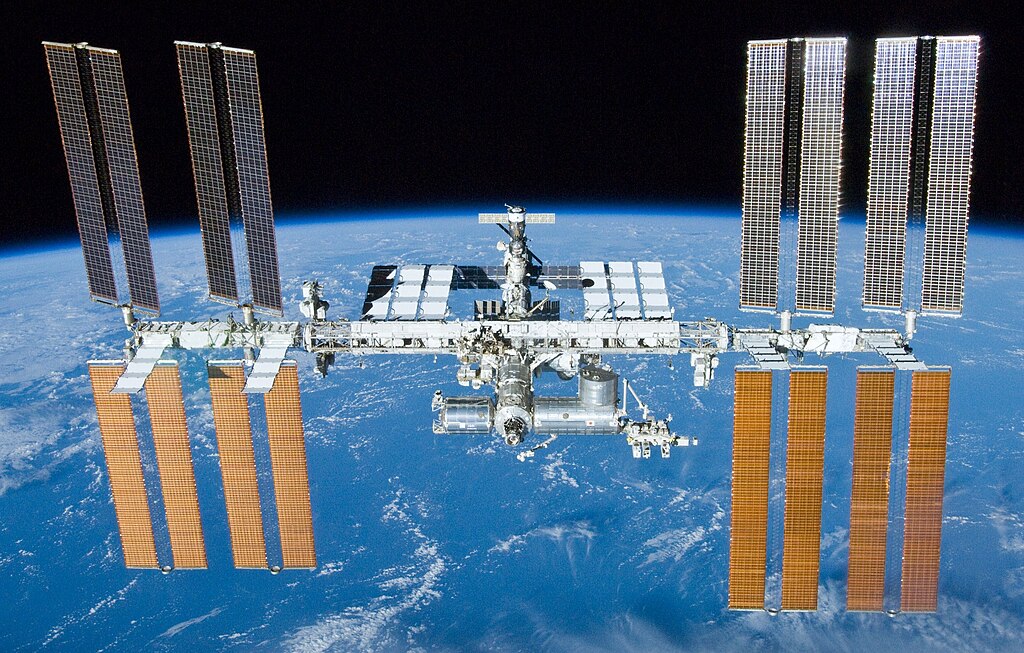
A foreward view of the International Space Station backdropped by the limb of the Earth. In view are the station's four large, maroon-coloured solar array wings, two on either side of the station, mounted to a central truss structure. Further along the truss are six large, white radiators, three next to each pair of arrays. In between the solar arrays and radiators is a cluster of pressurised modules arranged in an elongated T shape, also attached to the truss. A set of blue solar arrays are mounted to the module at the aft end of the cluster.
Image of the International Space Station (ISS), by an STS-132 crew member on board the Space Shuttle Atlantis, after leaving the station on 2010 May 23.
(Image Sources: NASA, Wikipedia.org, By NASA/Crew of STS-132 - http://spaceflight.nasa.gov/gallery/images/shuttle/sts-132/hires/s132e012208.jpg(http://spaceflight.nasa.gov/gallery/images/shuttle/sts-132/html/s132e012208.html), Public Domain, https://commons.wikimedia.org/w/index.php?curid=10561008)

By Glenn A. Walsh
Reporting for SpaceWatchtower

In anticipation of the first SpaceX astronaut crew to be launched toward the International Space Station (ISS) on May 27, SpaceX has created an on-line, docking simulator the public can use, free-of-charge. Although such ISS dockings are usually done automatically by computer, this simulator shows what astronauts would do if they needed to dock manually.

The “ISS Docking Simulator” program (Internet link to on-line simulator near end of this blog-post) is based on a real touchscreen-panel interface (although the on-line version is not a touchscreen-interface) software that the SpaceX Company, founded in 2002 by billionaire tech wizard Elon Musk, created to train the NASA astronauts to fly the new Crew Dragon spacecraft. The actual SpaceX docking simulator is located at the company's plant in Hawthorne, California.

SpaceX plans to launch two astronauts toward the International Space Station on Wednesday, 2020 May 27 at 4:32 p.m. Eastern Daylight Saving Time (EDT) / 20:32 Coordinated Universal Time (UTC). This will be the first launch of astronauts, from American soil, since the end of NASA's Space Shuttle program in July of 2011. Since 2011, NASA ,has been leasing seats on Russian Soyuz flights, for sending American astronauts to the ISS.

If the May 27 launch is delayed by poor weather or technical problems, the next launch window opens on the original Decoration Day, May 30.

This launch will also be the first launch of astronauts into Earth orbit using a non-government space program. NASA astronauts Robert Behnken and Douglas Hurley, who will be the crew of this historic flight, may stay on the ISS for 100 days or more.

SpaceX's Cargo Dragon or Dragon 1 spacecraft has flown 19 successful operational missions. These missions have flown supplies, only, to the International Space Station.

The May 27 launch will occur at the historic Launch Pad 39A at the John F. Kennedy Space Center near Cape Canaveral, Florida. Launch Pad 39A was originally built by NASA for the Apollo space program which launched 12 astronauts who walked on the Moon between 1969 and 1972, as well as the historic Apollo 8 flight when, for the first time, three astronauts went into orbit of a planetary body other than the Earth (the Earth's Moon) in December of 1968.

Launch Pad 39A was modified in the late 1970s for use in the Space Shuttle program. SpaceX leases Launch Pad 39A from NASA for the launch of the company's Falcon 9 and Falcon Heavy rockets. The Falcon 9 rocket will launch the Crew Dragon Demo-2 mission with astronauts Robert Behnken and Douglas Hurley on May 27.

Although many video games are action-packed, with objectives being achieved quickly, this is not true for the SpaceX simulator. This simulator shows that docking a spacecraft with the ISS is painstakingly slow and precise.

The simulator teaches the user to control the spacecraft, attempting to dock with the ISS, using the spacecraft's pitch, yaw, roll, and approach speed.

To be successful with this simulator, you have to carefully manipulate the controls. Although it is not real easy, the simulator includes some instructions to help the “virtual astronaut.”

SpaceX's “ISS Docking Simulator”: Link >>> https://iss-sim.spacex.com/

Internet Links to Additional Information ---

SpaceX Crew Dragon Demo-2 Mission:
Link >>> http://buhlplanetarium4.tripod.com/astrocalendar/2020.html#spacexlaunch

Photograph of SpaceX Crew Dragon Capsule:
Link >>> https://spacewatchtower.blogspot.com/2020/05/astro-calendar-2020-may-1st-private.html

SpaceX:
Link 1 >>> https://www.spacex.com/
Link 2 >>> https://en.wikipedia.org/wiki/SpaceX

International Space Station (ISS):
Link 1 >>> https://www.nasa.gov/mission_pages/station/main/index.html
Link 2 >>> https://en.wikipedia.org/wiki/International_Space_Station

Kennedy Space Center Historic Launch Pad 39A:
Link >>> https://en.wikipedia.org/wiki/Kennedy_Space_Center_Launch_Complex_39#Launch_Pad_39A

Related Blog Posts ----

"Astro-Calendar: 2020 May / 1st Private, Crewed Space Launch May 27." Fri., 2020 May 1.

Link >>> http://spacewatchtower.blogspot.com/2020/05/astro-calendar-2020-may-1st-private.html


"Web-Cast: 1st Test Launch of SpaceX Falcon Heavy Rocket Tue. Afternoon." Tue., 2018 Feb. 6.

Link >>> http://spacewatchtower.blogspot.com/2018/02/web-cast-1st-test-launch-of-spacex.html


Source: Glenn A. Walsh Reporting for SpaceWatchtower, a project of Friends of the Zeiss.
              Tuesday, 2020 May 19.

                             Like This Post?  Please Share!

           More Astronomy & Science News - SpaceWatchtower Twitter Feed:
            Link >>> https://twitter.com/spacewatchtower

        Astronomy & Science Links: Link >>> http://buhlplanetarium.tripod.com/#sciencelinks

                Want to receive SpaceWatchtower blog posts in your in-box ?
                Send request to < spacewatchtower@planetarium.cc >.

gaw

Glenn A. Walsh, Informal Science Educator & Communicator:
< http://buhlplanetarium2.tripod.com/weblog/spacewatchtower/gaw/ >
Electronic Mail: < gawalsh@planetarium.cc >
Project Director, Friends of the Zeiss: < http://buhlplanetarium.tripod.com/fotz/ >
SpaceWatchtower Editor / Author: < http://spacewatchtower.blogspot.com/ >
Formerly Astronomical Observatory Coordinator & Planetarium Lecturer, original Buhl Planetarium & Institute of Popular Science (a.k.a. Buhl Science Center), Pittsburgh's science & technology museum from 1939 to 1991.
Formerly Trustee, Andrew Carnegie Free Library and Music Hall, Pittsburgh suburb of Carnegie, Pennsylvania.
Author of History Web Sites on the Internet --
* Buhl Planetarium, Pittsburgh:
  < http://www.planetarium.cc >
* Adler Planetarium, Chicago:
  < http://adlerplanetarium.tripod.com >
* Astronomer, Educator, Optician John A. Brashear:
  < http://johnbrashear.tripod.com >
* Andrew Carnegie & Carnegie Libraries:
  < http://www.andrewcarnegie.cc >

Tuesday, May 12, 2020

NASA Contest: Help Design Mini Moon Rovers By June 8

                              http://buhlplanetarium2.tripod.com/observatory/pix/siderostat_moon.jpg
This is an image of the waxing crescent Moon taken in the 1980s by Francis G. Graham using the rather unique 10-inch Siderostat-type Refractor Telescope at the original Buhl Planetarium and Institute of Popular Science (a.k.a. Buhl Science Center - Pittsburgh's science and technology museum from 1939 to 1991). Francis Graham, who founded the American Lunar Society, is now Professor Emeritus of Physics, Kent State University. (Image Source: Friends of the Zeiss)

By Glenn A. Walsh
Reporting for SpaceWatchtower

Help provide ideas and suggestions for future Moon missions, in a NASA public prize competition. NASA's Jet Propulsion Laboratory (JPL) is seeking suggestions for advancing science on the Moon through miniature payloads, possibly including mini-rovers (perhaps as small as a home Roomba® vacuum cleaner) that could explore the lunar surface. There are $160,000 in monetary prizes being offered.

The NASA news release states:

NASA’s Jet Propulsion Laboratory in Southern California, is running a public prize competition to design miniaturized payloads for future Moon missions. The “Honey, I Shrunk the NASA Payload” challenge is seeking instrument designs that could help support a sustained human lunar presence, demonstrate and advance the use of resources found on the Moon, and enable new science. Future exploration of the Moon and beyond will require tools of all shapes and sizes – from sweeping orbiters to the tiniest of rovers. In addition to current planned scientific rovers, NASA could one day send even smaller rovers to help scout the Moon’s surface. These tiny robots would provide mission flexibility and collect key information about the lunar surface, its resources and the environment. The data collected by these rovers would be helpful for future lunar endeavors and NASA’s Artemis program.

NASA is looking for ways to create a sustained presence on the Moon for astronauts. To do so, NASA needs to find the resources on the Moon that can be transformed to help keep people alive and help them perform their scientific mission, as re-supply missions from Earth would be very expensive. Needed resources, that could possibly be found and transformed from lunar resources, include breathable air, water for drinking and food production, building materials for shelter, rocket propellants, among other necessities.

NASA needs to find new ways to prospect, map, and determine the resources available on the Moon that can supply a small lunar base. NASA and JPL are seeking the public's help in creating new, miniaturized technologies to carry-out this project, which would support NASA's Artemis Program for exploration of the Moon by male and female astronauts.

Deadline for submissions: Monday, 2020 June 8 at 5:00 p.m. Eastern Daylight Saving Time (EDT) / 21:00 Coordinated Universal Time (UTC).

Internet Links to Additional Information ---

More information on NASA / JPL “Honey, I Shrunk the NASA Payload” challenge:
Link >>> https://www.herox.com/NASApayload

Challenge Guidelines: Link >>> https://www.herox.com/NASApayload/guidelines

Source: Glenn A. Walsh Reporting for SpaceWatchtower, a project of Friends of the Zeiss.
              Tuesday, 2020 May 12.

                             Like This Post?  Please Share!

           More Astronomy & Science News - SpaceWatchtower Twitter Feed:
            Link >>> https://twitter.com/spacewatchtower

        Astronomy & Science Links: Link >>> http://buhlplanetarium.tripod.com/#sciencelinks

                Want to receive SpaceWatchtower blog posts in your in-box ?
                Send request to < spacewatchtower@planetarium.cc >.

gaw

Glenn A. Walsh, Informal Science Educator & Communicator:
< http://buhlplanetarium2.tripod.com/weblog/spacewatchtower/gaw/ >
Electronic Mail: < gawalsh@planetarium.cc >
Project Director, Friends of the Zeiss: < http://buhlplanetarium.tripod.com/fotz/ >
SpaceWatchtower Editor / Author: < http://spacewatchtower.blogspot.com/ >
Formerly Astronomical Observatory Coordinator & Planetarium Lecturer, original Buhl Planetarium & Institute of Popular Science (a.k.a. Buhl Science Center), Pittsburgh's science & technology museum from 1939 to 1991.
Formerly Trustee, Andrew Carnegie Free Library and Music Hall, Pittsburgh suburb of Carnegie, Pennsylvania.
Author of History Web Sites on the Internet --
* Buhl Planetarium, Pittsburgh:
  < http://www.planetarium.cc >
* Adler Planetarium, Chicago:
  < http://adlerplanetarium.tripod.com >
* Astronomer, Educator, Optician John A. Brashear:
  < http://johnbrashear.tripod.com >
* Andrew Carnegie & Carnegie Libraries:
  < http://www.andrewcarnegie.cc >

Friday, May 1, 2020

Astro-Calendar: 2020 May / 1st Private, Crewed Space Launch May 27


CCP SpaceX Demo-2 Dragon (3).jpg
SpaceX Crew Dragon Spacecraft, as it undergoes final processing at the Cape Canaveral Air Force Station in Florida for the Demo-2 launch on May 27, with two astronauts. This will be the first launch of astronauts from American soil since the end of the Space Shuttle program in 2011, as well as the first launch, ever, of astronauts on a private space vehicle into Earth orbit.
More information: Link >>> http://buhlplanetarium4.tripod.com/astrocalendar/2020.html#spacexlaunch
(Image Sources: SpaceX, NASA, Wikipedia.org, By SpaceX - https://images.nasa.gov/details-KSC-20200411-PH-SPX01_0003 (direct link), CC0, https://commons.wikimedia.org/w/index.php?curid=89261776)

Astronomical Calendar for 2020 May ---
Link >>> http://buhlplanetarium4.tripod.com/astrocalendar/2020.html#may

 Related Blog Post ---

"Astro-Calendar: 2020 April / 175th Anniversary (April 10): Great Pittsburgh Fire."

Wednesday, 2020 April 1.

Link >>> https://spacewatchtower.blogspot.com/2020/04/astro-calendar-2020-april-175th.html


Source: Friends of the Zeiss.
              Friday, 2020 May 1.

                             Like This Post?  Please Share!

            More Astronomy & Science News - SpaceWatchtower Twitter Feed:
            Link >>> https://twitter.com/spacewatchtower

        Astronomy & Science Links: Link >>> http://buhlplanetarium.tripod.com/#sciencelinks

                Want to receive SpaceWatchtower blog posts in your in-box ?
                Send request to < spacewatchtower@planetarium.cc >.

gaw

Glenn A. Walsh, Informal Science Educator & Communicator:
< http://buhlplanetarium2.tripod.com/weblog/spacewatchtower/gaw/ >
Electronic Mail: < gawalsh@planetarium.cc >
Project Director, Friends of the Zeiss: < http://buhlplanetarium.tripod.com/fotz/ >
SpaceWatchtower Editor / Author: < http://spacewatchtower.blogspot.com/ >
Formerly Astronomical Observatory Coordinator & Planetarium Lecturer, original Buhl Planetarium & Institute of Popular Science (a.k.a. Buhl Science Center), Pittsburgh's science & technology museum from 1939 to 1991.
Formerly Trustee, Andrew Carnegie Free Library and Music Hall, Pittsburgh suburb of Carnegie, Pennsylvania.
Author of History Web Sites on the Internet --
* Buhl Planetarium, Pittsburgh:
  < http://www.planetarium.cc >
* Adler Planetarium, Chicago:
  < http://adlerplanetarium.tripod.com >
* Astronomer, Educator, Optician John A. Brashear:
  < http://johnbrashear.tripod.com >
* Andrew Carnegie & Carnegie Libraries:
  < http://www.andrewcarnegie.cc >