Sunday, December 7, 2014

Air & Space Museum Debates Preservation of U.S. Plane at Pearl Harbor Attack


This Sikorsky JRS-1 is the only aircraft in the collection, of the Smithsonian Institution's
National Air and Space Museum, that was stationed at Pearl Harbor on 1941 December 7.
It was later used for testing by the predecessor agency to NASA.
(Image Source: National Air and Space Museum, Smithsonian Institution)

From Friday's edition of the PBS NewsHour:

Sunday marks the 73rd anniversary of the Pearl Harbor attack that launched U.S. involvement in World War II.

Tonight, we bring you a rare survivor of that day, an American military plane that is the last of its kind. We tagged along at the Smithsonian’s Air and Space Museum’s Udvar-Hazy Center, as curator Dr. Jeremy Kinney showed off the seaplane to a volunteer and explained the debate over how to restore it.

This is a Sikorsky JRS-1 flying boat. And it’s the only artifact in the Air and Space Museum’s collection that was present at Pearl Harbor on 1941 December 7.

In the immediate aftermath of the attack on Pearl Harbor, this JRS flew in search of Japanese submarines and the Japanese carrier fleet. And then as the months wore on through 1942, it continued its support mission for Navy fighting, bombing and torpedo squadrons.

This particular JRS flew until 1944 with the U.S. Navy. It went into storage. The Navy kept it as an airplane. It actually performed yeoman’s service with the NACA, the National Advisory Committee for Aeronautics, which is now NASA today, as an air dynamics testing platform.

If we restore it, then every — everything that’s original is removed pretty much or it’s painted over. So, I mean, this is the original glass, no matter how bad it looks. This is the original paint, no matter how badly chipped and cracked it is, the peeling fabric, which there are ways to repair that.

But it’s the things that curators and specialists and conservators agonize over. That’s a — it’s a big debate in terms of what we want to do with it, because it’s only original once, even though it’s in rough shape.

Complete television segment transcript and video:
Link >>> http://www.pbs.org/newshour/bb/remember-pearl-harbor-debate-restoring-last-kind-military-plane/

More on the Sikorsky JRS-1:
Link >>> http://airandspace.si.edu/collections/artifact.cfm?id=A19610112000

Source: Public Broadcasting Service.

2014: 75th Year of Pittsburgh's Buhl Planetarium Historic Zeiss II Planetarium Projector at Pittsburgh's original Buhl Planetarium and Institute of Popular Science.


Want to receive SpaceWatchtower blog posts in your inbox ?
Send request to < spacewatchtower@planetarium.cc >..

gaw

Glenn A. Walsh, Project Director,
Friends of the Zeiss < http://buhlplanetarium.tripod.com/fotz/ >
Electronic Mail - < gawalsh@planetarium.cc >
SpaceWatchtower Blog: < http://spacewatchtower.blogspot.com/ >
Also see: South Hills Backyard Astronomers Blog: < http://shbastronomers.blogspot.com/ >
Barnestormin: Writing, Essays, Pgh. News, & More: < http://www.barnestormin.blogspot.com/ >
About the SpaceWatchtower Editor / Author: < http://buhlplanetarium2.tripod.com/weblog/spacewatchtower/gaw/ >
SPACE & SCIENCE NEWS, ASTRONOMICAL CALENDAR:
< http://buhlplanetarium.tripod.com/#news >
Twitter: < https://twitter.com/spacewatchtower >
Facebook: < http://www.facebook.com/pages/SpaceWatchtower/238017839577841?sk=wall >
Author of History Web Sites on the Internet --
* Buhl Planetarium, Pittsburgh:
  < http://www.planetarium.cc >
* Adler Planetarium, Chicago:
  < http://adlerplanetarium.tripod.com >
* Astronomer, Educator, Optician John A. Brashear:
  < http://johnbrashear.tripod.com >
* Andrew Carnegie & Carnegie Libraries:
  < http://www.andrewcarnegie.cc >
* Civil War Museum of Andrew Carnegie Free Library:
  < http://garespypost.tripod.com >
* Duquesne Incline cable-car railway, Pittsburgh:
  < http://inclinedplane.tripod.com >
* Public Transit:
  < http://andrewcarnegie2.tripod.com/transit >

Friday, December 5, 2014

NASA Orion Spacecraft: Near-Perfect Test Mission After Day-Delay

SuperClose
NASA's Orion Deep-Space Vehicle floating in the Pacific Ocean shortly after a near-perfect splash-down at 11:29 EST this morning / 16:29 UTC. (Image Source: NASA)

By Glenn A. Walsh
Reporting for SpaceWatchtower

After a one-day delay due to high ground winds and a technical problem with the Delta IV Heavy launch rocket, NASA had great success on Friday morning with the first test of the Orion Deep-Space Vehicle. The Orion capsule, successor to the Space Shuttle and the first deep-space transport since Project Apollo, is expected to take astronauts back to the Moon, to asteroids, and perhaps eventually to Mars.

Early Friday morning there had been concern about weather conditions at the launch site, the Cape Canaveral Air Force Station in Florida. In fact, it had been estimated that there was only a 40 percent chance that weather conditions would allow a launch Friday morning.

However, the launch occurred right on time this morning, just after sunrise, at 7:05 EST / 12:05 UTC. And from then on, the test mission went like clock-work. The uncrewed flight lasted four and a-half hours, making nearly two full orbits of the Earth before landing in the Pacific Ocean, 270 miles west of Mexico's Baja California peninsula, right on schedule at 11:29 a.m. EST / 16:29 UTC.

While the Space Shuttle and the International Space Station fly in low-Earth orbit, about 250 miles above the Earth, Orion is designed to fly in deep-space. And, during this test flight, Orion flew more than 3,500 miles above the Earth, proving its deep-space capabilities. This is the first human-rated spacecraft to fly that far from the Earth since December of 1972, when Apollo 17 was the last mission that sent men to the Moon.

At NASA's post-mission media briefing, it was mentioned that the video processing units on-board Orion were automatically reset due to higher radiation experienced as Orion flew through the Van Allen Radiation Belts. However, scientists were pleased that no computer units experienced such resets.

The Van Allen Radiation Belts (two main belts exist) are layers of energetically-charged particles held in-place in Earth's upper atmosphere by our planet's magnetic field. They were named for University of Iowa space scientist Dr. James Van Allen, who discovered the radiation belts at the very beginning of the Space Age, from data received from three early satellites launched in 1958: Explorer 1, Explorer 3, and Pioneer 3. The Van Allen Radiation Belts extend 600 to 37,000 miles above the Earth, much higher than the orbit of the International Space Station or orbits used by the Space Shuttle.

For this mission, NASA used drones, in addition to chase aircraft, to obtain video of the spacecraft as it neared splash-down. Following splash-down, recovery of the spacecraft is being handled by two U.S. Navy ships: an amphbious transport dock ship, the USS Anchorage, and the Military Sealift Command rescue and salvage ship, USNS Salvor.

Once back on land, at Naval Base San Diego, the Orion capsule will be trucked back to the Kennedy Space Center in Florida. Due to the fact that the spacecraft will still contain unused fuel and other dangerous chemicals, the trucking firm that transports Orion will have to meet hazardous transport regulations for each state the truck travels through.

Just as the heat shield tiles were critical during each Space Shuttle mission, NASA scientists will now closely evaluate how the heat shield on Orion succeeded in keeping dangerous heat out of the capsule during re-entry into the Earth's atmosphere. By the time Orion hit the Earth's atmosphere during re-entry, it was expected that the spacecraft would be traveling more than 20,000 miles-per-hour, and the heat shield would experience up to +4,000 degrees Fahrenheit.

More on the Orion Deep-Space Vehicle:
Link 1 >>> www.nasa.gov/orion/
Link 2 >>> http://en.wikipedia.org/wiki/Orion_%28spacecraft%29

More on Orion's First Test Flight: Link >>> https://blogs.nasa.gov/orion/

More on the Van Allen Radiation Belts:
Link >>> http://en.wikipedia.org/wiki/Van_Allen_radiation_belt

More about spacecraft heat shields:
Link >>> http://en.wikipedia.org/wiki/Atmospheric_entry#Thermal_protection_systems

Related Blog Posts ---

Thur. 7:05 a.m.: 1st NASA Test Launch of Orion Deep-Space Vehicle (2014 Dec. 3):

Link >>> http://spacewatchtower.blogspot.com/2014/12/thur-705-am-1st-nasa-test-launch-of.html


Thur. NASA Orion Launch Scrubbed; Next Try Fri. 7:05 a.m.  (2014 Dec. 4):

Link >>> http://spacewatchtower.blogspot.com/2014/12/thur-nasa-orion-launch-scrubbed-next.html

Source: Glenn A. Walsh, Reporting for SpaceWatchtower, a project of Friends of the Zeiss.

2014: 75th Year of Pittsburgh's Buhl Planetarium Historic Zeiss II Planetarium Projector at Pittsburgh's original Buhl Planetarium and Institute of Popular Science.


Want to receive SpaceWatchtower blog posts in your inbox ?
Send request to < spacewatchtower@planetarium.cc >..

gaw

Glenn A. Walsh, Project Director,
Friends of the Zeiss < http://buhlplanetarium.tripod.com/fotz/ >
Electronic Mail - < gawalsh@planetarium.cc >
SpaceWatchtower Blog: < http://spacewatchtower.blogspot.com/ >
Also see: South Hills Backyard Astronomers Blog: < http://shbastronomers.blogspot.com/ >
Barnestormin: Writing, Essays, Pgh. News, & More: < http://www.barnestormin.blogspot.com/ >
About the SpaceWatchtower Editor / Author: < http://buhlplanetarium2.tripod.com/weblog/spacewatchtower/gaw/ >
SPACE & SCIENCE NEWS, ASTRONOMICAL CALENDAR:
< http://buhlplanetarium.tripod.com/#news >
Twitter: < https://twitter.com/spacewatchtower >
Facebook: < http://www.facebook.com/pages/SpaceWatchtower/238017839577841?sk=wall >
Author of History Web Sites on the Internet --
* Buhl Planetarium, Pittsburgh:
  < http://www.planetarium.cc >
* Adler Planetarium, Chicago:
  < http://adlerplanetarium.tripod.com >
* Astronomer, Educator, Optician John A. Brashear:
  < http://johnbrashear.tripod.com >
* Andrew Carnegie & Carnegie Libraries:
  < http://www.andrewcarnegie.cc >
* Civil War Museum of Andrew Carnegie Free Library:
  < http://garespypost.tripod.com >
* Duquesne Incline cable-car railway, Pittsburgh:
  < http://inclinedplane.tripod.com >
* Public Transit:
  < http://andrewcarnegie2.tripod.com/transit >

Thursday, December 4, 2014

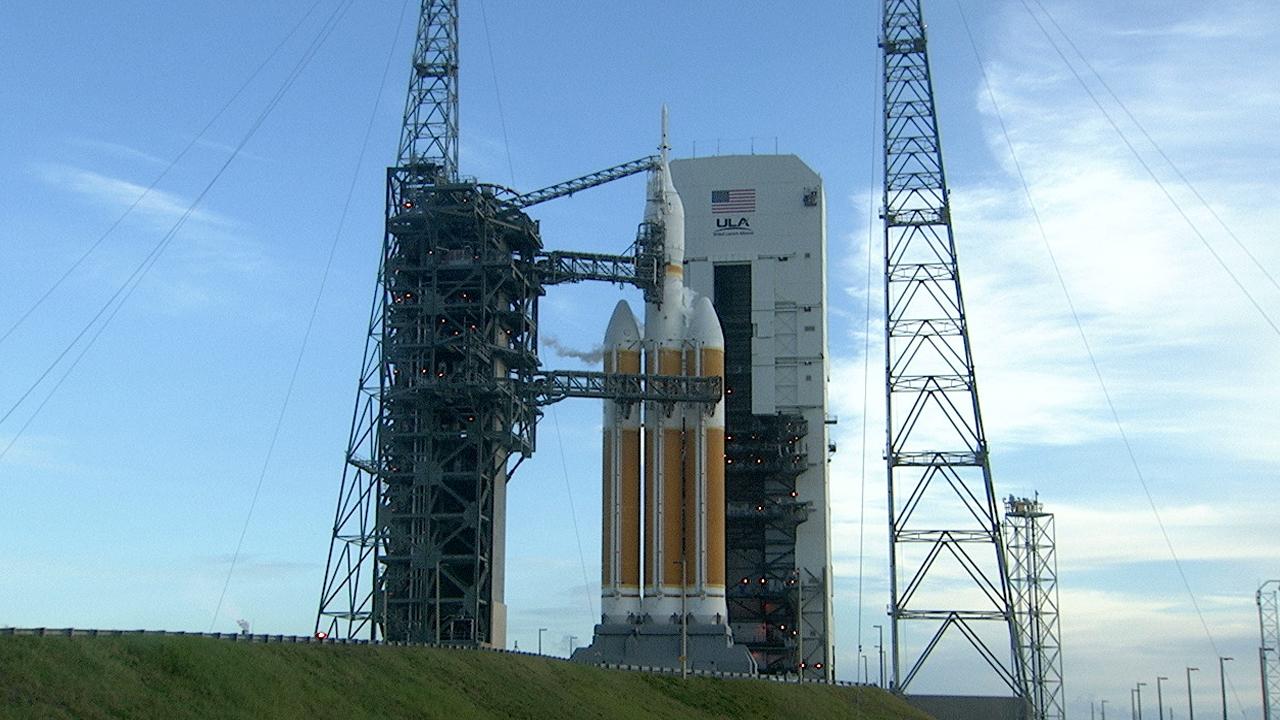
Thur. NASA Orion Launch Scrubbed; Next Try Fri. 7:05 a.m.


The Orion Deep-Space Vehicle continues sitting on the launch pad, at the Cape Canaveral Air Force Station in Florida, after Thursday's launch attempt was scrubbed due to problems with the Delta IV Heavy rocket. A launch will be attempted Friday morning. (Image Source: NASA)

UPDATE: 

NASA Orion Spacecraft: Near-Perfect Test Mission After Day-Delay (2014 Dec. 5):

Link >>> http://spacewatchtower.blogspot.com/2014/12/nasa-orion-spacecraft-near-perfect-test.html


By Glenn A. Walsh
Reporting for SpaceWatchtower

Thursday's (December 4) attempt to launch NASA's new Orion Deep-Space Vehicle was scrubbed just minutes before the launch window closed at 9:44 a.m. EST / 14:44 UTC. The launch had been originally delayed for most of the two and a-half hour launch window by high ground winds that the space agency had felt were unacceptable for this first flight.

However, a new problem cropped-up with United Launch Alliance's Delta IV Heavy rocket. The issue related to fill and drain valves on the rocket. NASA could not troubleshoot the problem before the launch window for Thursday expired. So, the decision was made to scrub and plan for a second try Friday morning.

Friday's (December 5) launch window duplicates the original Thursday window. The launch window opens at 7:05 a.m. EST / 12:05 UTC and continues until 9:44 a.m. EST / 14:44 UTC. The splash-down in the Pacific Ocean west of Baja California would be at 11:29 a.m. EST / 16:29 UTC, assuming the launch occurs at 7:05; otherwise, the splash-down would be delayed by a time similar to the delay in launch.

At NASA's Noon news conference from the Kennedy Space Center, they mentioned that should Friday's launch be scrubbed, the launch would have to be rescheduled later in December. Although, there is a possibility they could decide to skip Friday and make the second attempt on Saturday (December 6). However, as of this writing, they continue to be confident that weather conditions and  the rocket will be ready for a second launch attempt on Friday.

NASA Television, via both satellite channels and Internet web-casts, will carry live coverage of the launch and mission, beginning at 6:00 a.m. EST / 11:00 UTC on Friday.

In south suburban Pittsburgh, live coverage of this first test flight, via the live Internet web-cast from NASA, will be shown free-of-charge to the public, at the Mt. Lebanon Public Library which is located at 16 Castle Shannon Boulevard near Washington Road at the southern end of the Mt. Lebanon Uptown business district. The Library's coverage will run from the opening of the Library at 9:00 a.m. to approximately 12:30 p.m. EST and will occur in Study Room 1 on the Library's upper level. This special event is co-sponsored by Friends of the Zeiss and the Mt. Lebanon Public Library.

Live Orion Test Flight Mission Coverage ---

NASA Television Web-Cast:
Link >>> www.nasa.gov/multimedia/nasatv/index.html

More on the Orion Deep-Space Vehicle:
Link 1 >>> www.nasa.gov/orion/
Link 2 >>> http://en.wikipedia.org/wiki/Orion_%28spacecraft%29

More on Orion's First Test Flight:
Link 1 >>> https://blogs.nasa.gov/orion/
Link 2 >>> http://www.nbcnews.com/science/space/testing-nasa-how-space-exploration-will-work-orion-era-n259306

Related Blog Post ---

Thur. 7:05 a.m.: 1st NASA Test Launch of Orion Deep-Space Vehicle (2014 Dec. 3):

Link >>> http://spacewatchtower.blogspot.com/2014/12/thur-705-am-1st-nasa-test-launch-of.html


Source: Glenn A. Walsh, Reporting for SpaceWatchtower, a project of Friends of the Zeiss.

2014: 75th Year of Pittsburgh's Buhl Planetarium Historic Zeiss II Planetarium Projector at Pittsburgh's original Buhl Planetarium and Institute of Popular Science.


Want to receive SpaceWatchtower blog posts in your inbox ?
Send request to < spacewatchtower@planetarium.cc >..

gaw

Glenn A. Walsh, Project Director,
Friends of the Zeiss < http://buhlplanetarium.tripod.com/fotz/ >
Electronic Mail - < gawalsh@planetarium.cc >
SpaceWatchtower Blog: < http://spacewatchtower.blogspot.com/ >
Also see: South Hills Backyard Astronomers Blog: < http://shbastronomers.blogspot.com/ >
Barnestormin: Writing, Essays, Pgh. News, & More: < http://www.barnestormin.blogspot.com/ >
About the SpaceWatchtower Editor / Author: < http://buhlplanetarium2.tripod.com/weblog/spacewatchtower/gaw/ >
SPACE & SCIENCE NEWS, ASTRONOMICAL CALENDAR:
< http://buhlplanetarium.tripod.com/#news >
Twitter: < https://twitter.com/spacewatchtower >
Facebook: < http://www.facebook.com/pages/SpaceWatchtower/238017839577841?sk=wall >
Author of History Web Sites on the Internet --
* Buhl Planetarium, Pittsburgh:
  < http://www.planetarium.cc >
* Adler Planetarium, Chicago:
  < http://adlerplanetarium.tripod.com >
* Astronomer, Educator, Optician John A. Brashear:
  < http://johnbrashear.tripod.com >
* Andrew Carnegie & Carnegie Libraries:
  < http://www.andrewcarnegie.cc >
* Civil War Museum of Andrew Carnegie Free Library:
  < http://garespypost.tripod.com >
* Duquesne Incline cable-car railway, Pittsburgh:
  < http://inclinedplane.tripod.com >
* Public Transit:
  < http://andrewcarnegie2.tripod.com/transit >

Wednesday, December 3, 2014

Thur. 7:05 a.m.: 1st NASA Test Launch of Orion Deep-Space Vehicle


NASA's Orion Multi-Purpose Crew Vehicle, which will take astronauts to the Moon, asteroids, and eventually to Mars. The spacecraft is scheduled to undergo the first test launch, without a crew, on Thursday morning. (Image Source: NASA)

UPDATES: 

NASA Orion Spacecraft: Near-Perfect Test Mission After Day-Delay (2014 Dec. 5):

Link >>> http://spacewatchtower.blogspot.com/2014/12/nasa-orion-spacecraft-near-perfect-test.html


Thur. NASA Orion Launch Scrubbed; Next Try Fri. 7:05 a.m. (2014 Dec. 4):

Link >>> http://spacewatchtower.blogspot.com/2014/12/thur-nasa-orion-launch-scrubbed-next.html


By Glenn A. Walsh
Reporting for SpaceWatchtower

Thursday morning, NASA plans the first test launch of the first deep-space vehicle, since Project Apollo sent the first astronauts to the Moon 1968 to 1972. Officially known as the Orion Multi-Purpose Crew Vehicle (MPCV), Orion is planned to take astronauts to the Moon, asteroids, and eventually to Mars.

This $370 million test flight, officially known as Exploration Flight Test 1 (EFT-1), is an uncrewed mission which will be launched atop a United Launch Alliance Delta IV heavy rocket, from the Cape Canaveral Air Force Station in Florida.

The launch is currently scheduled for 7:05 a.m. EST / 12:05 UTC on Thursday Morning, 2014 December 4, with about a two-hour launch window should the launch be delayed from the scheduled time. The launch and mission coverage will be provided live on NASA Television, on both satellite channels and on Internet web-casts. The end of the mission is scheduled for 11:29 a.m. EST / 16:29 UTC, when Orion splashes-down in the Pacific Ocean off of the coast of Baja California. Re-entry into the atmosphere, including testing of Orion's heat shield and other systems during re-entry, will be crucial to the success of the mission.

In south suburban Pittsburgh, live coverage of this first test flight, via the live Internet web-cast from NASA, will be shown free-of-charge to the public, at the Mt. Lebanon Public Library which is located at 16 Castle Shannon Boulevard near Washington Road at the southern end of the Mt. Lebanon Uptown business district. The Library's coverage will run from the opening of the Library at 9:00 a.m. to approximately 12:30 p.m. EST. This special event is co-sponsored by Friends of the Zeiss and the Mt. Lebanon Public Library.

The Orion Deep-Space Vehicle is NASA's successor to the Space Shuttle, which was retired after its last flight on 2011 July 21. This new NASA spacecraft is designed to carry a maximum of four astronauts beyond low-Earth orbit. The Space Shuttle program, which started with the first launch on 1981 April 12, provided human access to low-Earth orbit, including access to the International Space Station and the Hubble Space Telescope, both of which Space Shuttle astronauts helped install in outer space.

In conjunction with the Orion Deep-Space Vehicle, NASA is also developing the "Space Launch System," which will be the world's most powerful rocket for launching Orion to deep-space destinations. The next test launch which will be comprised of both the Orion capsule and the Space Launch System rocket, scheduled in 2017 or 2018 and known as Exploration Mission 1 (EM-1), is scheduled to send a robotic capsule around the Moon and back. The first test with a crew of astronauts is scheduled for 2021: Expedition Mission (EM-2).

Live Orion Test Flight Mission Coverage ---

News Release - "Dec. 4 - Public Viewing, Via Web-Cast, of 1st NASA Test Launch of New Orion Deep-Space Vehicle at Mt. Lebanon Public Library":
Link >>> http://buhlplanetarium.tripod.com/fotz/news/releases/NR-orion1sttestlaunch.html

NASA Television Web-Cast:
Link >>> www.nasa.gov/multimedia/nasatv/index.html

More on the Orion Deep-Space Vehicle:
Link 1 >>> www.nasa.gov/orion/
Link 2 >>> http://en.wikipedia.org/wiki/Orion_%28spacecraft%29

More on Orion's First Test Flight:
Link 1 >>> https://blogs.nasa.gov/orion/
Link 2 >>> http://www.nbcnews.com/science/space/testing-nasa-how-space-exploration-will-work-orion-era-n259306

Source: Glenn A. Walsh, Reporting for SpaceWatchtower, a project of Friends of the Zeiss.

2014: 75th Year of Pittsburgh's Buhl Planetarium Historic Zeiss II Planetarium Projector at Pittsburgh's original Buhl Planetarium and Institute of Popular Science.


Upcoming Event:
DEC. 4 – PUBLIC VIEWING, VIA WEB-CAST, OF 1st NASA TEST LAUNCH
OF NEW ORION DEEP-SPACE VEHICLE AT MT. LEBANON PUBLIC LIBRARY


Want to receive SpaceWatchtower blog posts in your inbox ?
Send request to < spacewatchtower@planetarium.cc >..

gaw

Glenn A. Walsh, Project Director,
Friends of the Zeiss < http://buhlplanetarium.tripod.com/fotz/ >
Electronic Mail - < gawalsh@planetarium.cc >
SpaceWatchtower Blog: < http://spacewatchtower.blogspot.com/ >
Also see: South Hills Backyard Astronomers Blog: < http://shbastronomers.blogspot.com/ >
Barnestormin: Writing, Essays, Pgh. News, & More: < http://www.barnestormin.blogspot.com/ >
About the SpaceWatchtower Editor / Author: < http://buhlplanetarium2.tripod.com/weblog/spacewatchtower/gaw/ >
SPACE & SCIENCE NEWS, ASTRONOMICAL CALENDAR:
< http://buhlplanetarium.tripod.com/#news >
Twitter: < https://twitter.com/spacewatchtower >
Facebook: < http://www.facebook.com/pages/SpaceWatchtower/238017839577841?sk=wall >
Author of History Web Sites on the Internet --
* Buhl Planetarium, Pittsburgh:
  < http://www.planetarium.cc >
* Adler Planetarium, Chicago:
  < http://adlerplanetarium.tripod.com >
* Astronomer, Educator, Optician John A. Brashear:
  < http://johnbrashear.tripod.com >
* Andrew Carnegie & Carnegie Libraries:
  < http://www.andrewcarnegie.cc >
* Civil War Museum of Andrew Carnegie Free Library:
  < http://garespypost.tripod.com >
* Duquesne Incline cable-car railway, Pittsburgh:
  < http://inclinedplane.tripod.com >
* Public Transit:
  < http://andrewcarnegie2.tripod.com/transit >

Monday, December 1, 2014

Astronomical Calendar: 2014 December

Three Wise Men approaching Bethlehem, guided by a star.


  December marks 75 years after the beginning of the classic, "Star of Bethlehem" planetarium sky drama at Pittsburgh's original Buhl Planetarium and Institute of Popular Science. This traditional, holiday sky show, which provides possible, astronomical explanations for the star that guided the Three Wisemen to the Christ child, has been shown at Buhl Planetarium every Christmas season since 1939, and it is being shown this month at the Henry Buhl, Jr. Planetarium and Observatory at The Carnegie Science Center under the title, "The Christmas Star." This graphic was used to promote the show in Buhl's monthly, public newsletter, during Buhl Planetarium's 50th anniversary in 1989. More on this historic sky show, including a complete copy of  the 1979 show script at this link: http://buhlplanetarium3.tripod.com/skyshow/bethlehem/ (Image Source: Friends of the Zeiss)


Astronomical Calendar for 2014 December:

Link >>>  http://buhlplanetarium4.tripod.com/astrocalendar/2014.html#dec


The current month's Astronomical Calendar can also be found on the cover page of the History of The Buhl Planetarium and Institute of Popular Science, Pittsburgh web site at this link:

Link >>> http://buhlplanetarium.tripod.com/#astrocal


Source: Friends of the Zeiss. 


2014: 75th Year of Pittsburgh's Buhl Planetarium Historic Zeiss II Planetarium Projector at Pittsburgh's original Buhl Planetarium and Institute of Popular Science.


Upcoming Event:
DEC. 4 – PUBLIC VIEWING, VIA WEB-CAST, OF 1st NASA TEST LAUNCH
OF NEW ORION DEEP-SPACE VEHICLE AT MT. LEBANON PUBLIC LIBRARY


Want to receive SpaceWatchtower blog posts in your inbox ?
Send request to < spacewatchtower@planetarium.cc >..

gaw

Glenn A. Walsh, Project Director,
Friends of the Zeiss < http://buhlplanetarium.tripod.com/fotz/ >
Electronic Mail - < gawalsh@planetarium.cc >
SpaceWatchtower Blog: < http://spacewatchtower.blogspot.com/ >
Also see: South Hills Backyard Astronomers Blog: < http://shbastronomers.blogspot.com/ >
Barnestormin: Writing, Essays, Pgh. News, & More: < http://www.barnestormin.blogspot.com/ >
About the SpaceWatchtower Editor / Author: < http://buhlplanetarium2.tripod.com/weblog/spacewatchtower/gaw/ >
SPACE & SCIENCE NEWS, ASTRONOMICAL CALENDAR:
< http://buhlplanetarium.tripod.com/#news >
Twitter: < https://twitter.com/spacewatchtower >
Facebook: < http://www.facebook.com/pages/SpaceWatchtower/238017839577841?sk=wall >
Author of History Web Sites on the Internet --
* Buhl Planetarium, Pittsburgh:
  < http://www.planetarium.cc >
* Adler Planetarium, Chicago:
  < http://adlerplanetarium.tripod.com >
* Astronomer, Educator, Optician John A. Brashear:
  < http://johnbrashear.tripod.com >
* Andrew Carnegie & Carnegie Libraries:
  < http://www.andrewcarnegie.cc >
* Civil War Museum of Andrew Carnegie Free Library:
  < http://garespypost.tripod.com >
* Duquesne Incline cable-car railway, Pittsburgh:
  < http://inclinedplane.tripod.com >
* Public Transit:
  < http://andrewcarnegie2.tripod.com/transit >
Thursday, November 27, 2014

Buhl Planetarium Scale-Model Joins Miniature Railroad and Village


For the 75th anniversary of Buhl Planetarium, a scale-model of Pittsburgh's original Buhl Planetarium and Institute of Popular Science building joins scale-models of other Pittsburgh-area historic structures on the platform of the Miniature Railroad and Village. After starting at a private home in Brookville, Pennsylvania in 1920 and moving to Buhl Planetarium in 1954, the Miniature Railroad and Village exhibit is now displayed at The Carnegie Science Center.
(Image Source: Michael S. Nowak, former Buhl Science Center employee)

By Glenn A. Walsh
Reporting for SpaceWatchtower

Tomorrow (Black Friday: November 28), the 60th annual exhibition, in Pittsburgh, of the Miniature Railroad and Village opens at Pittsburgh's Carnegie Science Center, and the platform now includes a scale-model of Pittsburgh's original Buhl Planetarium and Institute of Popular Science building, in celebration of the 75th anniversary of Buhl Planetarium. The model of Buhl Planetarium, constructed using new laser-cutting technology (relying on original photographs of the building), joins scale-models of other historic Pittsburgh-area structures such as the original Allegheny Observatory (1861 to 1912), Monongahela Incline, Pittsburgh Pirates' Forbes Field, and Pittsburgh's original Rodgers Air Field.

The Miniature Railroad and Village, which depicts life in a small town and environs in Western Pennsylvania circa 1880 to 1930, is one of the largest, most detailed, and most animated model railroad layouts in the country. The current platform at The Carnegie Science Center measures 83 feet / 25 meters long by 30 feet / 9.1 meters wide, 60 percent larger than the original platform in the Bowdish Gallery of Buhl Planetarium. Although the number of Lionel model trains on the platform varies, often five trains (including at least one passenger train) and one trolley-car run throughout the Miniature Railroad and Village, of course, along with the historic Monongahela Incline (oldest and steepest inclined plane in the country).

The Miniature Railroad and Village began, on Christmas Eve in 1920, in the home of World War I U.S. Army veteran Charles Bowdish in the small town of Brookville, Pennsylvania, located 69 miles / 111 kilometers north-east of Pittsburgh. The display quickly became very popular in Brookville.

The management of Buhl Planetarium learned of the display's popularity in Brookville and offered to host the display in Pittsburgh. It started exhibition in Pittsburgh in 1954 as a Christmas holiday display. However, soon after encountering one-to-two hour waiting lines for people waiting to see the exhibit (particularly during the holiday week), it quickly became a Pittsburgh holiday icon. The exhibition was soon extended to be on display November through February each year, and the revenue generated by admission ticket sales during those four months pretty-much paid for the rest of the year's operation of Buhl Planetarium!

After the Buhl Planetarium closed as a public museum in 1991, the Miniature Railroad and Village was moved to the second floor of The Carnegie Science Center, directly across the hall from the new Henry Buhl, Jr. Planetarium and Observatory, and expanded, reopening a year later. At The Carnegie Science Center, the exhibition is open ten months of the year, closing in early Autumn for maintenance and reopening on Black Friday, the day after Thanksgiving Day. While on display at Buhl Planetarium, the display had always opened to the public at 1:00 p.m. EST on the first Friday in November.

Black Friday was sometimes the busiest day of the year at Buhl Planetarium, along with other very busy days during the Thanksgiving Weekend and the holiday week between Christmas and New Year's Days (at that time, Buhl Planetarium was open every day of the year except Christmas Day). The Miniature Railroad and Village was the primary reason for these very popular days, along with the annual "Star of Bethlehem" sky drama performed in Buhl Planetarium's Theater of the Stars.

When the Miniature Railroad and Village moved to Pittsburgh, it was first known as The Great Christmastown Railroad and displayed in the South Gallery on the lower level of Buhl Planetarium. In honor of the exhibition's creator, the exhibit hall was renamed Bowdish Gallery in November of 1983, the only time a Buhl exhibit gallery was named after an individual. The suggestion to rename the gallery was made by SpaceWatchtower Blog author Glenn A. Walsh at a Buhl staff meeting on 1983 February 28. At the time, Charles Bowdish's health was failing, and the author felt that the gallery should be renamed while Mr. Bowdish was still alive, so he could enjoy the accolade. Mr. Bowdish, in a wheelchair, did attend the renaming ceremony, the last time he visited his creation.

The Carnegie Science Center is located on the North Shore of the Ohio River, at One Allegheny Avenue on Pittsburgh's Lower North Side. It is located a short block from the Allegheny Station of the Port Authority of Allegheny County's Light Rail Transit / Subway system.

The Carnegie Science Center is normally open to the public 10:00 a.m. to 5:00 p.m. EST Sunday through Friday and 10:00 a.m. to 7:00 p.m. Saturday. This year, during the Thanksgiving Weekend, the Science Center will be open on both Friday and Saturday from 10:00 a.m. to 7:00 p.m., while the building will be closed on Thanksgiving Day and on Sunday. Due to the fact that the Pittsburgh Steelers' Heinz Field is located directly across the street, the Science Center is normally closed on days the football team plays a day game at home, such as on November 30. It is always closed on Thanksgiving and Christmas Days.

Also on display-only, in The Carnegie Science Center's Atrium Gallery on the first floor, is Buhl Planetarium's historic Zeiss II Planetarium Projector, which served as the only planetarium projector ever used at the original Buhl Planetarium, during the entire duration of the original institution: 1939 to 1991. It was the first planetarium projector to be placed on an elevator, custom-built with four huge worm-gears by Pittsburgh's Westinghouse Electric Company.

Pittsburgh's Zeiss II Planetarium Projector was the only Zeiss II to never receive any major modifications. Hence, by the 1990s and before it was dismantled in 2002, it was the oldest operable major planetarium projector in the world!

More on the history of the Miniature Railroad and Village at Pittsburgh's original Buhl Planetarium:
Link >>> http://buhlplanetarium3.tripod.com/MiniRR.htm

More on the Miniature Railroad and Village at The Carnegie Science Center:
Link >>> http://www.miniaturerailroad.com/

More on the history of Pittsburgh's original Buhl Planetarium:
Link >>> http://buhlplanetarium.tripod.com/75years/quickhistory.html

More on the historic "Star of Bethlehem" Sky Show at Pittsburgh's original Buhl Planetarium:
Link >>> http://buhlplanetarium3.tripod.com/skyshow/bethlehem/

More on Buhl Planetarium's historic Zeiss II Planetarium Projector:
Link >>> http://buhlplanetarium3.tripod.com/BuhlZeissII.htm

Related Blog Posts ---

75th Anniversary of America's 5th Major Planetarium (2014 Oct. 24):

Link >>> http://spacewatchtower.blogspot.com/2014/10/75th-anniversary-of-americas-5th-major.html


Solar Eclipse on Eve of Buhl Planetarium's 75th Anniversary  (2014 Oct. 21):

Link >>> http://spacewatchtower.blogspot.com/2014/10/solar-eclipse-on-eve-of-buhl.html


Asteroid Named for Henry Buhl of Buhl Planetarium  (2014 June 26):

Link >>> http://spacewatchtower.blogspot.com/2014/06/asteroid-named-for-henry-buhl-of-buhl.html


Buhl Community Park at Allegheny Square Opens  (2012 June 25):

Link >>> http://spacewatchtower.blogspot.com/2012/06/buhl-community-park-at-allegheny-square.html


70th Anniversary: Buhl Planetarium Observatory (2011 Nov. 19):

Link >>> http://spacewatchtower.blogspot.com/2011/11/70th-anniversary-buhl-planetarium.html


Source: Glenn A. Walsh, Reporting for SpaceWatchtower, a project of Friends of the Zeiss.

2014: 75th Year of Pittsburgh's Buhl Planetarium Historic Zeiss II Planetarium Projector at Pittsburgh's original Buhl Planetarium and Institute of Popular Science.


Upcoming Event:
DEC. 4 – PUBLIC VIEWING, VIA WEB-CAST, OF 1st NASA TEST LAUNCH
OF NEW ORION DEEP-SPACE VEHICLE AT MT. LEBANON PUBLIC LIBRARY


Want to receive SpaceWatchtower blog posts in your inbox ?
Send request to < spacewatchtower@planetarium.cc >..

gaw

Glenn A. Walsh, Project Director,
Friends of the Zeiss < http://buhlplanetarium.tripod.com/fotz/ >
Electronic Mail - < gawalsh@planetarium.cc >
SpaceWatchtower Blog: < http://spacewatchtower.blogspot.com/ >
Also see: South Hills Backyard Astronomers Blog: < http://shbastronomers.blogspot.com/ >
Barnestormin: Writing, Essays, Pgh. News, & More: < http://www.barnestormin.blogspot.com/ >
About the SpaceWatchtower Editor / Author: < http://buhlplanetarium2.tripod.com/weblog/spacewatchtower/gaw/ >
SPACE & SCIENCE NEWS, ASTRONOMICAL CALENDAR:
< http://buhlplanetarium.tripod.com/#news >
Twitter: < https://twitter.com/spacewatchtower >
Facebook: < http://www.facebook.com/pages/SpaceWatchtower/238017839577841?sk=wall >
Author of History Web Sites on the Internet --
* Buhl Planetarium, Pittsburgh:
  < http://www.planetarium.cc >
* Adler Planetarium, Chicago:
  < http://adlerplanetarium.tripod.com >
* Astronomer, Educator, Optician John A. Brashear:
  < http://johnbrashear.tripod.com >
* Andrew Carnegie & Carnegie Libraries:
  < http://www.andrewcarnegie.cc >
* Civil War Museum of Andrew Carnegie Free Library:
  < http://garespypost.tripod.com >
* Duquesne Incline cable-car railway, Pittsburgh:
  < http://inclinedplane.tripod.com >
* Public Transit:
  < http://andrewcarnegie2.tripod.com/transit >

Sunday, November 23, 2014

Largest Sunspot in 24 Years Returns for 2nd Month

By Glenn A. Walsh
Reporting for SpaceWatchtower

The largest sunspot on our Sun, in nearly a quarter-century, is now rotating back into view for the second month in a row. Actually, it attained the largest sunspot distinction last month, while it appears somewhat smaller this month.

Last month, Sunspot Active Region 2192 (AR-2192)  was more than ten times the size of the Earth, when it rivaled the October 23 Solar Eclipse in prominence. This month, the sunspot, re-numbered AR-2209, is about one-third its original size.

However, last month Sunspot AR-2192 produced six major solar flares, called X-Flares (the strongest magnitude of solar flares), and also some radio blackouts (R-1 to R-3) in late October. The area of the Sun with Sunspot AR-2209 continues to be active, with several intense M-class Solar Flares. A large M5.7-class Solar Flare peaked early last Monday morning (November 17)  at 12:48 a.m. EDT / 5:48 UTC. So, scientists continue to monitor this sunspot region, to watch for additional solar activity that could be directed towards Earth.

Such solar activity as solar flares and Coronal Mass Ejections (CMEs) can adversely affect radio communication, satellites and GPS systems, and in severe cases can disrupt electrical grid systems. In March of 1989, a large solar storm, known as a geomagnetic storm, caused power failures over large sections of the Canadian province of Quebec, while less severe storms occurred in 1921 and 1960 when there were widespread reports of radio disruptions.

However, the largest effects felt on Earth occurred, at the very beginning of the electrical age, in the first couple of days of September of 1859, when ground-based magnetometers recorded one of the largest geomagnetic storms ever. This is known as the "Carrington Event" for English Amateur Astronomer Richard Carrington, who made among the first observations of a major solar flare on September 1 that is associated with a huge CME that led to telegraph system failures, electric shocks to telegraph operators, and even fires in some telegraph offices. The Carrington Event also resulted in Aurora observations throughout the world, particularly in lower latitude locations unaccustomed to such displays.

This-past April, NASA announced that an event possibly similar to the Carrington Event may have missed the Earth in 2012. On 2012 July 23, NASA's STEREO-A spacecraft recorded a huge CME that sped four times faster from the Sun than a normal solar eruption. Fortunately, the Earth was not in the path of this CME, which Daniel Baker of the University of Colorado claimed "might have been stronger than the Carrington Event itself," as was the spacecraft.
 
The Spaceweather Prediction Center of the U.S. Department of Commerce's National Oceanic and Atmospheric Administration (NOAA, which also administers the National Weather Service), commented on Sunspot AR-2209 on November 16:


Although not quite as impressive in size, it is still a large region with a complex magnetic structure, and is capable of producing even more X-ray flare activity. It has already produced two M-class flares (R1-Minor radio blackouts), and has only been on the Earth-side of the sun for a couple of days. And, unlike its previous transit, it appears to have coronal mass ejections (CMEs) associated with some of its flare activity.
This could mean an increased probability for elevated geomagnetic storming. Forecasters will be monitoring this region closely over the next week and a half as it makes its way across the visible disk.

Sunspots and large sunspot regions are huge magnetic storms on the visible surface of the Sun's photosphere, some as large or larger than the planet Earth, such as the one now visible on the Sun. Sunspots appear darker than the rest of the Sun's photosphere, often with a black or brown coloration, because they are cooler than the rest of the photosphere, due to convection currents in the sunspot. When a sunspot reaches the Sun's surface, the convection is then inhibited resulting in less heat and consequently lower temperature.

However, sunspots are not cold or even cool. It is the contrast between the cooler sunspots ( at ~ +2,700 to +4,200 degrees Celsius) and the hotter photosphere (at ~ + 5,500 degrees Celsius) that makes the sunspots appear dark. A sunspot, if it could be removed from the Sun, is so hot that it would appear as a mini-star on its own!

The Sun is not solid like the Earth, and it is composed of hot plasma interwoven with magnetic fields. Like the Earth, the Sun does rotate on its axis, and because this rotation is uneven throughout the solar disk, the magnetic fields twist and turn, and when these magnetic fields break the solar surface the result is a sunspot. This is somewhat analogous to how the Earth's axial rotation affects weather systems in our atmosphere. The intense and twisted magnetic fields, which form the sunspot region, are usually the source of solar flares and CMEs. 

Sunspots, particularly the larger ones, sometimes, but not always, appear in pairs (a "leader" first develops, followed by a "follower" or "trailer," with respect to the direction of solar rotation), each with opposite magnetic polarity. The dark central portion of a sunspot is known as the umbra, while the lighter, outer portion of the sunspot is known as the penumbra (a similar naming convention is used for lunar eclipses).

Sunspots usually come in cycles of approximately eleven years (and could actually run anywhere from nine to fourteen years in length). Many more sunspots, often along with solar flares and CMEs, are seen around the peak of the sunspot cycle or Solar Maximum, while many fewer sunspots are seen during the lull portion of the cycle or Solar Minimum. A historical Solar Minimum, known as the Maunder Minimum, occurred from approximately 1645 to 1715, when sunspots were very rare according to solar observers of that time period.

Scientists say the current sunspot cycle, Solar Cycle 24, has reached the Solar Maximum this year, but is one of the lowest Solar Maximums in recent history. However, Sunspot AR-2209 and the 2012 CME are examples of what can happen even during a low Solar Maximum.

Similar "starspots" have been indirectly observed on stars beyond our solar system.

Pittsburgh's original Buhl Planetarium and Institute of Popular Science, which observed its 75th anniversary on October 24, regularly showed sunspots to the public, weather permitting (1941 to 1991), using a rather unique 10-inch Siderostat-type Refractor Telescope. The polar-aligned and horizontally mounted telescope, fed by a first-surface mirror on a sidereal coleostat or siderostat unit driven by a clock-drive motor, projected the solar image on a large projection screen in a heated observing room. Two small circles inscribed on the screen (depicting the size of the Earth) allowed the public to compare the size of sunspots to the size of the Earth, when the telescope used a 65-power or 80-power eyepiece to project the image of the Sun.

More on Sunspots: Link >>> http://en.wikipedia.org/wiki/Sunspot 

More on Solar Flares: Link >>> http://en.wikipedia.org/wiki/Solar_flare 

More on Coronal Mass Ejections: Link >>> http://en.wikipedia.org/wiki/Coronal_mass_ejection

More on the Sun: Link >>> http://en.wikipedia.org/wiki/Sun 

More on the Carrington Event: Link >>> http://en.wikipedia.org/wiki/Solar_storm_of_1859 

More on the Maunder Minimum: Link >>> http://en.wikipedia.org/wiki/Maunder_Minimum

More on Solar Observing at Pittsburgh's original Buhl Planetarium and Institute of Popular Science:
Link >>> http://buhlplanetarium2.tripod.com/

Related Blog Posts ---

Solar Eclipse on Eve of Buhl Planetarium's 75th Anniversary (2014 Oct. 21):

Link >>> http://spacewatchtower.blogspot.com/2014/10/solar-eclipse-on-eve-of-buhl.html


Very Strong Solar Storm Narrowly Misses Earth (2014 May 3):

Link >>> http://spacewatchtower.blogspot.com/2014/05/very-strong-solar-storm-narrowly-misses.html


Colossal Sunspot Growing Fast, Solar Storms Possible (2013 Feb. 21):

Link >>> http://spacewatchtower.blogspot.com/2013/02/colossal-sunspot-growing-fast-solar.html


Sunspot AR1654 Getting Bigger w/ Solar Flare (2013 Jan. 12):

Link >>> http://spacewatchtower.blogspot.com/2013/01/sunspot-ar1654-getting-bigger-w-solar.html

Enormous Sunspot Could Lead to Solar Flares (2012 May 9):

Link >>> http://spacewatchtower.blogspot.com/2012/05/enormous-sunspot-could-lead-to-solar.html


70th Anniversary: Buhl Planetarium Observatory: (2011 Nov. 19):

Link >>> http://spacewatchtower.blogspot.com/2011/11/70th-anniversary-buhl-planetarium.html


November 21 photograph of  Sunspot AR-2209, the largest sunspot in 24 years!
(Image Source: Alfredo Vidal)


Source: Glenn A. Walsh, Reporting for SpaceWatchtower, a project of Friends of the Zeiss.

2014: 75th Year of Pittsburgh's Buhl Planetarium Historic Zeiss II Planetarium Projector at Pittsburgh's original Buhl Planetarium and Institute of Popular Science.


Upcoming Event:
DEC. 4 – PUBLIC VIEWING, VIA WEB-CAST, OF 1st NASA TEST LAUNCH
OF NEW ORION DEEP-SPACE VEHICLE AT MT. LEBANON PUBLIC LIBRARY


Want to receive SpaceWatchtower blog posts in your inbox ?
Send request to < spacewatchtower@planetarium.cc >..

gaw

Glenn A. Walsh, Project Director,
Friends of the Zeiss < http://buhlplanetarium.tripod.com/fotz/ >
Electronic Mail - < gawalsh@planetarium.cc >
SpaceWatchtower Blog: < http://spacewatchtower.blogspot.com/ >
Also see: South Hills Backyard Astronomers Blog: < http://shbastronomers.blogspot.com/ >
Barnestormin: Writing, Essays, Pgh. News, & More: < http://www.barnestormin.blogspot.com/ >
About the SpaceWatchtower Editor / Author: < http://buhlplanetarium2.tripod.com/weblog/spacewatchtower/gaw/ >
SPACE & SCIENCE NEWS, ASTRONOMICAL CALENDAR:
< http://buhlplanetarium.tripod.com/#news >
Twitter: < https://twitter.com/spacewatchtower >
Facebook: < http://www.facebook.com/pages/SpaceWatchtower/238017839577841?sk=wall >
Author of History Web Sites on the Internet --
* Buhl Planetarium, Pittsburgh:
  < http://www.planetarium.cc >
* Adler Planetarium, Chicago:
  < http://adlerplanetarium.tripod.com >
* Astronomer, Educator, Optician John A. Brashear:
  < http://johnbrashear.tripod.com >
* Andrew Carnegie & Carnegie Libraries:
  < http://www.andrewcarnegie.cc >
* Civil War Museum of Andrew Carnegie Free Library:
  < http://garespypost.tripod.com >
* Duquesne Incline cable-car railway, Pittsburgh:
  < http://inclinedplane.tripod.com >
* Public Transit:
  < http://andrewcarnegie2.tripod.com/transit >