This diagram shows the position of the Earth, in relation to the Sun,
at the time of the Winter Solstice, as well as the other solstice and
equinoxes of the year, in Earth's Northern Hemisphere.
[Graphic Source: ©1999,
Eric G. Canali, former Floor Operations Manager of the original Buhl
Planetarium & Institute of Popular Science / Buhl Science Center
(Pittsburgh's science & technology museum from 1939 to 1991) and Founder of
the South
Hills Backyard Astronomers amateur astronomy club; permission granted
for only non-profit use with credit to author.]
By Glenn A. Walsh
Reporting for SpaceWatchtower
Despite the Nor'Easter a few days ago,
which blanketed much of the Northeastern United States with up-to a
foot of snow or more, Winter
begins on Monday. On the same day comes the Great Conjunction, the
closest view from Earth of the two largest planets in our Solar
System since 1623. And, the annual Ursid Meteor Shower peaks on
Tuesday.
The season of Winter, in the Northern
Hemisphere of Earth, begins at the moment of the Winter / December
Solstice, early Monday Morning, 2020 December 21 at 5:02 a.m. Eastern
Standard Time (EST) / 10:02 Coordinated Universal Time (UTC). This
moment also marks the astronomical beginning of the Summer season in
the Southern Hemisphere.
The Great Conjunction of 2020, where
the planets Jupiter and Saturn almost appear to touch, as viewed from
Earth (Jupiter passes just 0.1 degree south of Saturn), occurs less
than four hours after the Solstice, on Monday Morning, 2020 December
21 at 9:00 a.m. EST / 14:00 UTC.
Early in the evening marks the First
Quarter Primary Phase of Earth's Moon: Monday Evening, 2020 December
21 at 6:41 p.m. EST / 23:41 UTC. And, this year's Winter Solstice
marks the 52nd anniversary of the launch of Apollo 8, the
first human mission to the Moon. Apollo 8 astronauts Frank Borman,
James Lovell, and William Anders launched from Cape Canaveral,
Florida on 1968 December 21 at 7:51 a.m. EST / 12:51 UTC, entered
lunar orbit early on the morning of Christmas Eve, orbited the Moon
ten times, and returned to Earth on 1968 December 27.
Almost exactly 24 hours after the
Winter Solstice will mark the peak time for the annual Ursid Meteor
Shower. This meteor shower peaks Tuesday Morning, 2020 December 22 at
4:00 a.m. EST / 9:00 UTC.
Winter Solstice 2020
In etymology, the
word solstice comes from the Latin terms sol (Sun) and
sistere (to stand-still). In ancient times, astronomers /
astrologers / priests recognized that one day of the year when the
Sun would appear to reach its lowest point in the sky for the
entire year. The motion of the Sun's apparent path in the sky
(what is known astronomically today as the Sun's declination)
would cease on this day, and the Sun would appear to stand-still,
before reversing direction.
With our Gregorian
Calendar, this usually occurs on, or very close to, December 21. In
ancient times, when people used the Julian Calendar, the Winter
Solstice was on, or very close to, December 25, what we now know as
Christmas Day. Mid-Winter festivals, at the time of the Winter
Solstice, were common in ancient times. Instead of competing with
these traditions, the early Roman Catholic Church Christianized the
Winter festivals by observing the birth of Jesus Christ on December
25 (the actual birth date of Jesus was probably in late Summer or
early Autumn).
Today, we know
that, while the Sun does have motions, it is actually the motion of
the Earth, tilted on its axis 23.44 degrees from the plane of our
Solar System while revolving around the Sun, that causes the Earth's
seasons. Hence, as the Earth arrives at the point in its orbit around
the Sun, where the south polar axis is most directly inclined toward
the Sun (thus, the Sun appears at its lowest point for the
year in the Northern Hemisphere sky) around December 21, this marks
the Winter Solstice in the Northern Hemisphere (and the Summer
Solstice in the Southern Hemisphere).
Alternately around
June 21, the Summer Solstice marks the beginning of Summer in the
Northern Hemisphere (and this date also marks the Winter Solstice,
which is the beginning of Winter in the Southern Hemisphere) as the
Earth reaches the point in its orbit where the north polar axis is
most directly inclined toward the Sun.
The day of the
December Solstice is the only time of the year when the Sun reaches
the point of Local Solar Noon at the South Pole. Conversely, it is
also the only time of the year when Local Solar Midnight occurs at
the North Pole. And, of course, it is the reverse during the June
Solstice: the only time the Sun reaches the point of Local Solar Noon
at the North Pole and the only time when Local Solar Midnight occurs
at the South Pole.
Although the
Winter months in the Northern Hemisphere are known for the year's
coldest weather, the Earth is actually at the point in its orbit
closest to the Sun (astronomically known as the point of perihelion)
on or very near January 2. The Earth is farthest from the Sun, each
year shortly after the Northern Hemisphere's Summer Solstice, on or
very near July 5 (the point of aphelion).
Solar radiation,
and hence heat from the Sun, to warm an Earth hemisphere depends on
the length of daylight and the angle of the Sun above the horizon.
The tilt of the planet's axis toward the Sun determines the
additional and more direct solar radiation received by a planet's
northern or southern hemisphere, and hence, the warmer season of the
respective hemisphere.
The Earth's
perihelion in January, and aphelion in July, are due to the
elliptical nature of the Earth's orbit around the Sun. Perihelion and
aphelion would not occur if the Earth's orbit was a true circle.
Since the Earth is
closest to the Sun near the beginning of the Northern Hemisphere's
Winter Season, the Earth, then, moves faster in its orbit around the
Sun than it moves in July, making the Northern Hemisphere's Winter a
shorter season than Summer. Winter will last for only 89 days, while
this past-Summer lasted nearly 93 days. This is one of the observed
consequences of Johannes Kepler's Laws of Planetary Motion, which he
published at the beginning of the 17th century.
The day of the
Winter Solstice is known as the “shortest day of the year” and
the “longest night of the year” as the Sun shines on the Northern
Hemisphere for the shortest length of time for the entire year, on
this day. For this reason, Homeless Persons' Memorial Day is
commemorated on December 21.
Interestingly, the
climate of a locale in the Southern Hemisphere is, on average,
slightly milder than a location at the same latitude in the Northern
Hemisphere, because the Southern Hemisphere has significantly more
ocean water and much less land. Water warms-up and cools-down more
slowly than does land. The only exception is the Antarctic Continent,
which is colder than the Northern Hemisphere's Arctic region,
possibly because most of the Arctic region is covered with water
(although, often frozen water on the surface, but liquid water
beneath the ice) while Antarctica is mostly a land mass.
The Great Conjunction of 2020
The Great
Conjunction of Jupiter and Saturn will occur on the day of the Winter
Solstice only about three hours after the moment of the Winter
Solstice: Monday Morning, 2020 December 21 at 9:00 a.m. EST / 14:00
UTC.. Although the actual conjunction event occurs in the daytime sky
for much of North America, the two planets will appear nearly as
close on the evening before and the evening of the event.
As viewed from
Earth, bright Jupiter (Apparent Visual Magnitude: -2.0) will pass
only 0.1 degree (1/5 diameter of the Earth's Moon) south of the much
dimmer Saturn (Saturn is only 10 per-cent as bright as Jupiter -
Apparent Visual Magnitude: +0.6) at the moment of the conjunction
event. On the evening of the Winter Solstice, the two planets will
appear so close (one of the rare occasions when both planets can be
seen in the field-of-view of a telescope or binoculars), they may
appear as one bright object.
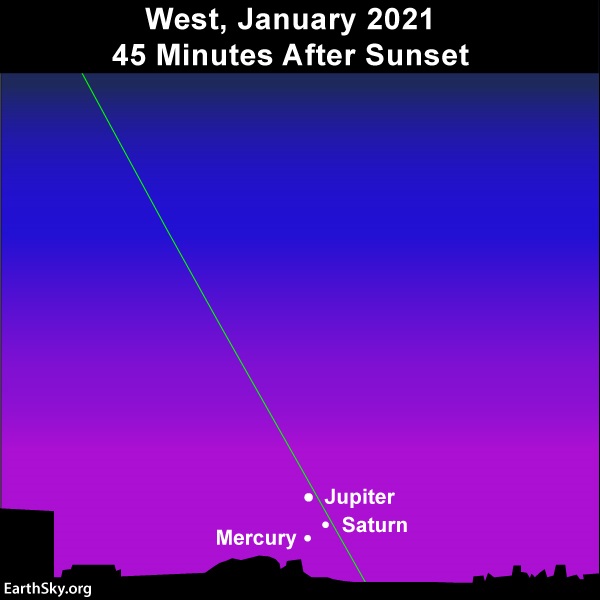
The two planets
will be easily visible, shortly after local sunset in the
southwestern sky. Even though a conjunction occurs for only one
moment, Jupiter and Saturn will be very close for several days in
December, as well as close for the next few months. So, if clouds
prevent a view of the event on the night of the Winter Solstice, the
two planets will continue their dance in the sky for awhile, as they
are now dancing together in the sky every evening as we approach the
actual conjunction event.
Saturn will appear
just above and a little to the left of Jupiter. As both are planets,
with visible disks, they do not twinkle as do stars. And, although
Saturn will be much dimmer than Jupiter, Saturn will appear as bright
as most of the bright stars visible.
Of course, as with
all celestial observations, viewing the Great Conjunction will be
weather-permitting.
Although the two
planets will appear close in the sky, they actually will be 456
million miles / 733.86 million kilometers apart. Saturn is nearly
twice as far from the Earth as is Jupiter.
Jupiter, the fifth
planet from the Sun, takes 12 years to make one solar orbit, while
Saturn, the sixth planet from the Sun, takes 30 years to orbit the
Sun. This is why Jupiter and Saturn have a conjunction, from the
viewpoint of an observer on Earth, once every 19.6 years on average;
although, some Great Conjunctions are much closer than others.
The
last conjunction of these two planets was on 2000 May 28. Great
Conjunctions will also occur on Halloween, 2040 (October 31) and 2060
April 7. However, the next time a really close Great
Conjunction of these two planets occur will be on 2080 March 15.
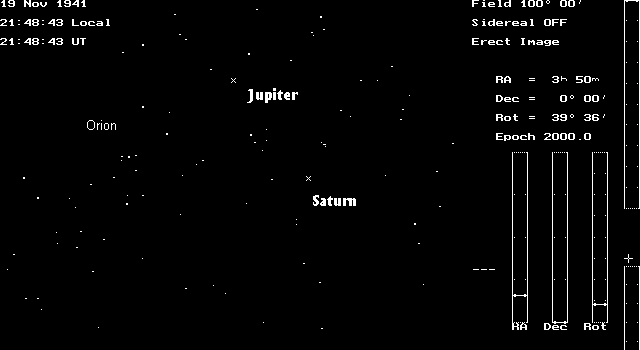
Jupiter
and Saturn were still fairly close to each other, as viewed from
Earth, on the night of the dedication of the rather unique 10-inch
Siderostat-type Refractor Telescope in Pittsburgh's original Buhl
Planetarium and Institute of Popular Science on 1941 November 19
(First Light through this telescope was the planet Saturn, that
evening). A 1941 Great Conjunction had occurred several months
earlier on 1941 February 20.
The
2020 event will be the closest conjunction of Jupiter and Saturn
since 1623 July 16 (only 14 years after Galileo used his first
telescope to view the two planets). In fact, the greatest observable
conjunction of Jupiter and Saturn came on 1226 March 4, when only
naked-eye (one-power) observations would have been possible. As with
2020, the actual time of conjunction in 1226 came during daytime
hours, when, even if Jupiter could have been found, Saturn would not
have been visible. However, the evenings near the day of conjunction
would have shown a brilliant “double-star”.
A
famous 17th century astronomer, Johannes Kepler, pointed-out that a
conjunction between Jupiter and Saturn occurred on 7 B.C. May 27,
near the time of the birth of Jesus Christ. Although this is a
possible explanation for the Star of Bethlehem, Johannes Kepler
actually preferred a nova / supernova hypothesis for the star that
allegedly led the Magi to the Christ child.
Ursid Meteor Shower
Almost 24 hours
after the Winter Solstice comes the peak of the annual Ursid Meteor
Shower, which actually begins on December 17 and usually lasts about
a week ending December 24, 25, or 26. The Ursids seem to comprise a
narrow stream of debris originating from Comet Tuttle. Hence, it is
difficult to see Ursid meteors outside of a 12-hour window before and
after the peak, where possibly 12 meteors per-hour could be seen,
under ideal conditions.
The Ursid Meteor
Shower is so-named because most meteors appear to radiate from a
point near the Star Beta Ursae Minoris (apparent meteor shower
radiant) in the Constellation Ursa Minor (better known as the
asterism the “Little Dipper”), which is the brightest star in the
bowl of the Little Dipper. Some people call these meteors “Ursids,”
in an attempt to emphasize that their apparent radiant is Ursa Minor,
not Ursa Major (the asterism the “Big Dipper”).
However, you
should not, necessarily, be looking only at the Little Dipper when
looking for meteors in this shower. Meteors can appear in any part of
the sky at any time (although a meteor's tail may tend to point back
toward the radiant).
Of course meteor
showers, like all celestial observations, are weather-permitting.
If there are more than a few clouds in the sky, meteors will be much
more difficult to find. Clear skies are not always available in the
skies of late Autumn and early Winter. And, it is always best to get
away from city lights, for the opportunity to see the smaller, dimmer
meteors. As always, the best time to view any meteor shower is
between local midnight and local dawn, when the Earth is actually
rotating into the stream of meteoric debris.
Binoculars and
telescopes are not very useful for finding meteors. Meteors streak
across the sky in a very short period of time, far too short to aim
binoculars or a telescope. So, the best way to view a meteor shower
is to lie on a blanket or beach towel on the ground, or use a
reclining a chair, outdoors in an area with a good view of the entire
sky (with few obstructions such as buildings, trees, or hills), and
keep scanning the entire sky.
So, if you go out
to see the Ursid Meteor Shower, start looking for meteors around
local midnight, or perhaps a little later. Make sure you have a good
site where you can see most of the sky, and that sky is relatively
clear. Be sure to dress properly for the early morning temperatures,
now that we are at the very beginning of Winter.
And, you want to
go out ahead of time, before you actually start looking for meteors,
to get your eyes accustomed to the dark sky. Dark-adapting your eyes
for meteor-watching could take up to a half-hour.
Internet Links to Additional
Information ---
Winter Solstice:
Link 1 >>>
http://scienceworld.wolfram.com/astronomy/WinterSolstice.html
Link
2 >>> http://en.wikipedia.org/wiki/Winter
Solstice:
Link >>> http://en.wikipedia.org/wiki/Solstice
Popular
Winter Planetarium Sky Shows Shown at Pittsburgh's original Buhl
Planetarium and Institute of Popular Science (1939 to 1991),
including full scripts of each show:
The Star of Bethlehem
>>>
http://buhlplanetarium3.tripod.com/skyshow/bethlehem/
The
Stars of Winter >>>
http://buhlplanetarium3.tripod.com/skyshow/winter/
Calendar
Formats ---
Gregorian
Calendar: Link >>>
http://en.wikipedia.org/wiki/Gregorian_calendar
Julian Calendar: Link >>>
http://en.wikipedia.org/wiki/Julian_calendar
Ursid
Meteor Shower: Link >>>
http://en.wikipedia.org/wiki/UrsidsA
Homeless
Persons' Memorial Day:
Link >>>
http://nationalhomeless.org/about-us/projects/memorial-day/
Great Conjunction: Jupiter & Saturn: Link >>> https://en.wikipedia.org/wiki/Great_conjunction
Great Conjunction of 2020: Link >>> https://earthsky.org/astronomy-essentials/great-jupiter-saturn-conjunction-dec-21-2020
Computer representation: positions of Jupiter & Saturn on night of dedication (1941 November 19): 10-inch Siderostat-type Refractor Telescope in
Pittsburgh's original Buhl Planetarium and Institute of Popular Science. Jupiter & Saturn 1941 Great
Conjunction: 1941 February 20: Link >>> https://spacewatchtower.blogspot.com/2020/12/astro-calendar-2020-dec-great.html
Source:
Glenn A. Walsh Reporting for SpaceWatchtower,
a project of Friends
of the Zeiss.
Sunday, 2020 December 20.
Like This Post? Please
Share!
More
Astronomy & Science News - SpaceWatchtower Twitter
Feed:
Link >>> https://twitter.com/spacewatchtower
Astronomy & Science Links: Link >>>
http://buhlplanetarium.tripod.com/#sciencelinks
Want to receive SpaceWatchtower blog
posts in your in-box ?
Send request to < spacewatchtower@planetarium.cc
>.
gaw
Glenn A. Walsh, Informal Science Educator &
Communicator:
Link >>> http://buhlplanetarium2.tripod.com/weblog/spacewatchtower/gaw/
Electronic
Mail: < gawalsh@planetarium.cc >
Project
Director, Friends of the Zeiss: Link >>> http://buhlplanetarium.tripod.com/fotz/
SpaceWatchtower
Editor / Author: Link >>> http://spacewatchtower.blogspot.com/
Formerly
Astronomical Observatory Coordinator & Planetarium Lecturer,
original Buhl Planetarium & Institute of Popular Science (a.k.a.
Buhl Science Center), Pittsburgh's science & technology museum
from 1939 to 1991.
Formerly Trustee, Andrew Carnegie Free Library
and Music Hall, Pittsburgh suburb of Carnegie, Pennsylvania.
Author
of History Web Sites on the Internet --
* Buhl Planetarium,
Pittsburgh: Link >>> http://www.planetarium.cc Buhl Observatory: Link >>> http://spacewatchtower.blogspot.com/2016/11/75th-anniversary-americas-5th-public.html
*
Adler Planetarium, Chicago: Link >>> http://adlerplanetarium.tripod.com
*
Astronomer, Educator, Optician John A. Brashear: Link >>> http://johnbrashear.tripod.com
*
Andrew Carnegie & Carnegie Libraries: Link >>> http://www.andrewcarnegie.cc