Tuesday, June 18, 2013

New NASA Astronauts Named: Half Are Women

These eight accomplished folks are NASA's newest astronauts in training.


It’s been two years since NASA’s space shuttle program came to an end, but thousands of Americans still dream of becoming astronauts. Eight of them – four men and four women – were introduced Monday as NASA’s astronaut candidate class for 2013.

More than 6,300 people applied to become astronauts-in-training, NASA Administrator Charles Bolden said in a video announcement. That is the second-most applications the space agency has ever received, according to a NASA statement.

The bios of the eight people selected will probably make you feel like a bit of a slacker. Two of them have PhDs and one is a physician training in sports medicine. Four have experience as test pilots for the Navy or Air Force. One person is working at the Pentagon on ways to defeat the homemade bombs that have plagued troops in Iraq and Afghanistan. One of them is the station chief for the National Oceanic and Atmospheric Administration’s research outpost in American Samoa.

Many headlines are emphasizing the fact that half the astronaut candidates are women – the first time NASA has had gender parity in an astronaut class. (There were four women in the astronaut candidate class of 1998, but they accounted for just 16% of the class’s 25 members, according to a post from Phys.org).

Some NASA watchers certainly see this as a cause for celebration. On the other hand, the fact that we’re even talking about whether these new astronauts are men or women is a sign that there’s still a ways to go. In the earliest days of the American space program, 13 women were being considered for the astronaut corps before then-Vice President Lyndon B. Johnson quashed a proposal to test their worthiness for space, Meg Waite Clayton wrote in a Los Angeles Times op-ed marking the 50th anniversary of the first spaceflight by a woman.

More - Link >>> http://www.latimes.com/news/science/sciencenow/la-sci-sn-nasa-new-astronauts-women-20130617,0,6855807.story

Source: Los Angeles Times.

NASA News Release - "NASA Selects Next Generation of Space Explorers":
Link >>> http://www.nasa.gov/home/hqnews/2013/jun/HQ_13-177_2013_Astronaut_Class.html 

Want to receive SpaceWatchtower blog posts daily in your inbox ?
Send request to < spacewatchtower@planetarium.cc >.

gaw

Glenn A. Walsh, Project Director,
Friends of the Zeiss < http://friendsofthezeiss.org >
Electronic Mail - < gawalsh@planetarium.cc >
About the Editor/Author: < http://buhlplanetarium.tripod.com/#GAW >
SPACE & SCIENCE NEWS, ASTRONOMICAL CALENDAR:
< http://buhlplanetarium.tripod.com/#news >
Twitter: < https://twitter.com/spacewatchtower >
Facebook: < http://www.facebook.com/pages/SpaceWatchtower/238017839577841?sk=wall >
Blog: < http://spacewatchtower.blogspot.com/ >
Author of History Web Sites on the Internet --
* Buhl Planetarium, Pittsburgh:
  < http://www.planetarium.cc >
* Adler Planetarium, Chicago:
  < http://adlerplanetarium.tripod.com >
* Astronomer, Educator, Optician John A. Brashear:
  < http://johnbrashear.tripod.com >
* Andrew Carnegie & Carnegie Libraries:
  < http://www.andrewcarnegie.cc >
* Civil War Museum of Andrew Carnegie Free Library:
  < http://garespypost.tripod.com >
* Duquesne Incline cable-car railway, Pittsburgh:
  < http://inclinedplane.tripod.com >
* Public Transit:
  < http://andrewcarnegie2.tripod.com/transit >

Monday, June 17, 2013

Scientists Moving 15-Ton Magnet From NY to Chicago


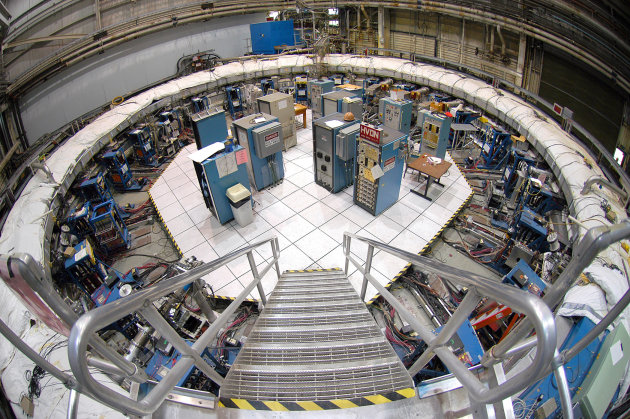
<p> A Dec. 22, 2005, photo provided by Brookhaven National Laboratory shows the 50-foot-wide electromagnet storage ring at Brookhaven National Laboratory in Upton, N.Y., on eastern Long Island. The ring, which will capture subatomic particles that live only 2.2 millionths of a second, will be transported in one piece, and moved flat, to its new home at the U.S. Department of Energy's Fermi National Accelerator Laboratory in Illinois. The trip is expected to take more than a month. (AP Photo/Brookhaven National Laboratory)
Associated Press -
A Dec. 22, 2005, photo provided by Brookhaven National Laboratory shows the 50-foot-wide electromagnet storage ring at Brookhaven National Laboratory in Upton, N.Y., on eastern Long Island.


New York to Chicago, in five weeks?

Scientists on Long Island are preparing to move a 50-foot-wide electromagnet 3,200 miles over land and sea to its new home at the U.S. Department of Energy's Fermi National Accelerator Laboratory in Illinois. The trip is expected to take more than a month.

"When we first started thinking about this, we all thought it wouldn't be possible," said Bill Morse, a physicist at Brookhaven National Lab on eastern Long Island. "But if you have a big problem, you find good people who can fix the problem. That's physics."

The electromagnet, which weighs at least 15 tons, was the largest in the world when it was built by scientists at Brookhaven in the 1990s, Morse said. Brookhaven scientists no longer have a need for the electromagnet, so it is being moved to the Fermi laboratory, where it will be used in a new experiment called Muon g-2.

The experiment will study the properties of muons, subatomic particles that live only 2.2 millionths of a second. The results of the experiment could create new discoveries in the realm of particle physics, said Chris Polly, manager of the Muon g-2 project at Fermilab.

More - Link >>> http://abcnews.go.com/Technology/wireStory/scientists-moving-15-ton-magnet-ny-chicago-19415098#.Ub6kYlHimYA

Source: Associated Press News Wire Service, ABC News.

Want to receive SpaceWatchtower blog posts daily in your inbox ?
Send request to < spacewatchtower@planetarium.cc >.

gaw

Glenn A. Walsh, Project Director,
Friends of the Zeiss < http://friendsofthezeiss.org >
Electronic Mail - < gawalsh@planetarium.cc >
About the Editor/Author: < http://buhlplanetarium.tripod.com/#GAW >
SPACE & SCIENCE NEWS, ASTRONOMICAL CALENDAR:
< http://buhlplanetarium.tripod.com/#news >
Twitter: < https://twitter.com/spacewatchtower >
Facebook: < http://www.facebook.com/pages/SpaceWatchtower/238017839577841?sk=wall >
Blog: < http://spacewatchtower.blogspot.com/ >
Author of History Web Sites on the Internet --
* Buhl Planetarium, Pittsburgh:
  < http://www.planetarium.cc >
* Adler Planetarium, Chicago:
  < http://adlerplanetarium.tripod.com >
* Astronomer, Educator, Optician John A. Brashear:
  < http://johnbrashear.tripod.com >
* Andrew Carnegie & Carnegie Libraries:
  < http://www.andrewcarnegie.cc >
* Civil War Museum of Andrew Carnegie Free Library:
  < http://garespypost.tripod.com >
* Duquesne Incline cable-car railway, Pittsburgh:
  < http://inclinedplane.tripod.com >
* Public Transit:
  < http://andrewcarnegie2.tripod.com/transit >

Sunday, June 16, 2013

Remnant of Russian Mir Space Station Found in Massachusetts


Green and his green rock.
(Credit: CBS Boston Screenshot by Chris Matyszczyk) 

Phil Green was wandering along the Merrimack River in Massachusetts when he discovered a piece of rock that didn't seem like it was from around his parts.

Green is a curious man, but not too curious. So he put his green rock in the Green garden and left it there for six years.

When a friend finally asked about it, Green thought he'd finally investigate.

It was his good fortune that his sister-in-law had a friend who worked at NASA.

In this case, the green rock did actually fall from the sky. NASA has determined it is a piece of the Russian Space Station Mir.

Mir first went up to the beyond in 1986. It was decommissioned and thrust back down to Earth in 2001.

Most of it landed in the South Pacific. This rogue piece -- and who knows how many more there might be -- decided that Massachusetts was a better resting place.
 
More - Link >>> http://news.cnet.com/8301-17852_3-57589481-71/man-finds-rock-by-river-its-a-piece-of-space-station-mir/

Source: CNET.com .

Want to receive SpaceWatchtower blog posts daily in your inbox ?
Send request to < spacewatchtower@planetarium.cc >.

gaw

Glenn A. Walsh, Project Director,
Friends of the Zeiss < http://friendsofthezeiss.org >
Electronic Mail - < gawalsh@planetarium.cc >
About the Editor/Author: < http://buhlplanetarium.tripod.com/#GAW >
SPACE & SCIENCE NEWS, ASTRONOMICAL CALENDAR:
< http://buhlplanetarium.tripod.com/#news >
Twitter: < https://twitter.com/spacewatchtower >
Facebook: < http://www.facebook.com/pages/SpaceWatchtower/238017839577841?sk=wall >
Blog: < http://spacewatchtower.blogspot.com/ >
Author of History Web Sites on the Internet --
* Buhl Planetarium, Pittsburgh:
  < http://www.planetarium.cc >
* Adler Planetarium, Chicago:
  < http://adlerplanetarium.tripod.com >
* Astronomer, Educator, Optician John A. Brashear:
  < http://johnbrashear.tripod.com >
* Andrew Carnegie & Carnegie Libraries:
  < http://www.andrewcarnegie.cc >
* Civil War Museum of Andrew Carnegie Free Library:
  < http://garespypost.tripod.com >
* Duquesne Incline cable-car railway, Pittsburgh:
  < http://inclinedplane.tripod.com >
* Public Transit:
  < http://andrewcarnegie2.tripod.com/transit >

Saturday, June 15, 2013

Video: New 3-D Map of Universe

File:Ilc 9yr moll4096.png

An earlier map of the Universe, created from nine years of microwave data from NASA's Wilkinson Microwave Anisotropy Probe (WMAP). (Image Source: Wikipedia.org )


Astronomers have put the known universe in a box on your computer screen – the 120 million light-years of it within our grasp, at least.

With a mellifluous French-accented narration, some light piano music and sweeping computer animation, the video could become a stoner classic. It also happens to be the most detailed modern cosmography of all that is visible in the sky – and a great deal of what is not.

At nearly 18 minutes long (that’s less than one side of Pink Floyd’s "The Dark Side of the Moon"), the video is not the stuff of the MTV generation and certainly not ready for prime time. But odds are it will reach cult status among astronomers, planetarium addicts and the cosmically inclined.

“I’d like to think this is the first of more ventures along the same line,” said University of Hawaii astrophysicist R. Brent Tully, who was treated to a public presentation of the work for his 70th birthday, in Paris, a week ago. “I think we’re learning how to do it. I think the next time around we’ll do it better.”

Tully worked with a team including Helene Courtois of the University of Lyon, who narrates, and whose son, Jules, accompanies her with an original piano composition.

Putting the video together -- largely the work of Daniel Pomarede of the Institute of Research on Fundamental Laws of the Universe, on the outskirts of Paris -- took months, but the research had gone on for several years. The work has been submitted to the Astronomical Journal.

Video & More - Link >>> http://www.latimes.com/news/science/sciencenow/la-sci-sn-video-maps-universe-20130613,0,5793604.story

Sources: Institute of Research on Fundamental Laws of the Universe, Los Angeles Times.

Want to receive SpaceWatchtower blog posts daily in your inbox ?
Send request to < spacewatchtower@planetarium.cc >.

gaw

Glenn A. Walsh, Project Director,
Friends of the Zeiss < http://friendsofthezeiss.org >
Electronic Mail - < gawalsh@planetarium.cc >
About the Editor/Author: < http://buhlplanetarium.tripod.com/#GAW >
SPACE & SCIENCE NEWS, ASTRONOMICAL CALENDAR:
< http://buhlplanetarium.tripod.com/#news >
Twitter: < https://twitter.com/spacewatchtower >
Facebook: < http://www.facebook.com/pages/SpaceWatchtower/238017839577841?sk=wall >
Blog: < http://spacewatchtower.blogspot.com/ >
Author of History Web Sites on the Internet --
* Buhl Planetarium, Pittsburgh:
  < http://www.planetarium.cc >
* Adler Planetarium, Chicago:
  < http://adlerplanetarium.tripod.com >
* Astronomer, Educator, Optician John A. Brashear:
  < http://johnbrashear.tripod.com >
* Andrew Carnegie & Carnegie Libraries:
  < http://www.andrewcarnegie.cc >
* Civil War Museum of Andrew Carnegie Free Library:
  < http://garespypost.tripod.com >
* Duquesne Incline cable-car railway, Pittsburgh:
  < http://inclinedplane.tripod.com >
* Public Transit:
  < http://andrewcarnegie2.tripod.com/transit >

Friday, June 14, 2013

New Book: "The Astronaut Wives Club: A True Story"


LIFE magazine cover, September 21, 1959. Top row, left to right: Jo Schirra, Louise Shepard. Middle row: Annie Glenn, Rene Carpenter, Marjorie Slayton. Bottom row: Trudy Cooper, Betty Grissom.

The Mercury Seven astronauts had a rendezvous with destiny, and it turns out their wives did too.

“To be an astronaut wife,” writes Lily Koppel in her new book The Astronaut Wives Club, “meant tea with Jackie Kennedy, high society galas, and instant celebrity.” When their husbands were selected by NASA, these seven women went from being military wives on Navy and Air Force bases to intense, unrelenting scrutiny in the public eye.

Koppel, who interviewed many of the Mercury, Gemini, and Apollo wives, fills the book with interesting tidbits.

More - Link >>> http://blogs.airspacemag.com/daily-planet/2013/06/the-astronaut-wives-club/

Amazon.com: New Book The Astronaut Wives Club: A True Story:
Link >>> http://www.amazon.com/The-Astronaut-Wives-Club-Story/dp/1455503258/ref=sr_1_1?ie=UTF8&qid=1366812895&sr=8-1&keywords=the+astronaut+wives+club

Source: Air & Space Smithsonian Magazine.

Want to receive SpaceWatchtower blog posts daily in your inbox ?
Send request to < spacewatchtower@planetarium.cc >.

gaw

Glenn A. Walsh, Project Director,
Friends of the Zeiss < http://friendsofthezeiss.org >
Electronic Mail - < gawalsh@planetarium.cc >
About the Editor/Author: < http://buhlplanetarium.tripod.com/#GAW >
SPACE & SCIENCE NEWS, ASTRONOMICAL CALENDAR:
< http://buhlplanetarium.tripod.com/#news >
Twitter: < https://twitter.com/spacewatchtower >
Facebook: < http://www.facebook.com/pages/SpaceWatchtower/238017839577841?sk=wall >
Blog: < http://spacewatchtower.blogspot.com/ >
Author of History Web Sites on the Internet --
* Buhl Planetarium, Pittsburgh:
  < http://www.planetarium.cc >
* Adler Planetarium, Chicago:
  < http://adlerplanetarium.tripod.com >
* Astronomer, Educator, Optician John A. Brashear:
  < http://johnbrashear.tripod.com >
* Andrew Carnegie & Carnegie Libraries:
  < http://www.andrewcarnegie.cc >
* Civil War Museum of Andrew Carnegie Free Library:
  < http://garespypost.tripod.com >
* Duquesne Incline cable-car railway, Pittsburgh:
  < http://inclinedplane.tripod.com >
* Public Transit:
  < http://andrewcarnegie2.tripod.com/transit >

Thursday, June 13, 2013

Snowboarding on Mars? Gullies by Cascades of Dry Ice

PBS NewsHour
 
 
This image from the High Resolution Imaging Science Experiment camera on NASA's Mars Reconnaissance Orbiter is an example "linear gullies" formed by dry ice thawing across the planet's sand dunes. Courtesy NASA/JPL-Caltech/University of Arizona.

Mars' surface is streaked with furrows and ditches across its rusty red soil, mimicking our planet's river plains. But unlike Earth, Mars has no surface rivers or streams that would leave such marks.

Serina Diniega, a planetary scientist at NASA's Jet Propulsion Laboratory in Pasadena, Calif., and lead author of a report published online in the journal Icarus, determined these signature gullies on its red sand dunes are a result of cascades of dry ice running across the planet's surface every spring.

"I have always dreamed of going to Mars," Diniega said in a post on NASA's website. "Now I dream of snowboarding down a Martian sand dune on a block of dry ice."

At first glance, the channels look like riverbeds on Earth. But when rivers on Earth reach their end, they leave a plain of silt and debris. Images from Mars Reconnaissance Orbiter's High Resolution Imaging Science Experiment camera show linear gullies on Mars' surface end abruptly.

The HiRISE images also showed the red dunes covered by carbon-dioxide frost during the Martian winter. By comparing photos from different seasons, researchers determined that the grooves must have formed during early spring. Some images revealed bright objects in the gullies, which researchers determined was dry ice.

Dry ice is carbon dioxide in its solid form, something that doesn't naturally form on Earth's surface, Diniega said. But it's abundant on Mars, where a CO2-rich atmosphere produces snowbanks of frozen carbon dioxide, not water.

More - Link >>> http://www.pbs.org/newshour/rundown/2013/06/dry-ice-on-mars-makes-remarkable-gullies.html

Source: PBS NewsHour.

Related Blog Post ---

Mars Meteorite Hints at Life Building-Block (2013 June 12):

Link >>> http://spacewatchtower.blogspot.com/2013/06/mars-meteorite-hints-at-life-building.html


Want to receive SpaceWatchtower blog posts daily in your inbox ?
Send request to < spacewatchtower@planetarium.cc >.

gaw

Glenn A. Walsh, Project Director,
Friends of the Zeiss < http://friendsofthezeiss.org >
Electronic Mail - < gawalsh@planetarium.cc >
About the Editor/Author: < http://buhlplanetarium.tripod.com/#GAW >
SPACE & SCIENCE NEWS, ASTRONOMICAL CALENDAR:
< http://buhlplanetarium.tripod.com/#news >
Twitter: < https://twitter.com/spacewatchtower >
Facebook: < http://www.facebook.com/pages/SpaceWatchtower/238017839577841?sk=wall >
Blog: < http://spacewatchtower.blogspot.com/ >
Author of History Web Sites on the Internet --
* Buhl Planetarium, Pittsburgh:
  < http://www.planetarium.cc >
* Adler Planetarium, Chicago:
  < http://adlerplanetarium.tripod.com >
* Astronomer, Educator, Optician John A. Brashear:
  < http://johnbrashear.tripod.com >
* Andrew Carnegie & Carnegie Libraries:
  < http://www.andrewcarnegie.cc >
* Civil War Museum of Andrew Carnegie Free Library:
  < http://garespypost.tripod.com >
* Duquesne Incline cable-car railway, Pittsburgh:
  < http://inclinedplane.tripod.com >
* Public Transit:
  < http://andrewcarnegie2.tripod.com/transit >

Wednesday, June 12, 2013

Mars Meteorite Hints at Life Building-Block


Date: 11 June 2013 Time: 04:54 PM ET
Electron microscope image showing the 700-million-year-old Martian clay veins containing boron (100 µm = one tenth of a millimeter).
CREDIT: UHNAI
At a time when life as we know it was just getting its start on Earth, Martian clay may have harbored a key component for one of life's molecular building blocks, researchers say.

Boron found in a Martian meteorite suggests the Red Planet may once have had the right chemistry to give rise to RNA, according to a new study.

"In early life RNA is thought to have been the informational precursor to DNA," study researcher James Stephenson, an evolutionary biologist, said in a statement.

The space rock at the center of the study was collected during the 2009-2010 field season of the Antarctic Search for Meteorites (ANSMET). This annual search aims to find dark rocks embedded in Antarctica's pale landscape that might be extraterrestrial in origin. The project is funded by NASA, the National Science Foundation and the Smithsonian Institution.

The new research was detailed online June 6 in the journal PLOS One.

More - Link >>> http://www.space.com/21526-mars-meteorite-ingredient-life.html

 Source: Space.com .

Want to receive SpaceWatchtower blog posts daily in your inbox ?
Send request to < spacewatchtower@planetarium.cc >.

gaw

Glenn A. Walsh, Project Director,
Friends of the Zeiss < http://friendsofthezeiss.org >
Electronic Mail - < gawalsh@planetarium.cc >
About the Editor/Author: < http://buhlplanetarium.tripod.com/#GAW >
SPACE & SCIENCE NEWS, ASTRONOMICAL CALENDAR:
< http://buhlplanetarium.tripod.com/#news >
Twitter: < https://twitter.com/spacewatchtower >
Facebook: < http://www.facebook.com/pages/SpaceWatchtower/238017839577841?sk=wall >
Blog: < http://spacewatchtower.blogspot.com/ >
Author of History Web Sites on the Internet --
* Buhl Planetarium, Pittsburgh:
  < http://www.planetarium.cc >
* Adler Planetarium, Chicago:
  < http://adlerplanetarium.tripod.com >
* Astronomer, Educator, Optician John A. Brashear:
  < http://johnbrashear.tripod.com >
* Andrew Carnegie & Carnegie Libraries:
  < http://www.andrewcarnegie.cc >
* Civil War Museum of Andrew Carnegie Free Library:
  < http://garespypost.tripod.com >
* Duquesne Incline cable-car railway, Pittsburgh:
  < http://inclinedplane.tripod.com >
* Public Transit:
  < http://andrewcarnegie2.tripod.com/transit >