Wednesday, April 17, 2013

Trip to Space Contest Offered by Dutch Airline

KLM launches competition to win a flight into space
The Lynx suborbital vehicle Photo: Copyright © 2013 XCOR Aerospace, Inc.

11:56 AM BST 17 Apr 2013

The winner who correctly guesses the answer to a single question will be able to board a suborbital flight to the edge of the realm once described as man’s final frontier. 

KLM’s competition offers a place on a Space Expedition Corporation (SXC) Lynx spaceship, with room for one passenger and one astronaut, launching from Curacao in the Dutch Caribbean.

It claims it will be the first commercial flight to space, departing on January 1, 2014 and lasting approximately an hour, with tickets normally costing $95,000 (£62,018).

Entrants to the competition are being asked to guess the height at which a high altitude balloon, to be released above the Nevada desert by KLM on April 22, will pop and fall back to Earth.

More - Link >>> http://www.telegraph.co.uk/travel/10000316/Win-a-trip-to-space-in-KLM-competition.html

Source: The Telegraph of London.

KLM Airline Trip to Space Contest: Link >>> http://space.klm.com/

gaw

Glenn A. Walsh, Project Director,
Friends of the Zeiss < http://friendsofthezeiss.org >
Electronic Mail - < gawalsh@planetarium.cc >
About the Author: < http://buhlplanetarium.tripod.com/#GAW >
SPACE & SCIENCE NEWS, ASTRONOMICAL CALENDAR:
< http://buhlplanetarium.tripod.com/#news >
Twitter: < https://twitter.com/spacewatchtower >
Facebook: < http://www.facebook.com/pages/SpaceWatchtower/238017839577841?sk=wall >
Blog: < http://spacewatchtower.blogspot.com/ >
Author of History Web Sites on the Internet --
* Buhl Planetarium, Pittsburgh:
  < http://www.planetariu p.m. m.cc >
* Adler Planetarium, Chicago:
  < http://adlerplanetarium.tripod.com >
* Astronomer, Educator, Optician John A. Brashear:
  < http://johnbrashear.tripod.com >
* Andrew Carnegie & Carnegie Libraries:
  < http://www.andrewcarnegie.cc >
* Civil War Museum of Andrew Carnegie Free Library:
  < http://garespypost.tripod.com >
* Duquesne Incline cable-car railway, Pittsburgh:
  < http://inclinedplane.tripod.com >
* Public Transit:
  < http://andrewcarnegie2.tripod.com/transit >

2 Spacecraft to Fly in Formation as Test for Future Huge Space Telescopes

For the Very First Time, Two Spacecraft Will Fly in Formation With Millimeter Precision

Apr. 16, 2013 — Spanish industry is leading the Proba-3 mission, a world first in precise formation flying. This European Space Agency (ESA) project aims to demonstrate that two satellites can move as one single object with sub-millimetre precision. This configuration will enable the creation of enormous space telescopes with the lens and detector hundreds of metres apart.


For the very first time, two spacecraft will fly in formation with sub-millimeter precision. (Credit: ESA - P. Carril)
"Proba-3 will be the first mission in which two spacecraft will fly through space as a single unit, pointing at selectable directions, and with sub-millimetre precision, in other words, relative position accuracy to within less than one millimetre," Salvador Llorente, director of this project in SENER, the first Spanish company to lead an ESA mission, explained. There have been very few formation satellite missions up to now, such as the Swedish Prisma project, and only in the near Earth environment and with a level of precision of tens of centimetres.

The new mission includes two satellites weighing approximately 340 kg and 200 kg. They will be launched in 2017 -several launchers are being evaluated, including one from India and another from the US- and they will travel jointly attached together until they separate in a highly-eccentric orbit. Their nearest point, the perigee, will only be 600 km from Earth. Every time they pass through this zone they will be in free flight, but under well controlled trajectories.

More - Link >>> http://www.sciencedaily.com/releases/2013/04/130416114208.htm?utm_source=feedburner&utm_medium=email&utm_campaign=Feed%3A+sciencedaily%2Fspace_time+%28ScienceDaily%3A+Space+%26+Time+News%29&utm_content=Yahoo!+Mail

Sources: Plataforma SINC, AlphaGalileo, and ScienceDaily.com .

gaw

Glenn A. Walsh, Project Director,
Friends of the Zeiss < http://friendsofthezeiss.org >
Electronic Mail - < gawalsh@planetarium.cc >
About the Author: < http://buhlplanetarium.tripod.com/#GAW >
SPACE & SCIENCE NEWS, ASTRONOMICAL CALENDAR:
< http://buhlplanetarium.tripod.com/#news >
Twitter: < https://twitter.com/spacewatchtower >
Facebook: < http://www.facebook.com/pages/SpaceWatchtower/238017839577841?sk=wall >
Blog: < http://spacewatchtower.blogspot.com/ >
Author of History Web Sites on the Internet --
* Buhl Planetarium, Pittsburgh:
  < http://www.planetariu p.m. m.cc >
* Adler Planetarium, Chicago:
  < http://adlerplanetarium.tripod.com >
* Astronomer, Educator, Optician John A. Brashear:
  < http://johnbrashear.tripod.com >
* Andrew Carnegie & Carnegie Libraries:
  < http://www.andrewcarnegie.cc >
* Civil War Museum of Andrew Carnegie Free Library:
  < http://garespypost.tripod.com >
* Duquesne Incline cable-car railway, Pittsburgh:
  < http://inclinedplane.tripod.com >
* Public Transit:
  < http://andrewcarnegie2.tripod.com/transit >

Tuesday, April 16, 2013

Update: Comet Close Flyby of Mars in 2014 October

Apr. 15, 2013 — New observations of comet C/2013 A1 (Siding Spring) have allowed NASA's Near-Earth Object Office at the Jet Propulsion Laboratory in Pasadena, Calif. to further refine the comet's orbit.


This computer graphic depicts the orbit of comet 2013 A1 (Siding Spring) through the inner solar system. (Credit: NASA/JPL-Caltech)
Based on data through April 7, 2013, the latest orbital plot places the comet's closest approach to Mars slightly closer than previous estimates, at about 68,000 miles (110,000 kilometers). At the same time, the new data set now significantly reduces the probability the comet will impact the Red Planet.

More - Link >>> http://www.sciencedaily.com/releases/2013/04/130415123213.htm?utm_source=feedburner&utm_medium=email&utm_campaign=Feed%3A+sciencedaily%2Fspace_time+%28ScienceDaily%3A+Space+%26+Time+News%29&utm_content=Yahoo!+Mail

Sources: NASA/Jet Propulsion Laboratory, California Institute of Technology, ScienceDaily.com .

Related Blog Posts ---

Collision Course? A Comet Heads for Mars  (2013 March 28):

Link >>> http://spacewatchtower.blogspot.com/2013/03/collision-course-comet-heads-for-mars.html


Could a Comet Hit Mars in 2014? (2013 March 2):

Link >>> http://spacewatchtower.blogspot.com/2013/03/could-comet-hit-mars-in-2014.html


gaw

Glenn A. Walsh, Project Director,
Friends of the Zeiss < http://friendsofthezeiss.org >
Electronic Mail - < gawalsh@planetarium.cc >
About the Author: < http://buhlplanetarium.tripod.com/#GAW >
SPACE & SCIENCE NEWS, ASTRONOMICAL CALENDAR:
< http://buhlplanetarium.tripod.com/#news >
Twitter: < https://twitter.com/spacewatchtower >
Facebook: < http://www.facebook.com/pages/SpaceWatchtower/238017839577841?sk=wall >
Blog: < http://spacewatchtower.blogspot.com/ >
Author of History Web Sites on the Internet --
* Buhl Planetarium, Pittsburgh:
  < http://www.planetariu p.m. m.cc >
* Adler Planetarium, Chicago:
  < http://adlerplanetarium.tripod.com >
* Astronomer, Educator, Optician John A. Brashear:
  < http://johnbrashear.tripod.com >
* Andrew Carnegie & Carnegie Libraries:
  < http://www.andrewcarnegie.cc >
* Civil War Museum of Andrew Carnegie Free Library:
  < http://garespypost.tripod.com >
* Duquesne Incline cable-car railway, Pittsburgh:
  < http://inclinedplane.tripod.com >
* Public Transit:
  < http://andrewcarnegie2.tripod.com/transit >

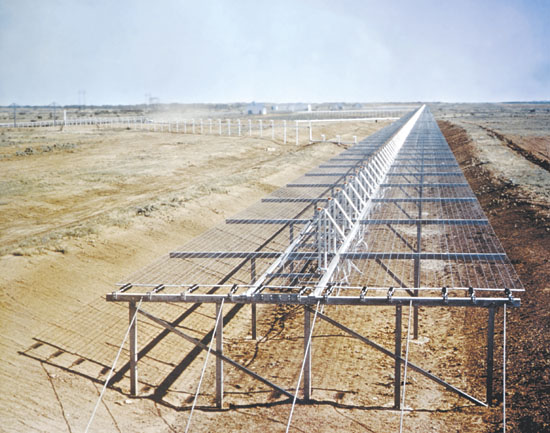
Sequestration: Cuts to USAF 'Space Fence' Tracking Space Junk ?

File:NAVSPASUR Fence 2001.jpg

Part of the master transmitter antenna for the Air Force Space Surveillance System, colloquially known as the Space Fence, at Lake Kickapoo, Texas c.2001.
(Image Source: Wikipedia.org )

U.S. Air Force says Space Fence program safe for now


Tue Apr 16, 2013 12:12pm EDT
(Corrects typo in date in first paragraph; earlier, in the 18th paragraph, the spelling of a general's name was corrected to McMurry)

* Lockheed, Raytheon bidding to build new radar
* Space programs vulnerable to further budget cuts
* Decisions due in coming years on new approaches

By Andrea Shalal-Esa

WASHINGTON, April 15 (Reuters) - The U.S. Air Force on Monday said it took steps to fully fund the first increment of a new ground-based radar to track satellites and other objects in space in its fiscal 2014 budget proposal, but there was no funding for a second site for now.

Jamie Morin, acting undersecretary of the Air Force, told reporters the Space Fence program was a priority given growing threats in space and the need to monitor activities in space.

"Space Fence is as solid as any program can be in the fiscal environment we're in right now," Morin, who also serves as the Air Force's top budget official, told reporters.

The new program will allow the Air Force to sharply increase its ability to track "space junk" and other smaller objects in space. Currently the Air Force tracks about 23,000 of an estimated 500,000 objects in space, but the new program would allow it to track hundreds of thousands of additional objects.


More - Link >>> http://www.reuters.com/article/2013/04/16/usa-airforce-space-idUSL2N0D300O20130416

Source: Reuters News Wire Service.

More on the U.S. Air Force Space Surveillance System, colloquially known as the Space Fence:
Link >>> http://en.wikipedia.org/wiki/Space_Fence

Related Blog Posts ---

Sequestration: NASA Cuts Public Education & Outreach (2013 March 24):

Link >>> http://spacewatchtower.blogspot.com/2013/03/sequestration-nasa-cuts-public.html


How Sequestration Could Hit NASA Projects (2013 Feb. 25):

Link >>> http://spacewatchtower.blogspot.com/2013/02/how-sequestration-could-hit-nasa.html


Sequestration: NASA to Lose $1.5 Billion (2012 Sept. 16):

Link >>> http://spacewatchtower.blogspot.com/2012/09/sequestration-nasa-to-lose-15-billion.html


gaw

Glenn A. Walsh, Project Director,
Friends of the Zeiss < http://friendsofthezeiss.org >
Electronic Mail - < gawalsh@planetarium.cc >
About the Author: < http://buhlplanetarium.tripod.com/#GAW >
SPACE & SCIENCE NEWS, ASTRONOMICAL CALENDAR:
< http://buhlplanetarium.tripod.com/#news >
Twitter: < https://twitter.com/spacewatchtower >
Facebook: < http://www.facebook.com/pages/SpaceWatchtower/238017839577841?sk=wall >
Blog: < http://spacewatchtower.blogspot.com/ >
Author of History Web Sites on the Internet --
* Buhl Planetarium, Pittsburgh:
  < http://www.planetariu p.m. m.cc >
* Adler Planetarium, Chicago:
  < http://adlerplanetarium.tripod.com >
* Astronomer, Educator, Optician John A. Brashear:
  < http://johnbrashear.tripod.com >
* Andrew Carnegie & Carnegie Libraries:
  < http://www.andrewcarnegie.cc >
* Civil War Museum of Andrew Carnegie Free Library:
  < http://garespypost.tripod.com >
* Duquesne Incline cable-car railway, Pittsburgh:
  < http://inclinedplane.tripod.com >
* Public Transit:
  < http://andrewcarnegie2.tripod.com/transit >

Monday, April 15, 2013

Scientists Plan for Asteroid Deflection Mission


File:Minor Planets - Apollo.svg

The Apollo asteroid group (shown in green). The Sun is in the center, with the planets Mercury (black), Venus (yellow), Earth (blue) and Mars (red). The European Space Agency and NASA plan on crashing a spacecraft into an Apollo asteroid, to study techniques which could deflect a future asteroid that may pose a danger to Earth. (Image Source: Wikipedia.org )

Scientists Plan for 2022 Space Smash

By Eve Pearce, European Correspondent
Reporting for SpaceWatchtower 
2013 April 15
 
Leading astronomers in the United States and Europe are planning to crash a spacecraft into an asteroid in order to research deflection methods. The project, entitled the Asteroid Impact and Deflection Assessment Mission (AIDA), will be launched in 2019. Two spacecraft – one built by the European Space Agency and the other by scientists from the United States – will take three years to reach their destination, the asteroid Didymos.

More - Link >>> http://buhlplanetarium2.tripod.com/weblog/spacewatchtower/pearcee/Scientists_Plan_for_Asteroid_Deflection_Mission.html

Source: Eve Pearce, European Correspondent Reporting for SpaceWatchtower, a project of Friends of the Zeiss.
Biography: >>> http://buhlplanetarium2.tripod.com/weblog/spacewatchtower/pearcee/index.html

More on Asteroid 65803 Didymos:
Link >>> http://en.wikipedia.org/wiki/65803_Didymos

Related Blog Post ---

NASA-ESA Asteroid Deflection Mission Ideas Sought (2013 Jan. 16):

Link >>> http://spacewatchtower.blogspot.com/2013/01/nasa-esa-asteroid-deflection-mission.html


gaw

Glenn A. Walsh, Project Director,
Friends of the Zeiss < http://friendsofthezeiss.org >
Electronic Mail - < gawalsh@planetarium.cc >
About the Author: < http://buhlplanetarium.tripod.com/#GAW >
SPACE & SCIENCE NEWS, ASTRONOMICAL CALENDAR:
< http://buhlplanetarium.tripod.com/#news >
Twitter: < https://twitter.com/spacewatchtower >
Facebook: < http://www.facebook.com/pages/SpaceWatchtower/238017839577841?sk=wall >
Blog: < http://spacewatchtower.blogspot.com/ >
Author of History Web Sites on the Internet --
* Buhl Planetarium, Pittsburgh:
  < http://www.planetariu p.m. m.cc >
* Adler Planetarium, Chicago:
  < http://adlerplanetarium.tripod.com >
* Astronomer, Educator, Optician John A. Brashear:
  < http://johnbrashear.tripod.com >
* Andrew Carnegie & Carnegie Libraries:
  < http://www.andrewcarnegie.cc >
* Civil War Museum of Andrew Carnegie Free Library:
  < http://garespypost.tripod.com >
* Duquesne Incline cable-car railway, Pittsburgh:
  < http://inclinedplane.tripod.com >
* Public Transit:
  < http://andrewcarnegie2.tripod.com/transit >

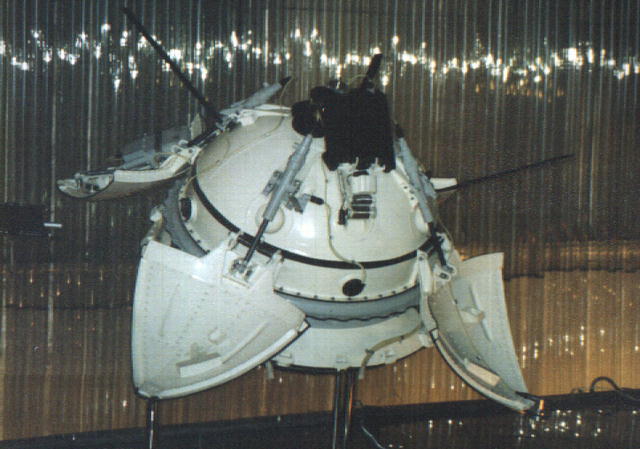
Amateur Astronomers Spot Missing Russian Mars Lander

File:Mars3 lander vsm.jpg

Mars 3 Lander model at the Memorial Museum of Cosmonautics in Moscow.
(Image Source: Wikipedia.org )

Using imagery taken by NASA's Mars Reconnaissance Orbiter in 2007, amateur astronomers located an object that could be a Russian lander that went dark after a few seconds on Mars in 1971. John Matson reports.

Back in 1971 the Soviet lander Mars 3 scored the first soft landing on the Red Planet. But it operated for only about 15 seconds and then failed. Since that time, Mars 3 has been little more than an historic interplanetary paperweight, its exact resting place unknown.

Now a team of amateur researchers may have located the defunct lander, using imagery taken by NASA’s Mars Reconnaissance Orbiter in 2007.

More - Link http://www.scientificamerican.com/podcast/episode.cfm?id=amateur-astronomers-spot-missing-ru-13-04-15&WT.mc_id=SA_DD_20130415

Source: Scientific American Magazine.

More on the Russian Mars 3 Mission:

gaw

Glenn A. Walsh, Project Director,
Friends of the Zeiss < http://friendsofthezeiss.org >
Electronic Mail - < gawalsh@planetarium.cc >
About the Author: < http://buhlplanetarium.tripod.com/#GAW >
SPACE & SCIENCE NEWS, ASTRONOMICAL CALENDAR:
< http://buhlplanetarium.tripod.com/#news >
Twitter: < https://twitter.com/spacewatchtower >
Facebook: < http://www.facebook.com/pages/SpaceWatchtower/238017839577841?sk=wall >
Blog: < http://spacewatchtower.blogspot.com/ >
Author of History Web Sites on the Internet --
* Buhl Planetarium, Pittsburgh:
  < http://www.planetariu p.m. m.cc >
* Adler Planetarium, Chicago:
  < http://adlerplanetarium.tripod.com >
* Astronomer, Educator, Optician John A. Brashear:
  < http://johnbrashear.tripod.com >
* Andrew Carnegie & Carnegie Libraries:
  < http://www.andrewcarnegie.cc >
* Civil War Museum of Andrew Carnegie Free Library:
  < http://garespypost.tripod.com >
* Duquesne Incline cable-car railway, Pittsburgh:
  < http://inclinedplane.tripod.com >
* Public Transit:
  < http://andrewcarnegie2.tripod.com/transit >

Sunday, April 14, 2013

Construction of World's Largest Telescope Approved by Hawaii

File:Top view of tmt complex.jpg

Rendering of the Thirty Meter Telescope design as of 2012 (Image Source: Wikipedia.org )

Hawaii land board approves Thirty Meter Telescope, but imposes conditions


HONOLULU — A plan by California and Canadian universities to build the world’s largest telescope at the summit of Hawaii’s Mauna Kea volcano won approval from the state Board of Land and Natural Resources on Friday.

The decision clears the way for the group managing the Thirty Meter Telescope project to negotiate a sublease for land with the University of Hawaii.

The telescope would be able to observe planets that orbit stars other than the sun and enable astronomers to watch new planets and stars being formed. It should also help scientists see some 13 billion light-years away for a glimpse into the early years of the universe. Construction costs are expected to top $1 billion.

The telescope’s segmented primary mirror, which is nearly 100 feet (30 meters) long, will give it nine times the collecting area of the largest optical telescopes in use today. Its images also will be three times sharper.

More - Link >>> http://www.washingtonpost.com/national/health-science/hawaii-land-board-approves-thirty-meter-telescope-but-imposes-conditions/2013/04/13/9581dd06-a468-11e2-82bc-511538ae90a4_story.html

Sources: Associated Press News Wire Service, The Washington Post.

More on the proposed Thirty-Meter Telescope (TMT):
Link >>> http://en.wikipedia.org/wiki/Thirty_Meter_Telescope

gaw

Glenn A. Walsh, Project Director,
Friends of the Zeiss < http://friendsofthezeiss.org >
Electronic Mail - < gawalsh@planetarium.cc >
About the Author: < http://buhlplanetarium.tripod.com/#GAW >
SPACE & SCIENCE NEWS, ASTRONOMICAL CALENDAR:
< http://buhlplanetarium.tripod.com/#news >
Twitter: < https://twitter.com/spacewatchtower >
Facebook: < http://www.facebook.com/pages/SpaceWatchtower/238017839577841?sk=wall >
Blog: < http://spacewatchtower.blogspot.com/ >
Author of History Web Sites on the Internet --
* Buhl Planetarium, Pittsburgh:
  < http://www.planetariu p.m. m.cc >
* Adler Planetarium, Chicago:
  < http://adlerplanetarium.tripod.com >
* Astronomer, Educator, Optician John A. Brashear:
  < http://johnbrashear.tripod.com >
* Andrew Carnegie & Carnegie Libraries:
  < http://www.andrewcarnegie.cc >
* Civil War Museum of Andrew Carnegie Free Library:
  < http://garespypost.tripod.com >
* Duquesne Incline cable-car railway, Pittsburgh:
  < http://inclinedplane.tripod.com >
* Public Transit:
  < http://andrewcarnegie2.tripod.com/transit >