Thursday, April 18, 2019

NASA Studying Earth Bacteria in Space from ISS to Human Waste on the Moon!


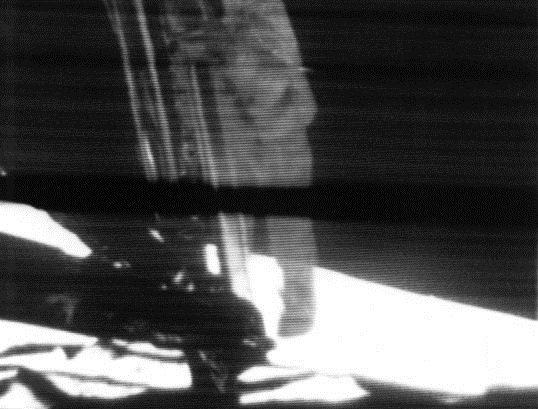
             Neil Armstrong became the first human to step onto the surface of the Moon
In this image from a black-and-white, live telecast from the Moon, Neil Armstrong became the first human to set-foot on another planetary body, other than Earth: Sunday Evening, 1969 July 20, 10:56:20 p.m. Eastern Daylight Saving Time (EDT) / July 21, 2:56:20 Coordinated Universal Time (UTC). In addition to leaving footprints on the Moon, the twelve NASA astronauts left 96 bags of human waste!
(Image Sources: NASA, Wikipedia.com, By National Aeronautics and Space Administration - NASA's Apollo 11 Multimedia webpage, Public Domain, https://commons.wikimedia.org/w/index.php?curid=433831)

By Glenn A. Walsh
Reporting for SpaceWatchtower

As plans continue to be made for human space flight to the Moon, Mars, and beyond, NASA continues to study the several challenges to sending people beyond low-Earth orbit, where the International Space Station is located. Some of these challenges include cosmic radiation, the effect of micro-gravity on bones, muscles, and eyes, and even the bacteria each one of us carries with us wherever we go.

Last week, NASA released a study of the microbiome of the International Space Station (ISS) which examined the bacteria and fungi present and viable. This microbiome is formed from microbes flaking off the astronauts / cosmonauts (usually around six on-board at a time), as well as from cargo received at the ISS four-to-six times a year.

It was found that four times more microbes were viable on the ISS, when the microbes have a nutrient-rich source, compared to spacecraft assembly cleanrooms. It was determined that, unlike on Earth, most of these microbes were from animal skin sources (i.e. mostly human sources); on Earth, more soil microbiomes are found.

NASA is looking for “opportunistic pathogens” which could harm astronauts in space. Their research is trying to determine how possible pathogens might be affected by the space environment, including radiation and micro-gravity.

“Spaceflight can turn harmless bacteria into potential pathogens,” senior study author Elisabeth Grohmann, a professor at Beuth University of Applied Sciences Berlin, said in a statement. “Just as stress hormones leave astronauts vulnerable to infection, the bacteria they carry become hardier developing thick protective coatings and resistance to antibiotics--and more vigorous, multiplying and metabolizing faster.”

And, some microbes can form biofilms, that is structures that can glue microbes to one-another, as well as to solid surfaces. NASA is concerned that such biofilms may be more resistant to antibiotics available on the ISS, should an astronaut become infected by a pathogen. Scientists also want to determine if bacteria and fungi which cause corrosion on Earth could do the same thing in deep-space vehicles.

Recently, tests of a new anti-microbial coating, called AGXX, have been conducted on the International Space Station. This new silver and ruthenium-based coating showed promise in greatly reducing the amount of bacteria on contamination-prone surfaces.

“Immunosuppression, bacterial virulence and therefore infection risk increase with duration of spaceflight,” Dr. Grohmann said. “We must continue to develop new approaches to combat bacterial infections if we are to attempt longer missions to Mars and beyond. For our part, we are continuing to analyze the antimicrobial performance of AGXX, most recently aboard the joint IBMP-NASA SIRIUS 18/9 isolation mission.”

Once we return to the Moon, NASA also plans to study the 96 bags of human waste, “urine, food waste, vomit, and other waste,” left by the twelve Apollo astronauts who walked on the Moon 50 years ago. This waste was tossed to the lunar surface in white “jett” jettison bags before the astronauts left the Moon.

Of course, the question is whether bacteria in the jett bags could survive over the last five decades. According to the NASA report, if microbes in this human waste can survive for 50 years in the harsh lunar environment, such microbes could possibly survive interplanetary or even interstellar travel and possibly seed life on other planets visited by spacecraft from Earth.

Folklore over the years, and in later years promoted by the Internet, states that microbes were found living on a camera launched to the Moon in April of 1967, aboard the Surveyor 3 unmanned lander spacecraft. This camera had been returned to Earth by astronauts from the Apollo 12 mission in November of 1969, which had landed close to Surveyor 3 specifically for the purpose of studying the remains of the unmanned spacecraft.

However, by 2011 the conclusion that microbes had survived on Surveyor 3 for more than two years was highly in-question. NASA researchers concluded that re-contamination of the camera, either in the Apollo 12 capsule during the trip back to Earth, or during the evaluation of the camera back on Earth, could account for the microbes found on the camera.

On the Apollo 16 mission in April of 1972, the astronauts perfomed an experiment where nine species of microbes were exposed to the harsh environment on the outside of the spacecraft for a few days. Many of these microbes did survive, but again, only for a few days.

Once NASA astronauts can get back to the Moon, they can determine if the bacteria in the “poop” from 50 years ago were also able to survive.

University of Florida scientist Andrew Schuerger told Vox.com that it is unlikely that any microbes in the human waste from the Apollo missions did survive, “But it’s the highest probability [out] of anything that landed on the moon.”

Internet Links to Additional Information ---

Linh Anh Cat. "4 Discoveries About Microbes On The International Space Station."
Forbes Magazine 2019 April 17.
Link >>> https://www.forbes.com/sites/linhanhcat/2019/04/17/microbes-international-space-station/#60ddee643ef8

Walter, Kenny. "New Antimicrobial Coating Protects Astronauts From Superbugs in Space."
R&D Magazine 2019 March 22.
Link >>> https://www.rdmag.com/news/2019/03/new-antimicrobial-coating-protects-astronauts-superbugs-space

Resnick, Brian. "Apollo astronauts left their poop on the moon. We gotta go back for that shit."
Vox.com 2019 April 1.
Link >>> https://www.vox.com/science-and-health/2019/3/22/18236125/apollo-moon-poop-mars-science

Source: Glenn A. Walsh Reporting for SpaceWatchtower, a project of Friends of the Zeiss.
              Thursday, 2019 April 18.

                             Like This Post?  Please Share!

           More Astronomy & Science News - SpaceWatchtower Twitter Feed:
            Link >>> https://twitter.com/spacewatchtower

        Astronomy & Science Links: Link >>> http://buhlplanetarium.tripod.com/#sciencelinks

                Want to receive SpaceWatchtower blog posts in your in-box ?
                Send request to < spacewatchtower@planetarium.cc >.

gaw

Glenn A. Walsh - Informal Science Educator & Communicator:
< http://buhlplanetarium2.tripod.com/weblog/spacewatchtower/gaw/ >
Electronic Mail: < gawalsh@planetarium.cc >
Project Director, Friends of the Zeiss: < http://buhlplanetarium.tripod.com/fotz/ >
SpaceWatchtower Editor / Author: < http://spacewatchtower.blogspot.com/ >
Formerly Astronomical Observatory Coordinator & Planetarium Lecturer, original Buhl Planetarium & Institute of Popular Science (a.k.a. Buhl Science Center), Pittsburgh's science & technology museum from 1939 to 1991.
Formerly Trustee of the Andrew Carnegie Free Library and Music Hall, Pittsburgh suburb of Carnegie, Pennsylvania.
Author of History Web Sites on the Internet --
* Buhl Planetarium, Pittsburgh:
  < http://www.planetarium.cc >
* Adler Planetarium, Chicago:
  < http://adlerplanetarium.tripod.com >
* Astronomer, Educator, Optician John A. Brashear:
  < http://johnbrashear.tripod.com >
* Andrew Carnegie & Carnegie Libraries:
  < http://www.andrewcarnegie.cc >

Monday, April 1, 2019

Astro-Calendar: April / Possible GPS Date & Time Problem April 6


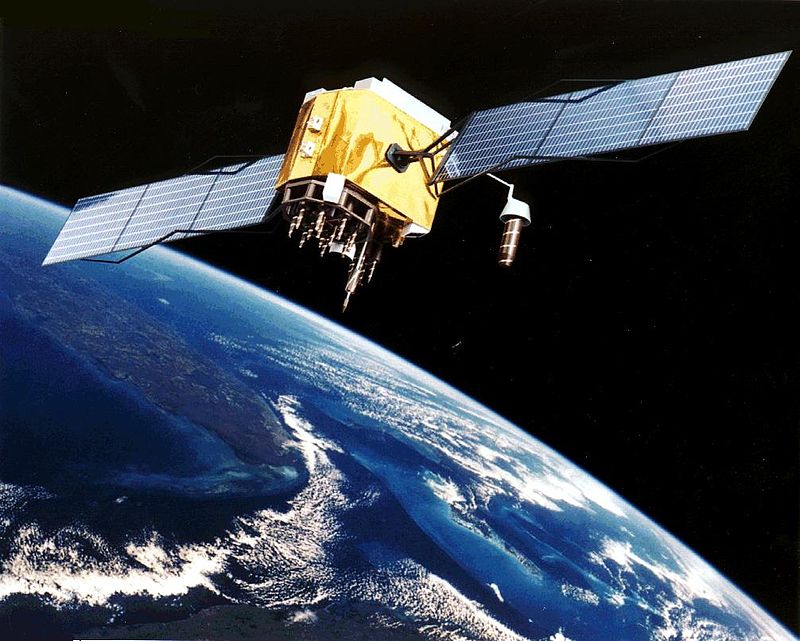
Artist's conception of GPS Block II-F satellite in Earth orbit.
(Image Sources: NASA, Wikipedia.org, By NASA - http://www.navcen.uscg.gov/ftp/gps/ggeninfo/gps-iif.tif[dead link] (Wayback Machine), Public Domain, https://commons.wikimedia.org/w/index.php?curid=564265)
 April 6 will mark a critical "Week Number Roll-Over Event" which could affect the date and time functions on some GPS receivers. Since GPS began in 1980, this will only be the second time this event has happened, which occurs about once every 19.7 years.
More info: Link >>> https://www.gps-repeaters.com/blog/gps-week-number-rollover-april-6th-2019/

Astronomical Calendar for 2019 April ---
Link >>> http://buhlplanetarium4.tripod.com/astrocalendar/2019.html#apr

 Related Blog Post ---

"Astro-Calendar: March / 1st SpaceX Crew Dragon Launch March 2."

2019 March. 1.

Link >>> https://spacewatchtower.blogspot.com/2019/03/astro-calendar-march-1st-crew-dragon.html


Source: Friends of the Zeiss.
              Monday, 2019 April 1.

                             Like This Post?  Please Share!

            More Astronomy & Science News - SpaceWatchtower Twitter Feed:
            Link >>> https://twitter.com/spacewatchtower

        Astronomy & Science Links: Link >>> http://buhlplanetarium.tripod.com/#sciencelinks

                Want to receive SpaceWatchtower blog posts in your in-box ?
                Send request to < spacewatchtower@planetarium.cc >.

gaw

Glenn A. Walsh, Informal Science Educator & Communicator:
< http://buhlplanetarium2.tripod.com/weblog/spacewatchtower/gaw/ >
Electronic Mail: < gawalsh@planetarium.cc >
Project Director, Friends of the Zeiss: < http://buhlplanetarium.tripod.com/fotz/ >
SpaceWatchtower Editor / Author: < http://spacewatchtower.blogspot.com/ >
Formerly Astronomical Observatory Coordinator & Planetarium Lecturer, original Buhl Planetarium & Institute of Popular Science (a.k.a. Buhl Science Center), Pittsburgh's science & technology museum from 1939 to 1991.
Formerly Trustee of the Andrew Carnegie Free Library and Music Hall, Pittsburgh suburb of Carnegie, Pennsylvania.
Author of History Web Sites on the Internet --
* Buhl Planetarium, Pittsburgh:
  < http://www.planetarium.cc >
* Adler Planetarium, Chicago:
  < http://adlerplanetarium.tripod.com >
* Astronomer, Educator, Optician John A. Brashear:
  < http://johnbrashear.tripod.com >
* Andrew Carnegie & Carnegie Libraries:
  < http://www.andrewcarnegie.cc >

Wednesday, March 20, 2019

Spring to Begin: Vernal Equinox on Earth Wednesday & on Mars Saturday!

   http://buhlplanetarium.tripod.com/pix/graphics/solsticeimage008.png
This diagram shows the position of the Earth, in relation to the Sun, at the time of the Vernal Equinox at the official beginning of the season of Spring in the Earth's Northern Hemisphere (Autumn in Earth's Southern Hemisphere), as well as the other solstices and equinox of the year.
(Graphic Source: ©1999, Eric G. Canali, former Floor Operations Manager of the original Buhl Planetarium and Institute of Popular Science (a.k.a. Buhl Science Center - Pittsburgh's science and technology museum from 1939 to 1991) and Founder of the South Hills Backyard Astronomers amateur astronomy club; permission granted for only non-profit use with credit to author.)

By Glenn A. Walsh
Reporting for SpaceWatchtower

Spring begins Wednesday afternoon at the moment of the Vernal Equinox in Earth's Northern Hemisphere. In the Southern Hemisphere of Earth, this marks the astronomical beginning of the season of Autumn. On Mars, the Vernal Equinox marks the beginning of the New Year on March 23! And, a so-called "Super-Moon" also occurs on March 20!

                                                Vernal Equinox on Earth

The Vernal Equinox occurs on Earth at precisely: 5:58 p.m. Eastern Daylight Saving Time (EDT) / 21:58 Coordinated Universal Time (UTC) on Wednesday Afternoon, 2019 March 20.

As the diagram at the beginning of this blog-post demonstrates, on the day of Equinox the Sun appears directly overhead at local Noon on the Equator. At the moment of Equinox, the Northern and Southern Hemispheres of Earth are illuminated equally. And, the time of Equinox is the only time when the Earth Terminator (dividing line on Earth between daylight and darkness) is perpendicular to the Equator.

This, and the reason for seasons on Earth in the first place, is due to the fact that Earth rotates on its axis, which is tilted at a 23.439281-degree angle from the plane of the Earth's orbit around the Sun. As the Earth revolves around the Sun, this axial tilt causes one hemisphere of the planet to receive more direct solar radiation during that hemisphere's season of Summer and much less direct solar radiation a half-year later during that hemisphere's season of Winter. As mentioned, during an Equinox (about half-way between Summer and Winter, and about half-way between Winter and Summer) both planetary hemispheres receive an equal amount of solar radiation.

Although "Equinox" in Latin means equal-night, the day of the Equinox does not actually have an equal amount of daylight and nightfall, as it appears on the Earth's surface. If the Sun was just a pin-point of light in our sky, as all other stars appear, day and night would be equal.

But, because the Sun is a disk, part of the Sun has risen above the horizon before the center of the Sun (which would be the pin-point of light); so there are extra moments of light on the Equinox. Likewise, part of the Sun is still visible, after the center of the Sun has set.

Additionally, the refraction of sunlight by our atmosphere causes sunlight to appear above the horizon, before sunrise and after sunset.

March 16 marked the Equilux ("equal-light"), the actual day with equal hours and minutes of the Sun above the horizon, and equal hours and minutes of the Sun below the horizon. The Equilux occurs twice each year, approximately 3-to-4 days before the Vernal Equinox and 3-to-4 days after the Autumnal Equinox (September 25).

An urban legend that has been making the rounds for decades, now exacerbated by the Internet and Social Media, has it that eggs can be stood on their ends only during an Equinox, whether the Vernal Equinox in the Spring or the Autumnal Equinox in the Fall. This is completely false!

Depending greatly on the size and shape of the particular egg, eggs can be stood on their ends any day of the year! Astronomy has nothing to do with whether an egg can stand on its end. If an egg can stand on its end on the Equinox (and, due to the shape and size of some eggs, this is not even possible), it can stand the same way any other day of the year.

In the last few years, with the help of the Internet and Social Media, another urban legend has become prevalent. Now it is claimed that brooms can stand, on their own, on their bristles, only on an Equinox day. This is also false! Again, as with eggs, if a broom can stand on its bristles by itself (this usually only works with newer brooms, with more even bristles) on an Equinox, it can do so any day of the year!

In ancient times, the Vernal Equinox was considered the beginning of the new calendar year. This was when most of Western Civilization used the Julian Calendar, and the Vernal Equinox occurred on March 25, later observed by Christians as the Feast of the Annunciation (observed nine full months before Christmas Day). As part of the Gregorian Calendar reform, in October of 1582, Pope Gregory XIII chose the Feast of the Circumcision of Christ (January 1) as the beginning of the New Year in the Roman Catholic Church's Liturgical Year.

The Vernal Equinox continues to be considered the beginning of the New Year, or an important holy day, in several other places on Earth ---
* Beginning of New Year (using the Solar Calendar) - Nowruz: Afghanistan and Iran / Persia.
* Holy Day for adherents to the Zoroastrian Religion and Baha'i Naw-Ruz, one of nine holy days of the Bahá'í Faith.

NASA and the European Space Agency (ESA) observe Sun-Earth Day on or near the Vernal Equinox. This is a joint educational program started in 2000, to popularize the knowledge about the Sun, and the way it influences life on Earth, among students and the public. This is part of Solar Week, which is the calendar week that includes the Vernal Equinox.

The first week of Spring, beginning with the Vernal Equinox, has been declared by physicians as Medicine Cabinet Clean-Up Week. To avoid prescription drug abuse, particularly important at this time of the opioid crisis, physicians encourage everyone to get rid of unused and no-longer-needed medications and other drugs, which may have lingered in the household, as part of an annual Spring cleaning. Several states have prescription drug take-back locations, where these drugs can be dropped-off.

The week of the Vernal Equinox is the also the beginning of the National Cherry Blossom Festival held each year in Washington, DC, which begins on March 20. This festival commemorates the 1912 gift of 3,000 cherry trees from the Mayor of Tokyo to the City of Washington. The festival runs through April 14 this year.

                                             Vernal Equinox on Mars

Earth is not the only planet to experience a Vernal Equinox this month. Just three days later, on March 23, the Vernal Equinox occurs on the Planet Mars. It is purely coincidental that the Vernal Equinox on Earth and Mars are so close in time, this year.

The Vernal Equinox is considered the beginning of the New Year on Mars (the time of the Vernal Equinox in the Northern Hemisphere of Mars, beginning Mars Year 35) . As Mars is much further from the Sun than Earth, the Martian year is 686.98 Earth days long. After March 23, the next Martian Vernal Equinox / New Year's Day will occur on 2021 February 7; the previous New Year on Mars began on 2017 May 4.

As the Martian orbit around the Sun is more lopsided than the orbit of Earth, the speed Mars moves in its orbit varies quite a bit, depending on how close to the Sun Mars is at the time. Mars is further from the Sun during the Spring season in the Northern Hemisphere than the Autumn Season. Hence, Mars moves more slowly in its orbit during Spring resulting in the Spring season in the Northern Hemisphere (length: 194 Mars days)  being much longer than the Autumn season (length: 142 Mars days). While a day on Earth measures 24 hours, a day on Mars is just a little longer: 24 hours, 39 minutes, 35 seconds.

Once again this year, the small borough of Mars, Pennsylvania (about 25 miles / 40 kilometers north of Pittsburgh) will be celebrating the Martian New Year this week.

                                        Another So-Called "Super-Moon"

In another coincidence this year, the March Primary Full Moon phase of Earth's Moon occurs a few hours after the Vernal Equinox on Earth: Wednesday Evening, 2019 March 20 at 9:43 p.m. EDT / March 21 at 1:43 UTC. This is the first time since 1981 that a Full Moon and the Vernal Equinox occur on the same day. The Full Moon of March is known as the Worm Moon.

This year, the March Full Moon is also considered by some as a so-called "Super-Moon." This is due to the fact that the Moon passes the monthly perigee point, or point in lunar orbit closest to the Earth and when the Moon appears largest in our sky for the month, about a day before Full Moon. Lunar Perigee occurred this month on Tuesday Afternoon, 2019 March 19 at 4:00 p.m. EDT /20:00 UTC. The distance between Earth and the Moon, at that time, was 223,306.51495 statute miles / 359,377 kilometers.

Native Americans also had other names for the March Full Moon. With the increased cawing of crows, northern tribes knew the March Full Moon as the Crow Moon. They also called it the Snow Crust Moon, for the increased crusting of snow, caused by the thawing of snow by day and the freezing of the water by night.

The Abenaki tribe (New England and adjacent areas of Canada) called the March Full Moon “Mozokas” or the Moose Hunter Moon. The Creek nation, located further south, called it the “Tasahcusee” or Little Spring Moon. And, the Dakota Sioux actually called it the “Moon When Eyes Are Sore From Bright Snow.”

Colonial Americans called the March Full Moon the Sap Moon, for the time when maple trees were tapped. They also called it the Lenten Moon, as it was the last Full Moon of Winter usually occurring during the Christian period of Lent.

Full Moon names for March, in the Southern Hemisphere, include Harvest Moon and Corn Moon.

Internet Links to Additional Information ---

Vernal Equinox: Link >>> http://scienceworld.wolfram.com/astronomy/VernalEquinox.html

Season of Spring: Link >>> http://en.wikipedia.org/wiki/Spring_%28season%29

Equinox: Link >>> http://en.wikipedia.org/wiki/Equinox

Earth's Seasons: Link >>> http://en.wikipedia.org/wiki/Season

Tilt of a Planet's Axis: Link >>> http://en.wikipedia.org/wiki/Axial_tilt

National Cherry Blossom Festival: Link >>> https://nationalcherryblossomfestival.org/

Mars Vernal Equinox / New Year's Day:
Link >>> http://buhlplanetarium4.tripod.com/astrocalendar/2019.html#marsnewyear

Full Moon: Link >>> http://en.wikipedia.org/wiki/Full_moon

Full Moon names ---
Link 1 >>> http://earthsky.org/astronomy-essentials/full-moon-names
Link 2 >>> https://en.wikipedia.org/wiki/Full_moon#Full_moon_names
Link 3 >>> http://www.farmersalmanac.com/full-moon-names/

Related Blog Post ---

Astronomical Calendar: 2017 May." Monday, 2017 May 1.

Link >>> https://spacewatchtower.blogspot.com/2017/05/astronomical-calendar-2017-may.html

Martian New Year (Vernal Equinox in the Northern Hemisphere of Mars - Mars Year 34) began 2017 May 4.


Source: Glenn A. Walsh Reporting for SpaceWatchtower, a project of Friends of the Zeiss.
              Wednesday, 2019 March 20.

                             Like This Post?  Please Share!

           More Astronomy & Science News - SpaceWatchtower Twitter Feed:
            Link >>> https://twitter.com/spacewatchtower

        Astronomy & Science Links: Link >>> http://buhlplanetarium.tripod.com/#sciencelinks

                Want to receive SpaceWatchtower blog posts in your in-box ?
                Send request to < spacewatchtower@planetarium.cc >.

gaw

Glenn A. Walsh - Informal Science Educator & Communicator:
< http://buhlplanetarium2.tripod.com/weblog/spacewatchtower/gaw/ >
Electronic Mail: < gawalsh@planetarium.cc >
Project Director, Friends of the Zeiss: < http://buhlplanetarium.tripod.com/fotz/ >
SpaceWatchtower Editor / Author: < http://spacewatchtower.blogspot.com/ >
Formerly Astronomical Observatory Coordinator & Planetarium Lecturer, original Buhl Planetarium & Institute of Popular Science (a.k.a. Buhl Science Center), Pittsburgh's science & technology museum from 1939 to 1991.
Formerly Trustee of the Andrew Carnegie Free Library and Music Hall, Pittsburgh suburb of Carnegie, Pennsylvania.
Author of History Web Sites on the Internet --
* Buhl Planetarium, Pittsburgh:
  < http://www.planetarium.cc >
* Adler Planetarium, Chicago:
  < http://adlerplanetarium.tripod.com >
* Astronomer, Educator, Optician John A. Brashear:
  < http://johnbrashear.tripod.com >
* Andrew Carnegie & Carnegie Libraries:
  < http://www.andrewcarnegie.cc >

Wednesday, March 13, 2019

Middle & High School Students: NASA App Development Challenge for Orion

Orion with ATV SM.jpg
The Orion spacecraft, now under development by NASA, as the first deep-space vehicle for human use since the Apollo program 50 years ago.
(Image Sources: NASA, Wikipedia.org, By NASA - http://spaceinimages.esa.int/Images/2013/01/Orion6, Public Domain, https://commons.wikimedia.org/w/index.php?curid=24626935)

By Glenn A. Walsh
Reporting for SpaceWatchtower

NASA continues planning for, and developing, the Orion space capsule, the American space agency's first human-rated vehicle destined for deep-space missions, since the Apollo space program 50 years ago. NASA is creating a Launch Abort System (LAS) for Orion, which will be a state-of-the-art crew escape system attached to the top of the spacecraft, which can propel the crew module away from the rocket within milliseconds in the case of a life-threatening occurrence shortly after launch.

Today (2019 March 13), NASA is launching Round 1 of an App Development Challenge (ADC), which will give middle and high school student teams the opportunity to demonstrate the practice of computer coding and applications development. The app that NASA will ask students to develop will visualize three minutes of simulated test data in support of the upcoming Ascent Abort-2 (AA-2) flight test, regarding the Launch Abort System.

A full-stress test of the Orion space capsule's Launch Abort System (called Ascent Abort-2) is scheduled for June. For Orion to be a safe spacecraft for humans, it is critical to demonstrate that the LAS can separate the capsule from a failing rocket in the event of an emergency.

Round 1 of the challenge will give participants the opportunity to confer with NASA scientists, who will provide tips on the app development. The student teams would then post videos of their app designs on the World-Wide-Web for consideration for future missions by NASA. Video submissions for Round 1 are due 2019 May 1.

Student teams with favorable video submissions will advance to Round 2 of the competition. These student teams will have the opportunity to present their app during an interview with NASA engineers working on the Ascent Abort-2 flight test. At the conclusion of Round 2, NASA will select a student team or teams, who will receive an all-expenses paid trip to a NASA field center in the early Summer of this year.

Internet Links to Additional Information ---

NASA Student App Development Challenge for Ascent Abort-2 Test Flight:
Link >>> https://www.nasa.gov/education/nextgenstem/moon_to_mars/app_challenge.html

NASA Orion Spacecraft -
Link 1 >>> https://www.nasa.gov/exploration/systems/orion/index.html
Link 2 >>> https://en.wikipedia.org/wiki/Orion_(spacecraft)

Source: Glenn A. Walsh Reporting for SpaceWatchtower, a project of Friends of the Zeiss.
              Wednesday, 2019 March 13.

                             Like This Post?  Please Share!

           More Astronomy & Science News - SpaceWatchtower Twitter Feed:
            Link >>> https://twitter.com/spacewatchtower

        Astronomy & Science Links: Link >>> http://buhlplanetarium.tripod.com/#sciencelinks

                Want to receive SpaceWatchtower blog posts in your in-box ?
                Send request to < spacewatchtower@planetarium.cc >.

gaw

Glenn A. Walsh - Informal Science Educator & Communicator:
< http://buhlplanetarium2.tripod.com/weblog/spacewatchtower/gaw/ >
Electronic Mail: < gawalsh@planetarium.cc >
Project Director, Friends of the Zeiss: < http://buhlplanetarium.tripod.com/fotz/ >
SpaceWatchtower Editor / Author: < http://spacewatchtower.blogspot.com/ >
Formerly Astronomical Observatory Coordinator & Planetarium Lecturer, original Buhl Planetarium & Institute of Popular Science (a.k.a. Buhl Science Center), Pittsburgh's science & technology museum from 1939 to 1991.
Formerly Trustee of the Andrew Carnegie Free Library and Music Hall, Pittsburgh suburb of Carnegie, Pennsylvania.
Author of History Web Sites on the Internet --
* Buhl Planetarium, Pittsburgh:
  < http://www.planetarium.cc >
* Adler Planetarium, Chicago:
  < http://adlerplanetarium.tripod.com >
* Astronomer, Educator, Optician John A. Brashear:
  < http://johnbrashear.tripod.com >
* Andrew Carnegie & Carnegie Libraries:
  < http://www.andrewcarnegie.cc >

Friday, March 1, 2019

Astro-Calendar: March / 1st SpaceX Crew Dragon Launch March 2

SpaceX Crew Dragon (More cropped).jpg
Artist's rendering of the SpaceX Crew Dragon spacecraft, which will be launched for the first time, without a crew, on Saturday, March 2, scheduled for 2:49 a.m. EST / 7:49 UTC from Cape Canaveral, Florida. Although weather looks good for a March 2 launch, the back-up launch date is March 5.
More information: Link >>> https://www.space.com/spacex-crew-dragon-test-flight-weather-forecast.html
(Image Sources: Wikipedia.org, By NASA/SpaceX - https://www.flickr.com/photos/nasakennedy/42840169205/, Public Domain, https://commons.wikimedia.org/w/index.php?curid=71616976)

Astronomical Calendar for 2019 March ---
Link >>> http://buhlplanetarium4.tripod.com/astrocalendar/2019.html#mar

 Related Blog Post ---

"Astro-Calendar: Feb. / Full Moon: Largest So-Called 'Super-Moon' of 2019." 2019 Feb. 1.

Link >>> http://spacewatchtower.blogspot.com/2019/02/astro-calendar-feb-largest-so-called.html


Source: Friends of the Zeiss.
              Friday, 2019 March 1.

                             Like This Post?  Please Share!

            More Astronomy & Science News - SpaceWatchtower Twitter Feed:
            Link >>> https://twitter.com/spacewatchtower

        Astronomy & Science Links: Link >>> http://buhlplanetarium.tripod.com/#sciencelinks

                Want to receive SpaceWatchtower blog posts in your in-box ?
                Send request to < spacewatchtower@planetarium.cc >.

gaw

Glenn A. Walsh - Informal Science Educator & Communicator:
< http://buhlplanetarium2.tripod.com/weblog/spacewatchtower/gaw/ >
Electronic Mail: < gawalsh@planetarium.cc >
Project Director, Friends of the Zeiss: < http://buhlplanetarium.tripod.com/fotz/ >
SpaceWatchtower Editor / Author: < http://spacewatchtower.blogspot.com/ >
Formerly Astronomical Observatory Coordinator & Planetarium Lecturer, original Buhl Planetarium & Institute of Popular Science (a.k.a. Buhl Science Center), Pittsburgh's science & technology museum from 1939 to 1991.
Formerly Trustee of the Andrew Carnegie Free Library and Music Hall, Pittsburgh suburb of Carnegie, Pennsylvania.
Author of History Web Sites on the Internet --
* Buhl Planetarium, Pittsburgh:
  < http://www.planetarium.cc >
* Adler Planetarium, Chicago:
  < http://adlerplanetarium.tripod.com >
* Astronomer, Educator, Optician John A. Brashear:
  < http://johnbrashear.tripod.com >
* Andrew Carnegie & Carnegie Libraries:
  < http://www.andrewcarnegie.cc >

Sunday, February 17, 2019

150th Anniversary: Periodic Table of Chemical Elements


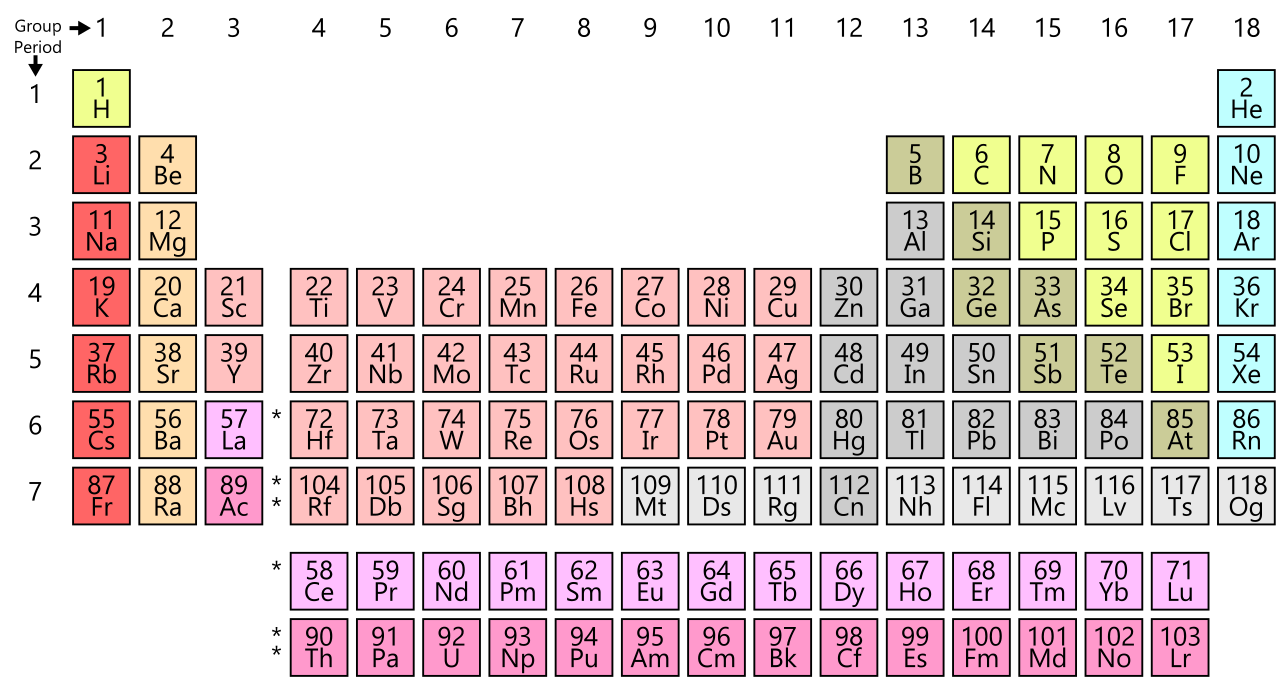
                                            Periodic Table of Chemical Elements
(Image Sources: Wikipedia.org, By Offnfopt - Own work, Public Domain, https://commons.wikimedia.org/w/index.php?curid=62296883)

By Glenn A. Walsh
Reporting for SpaceWatchtower

All ordinary matter in the Universe (not including “Dark Matter”) is composed of chemical elements. It was not until 150 years ago today (on 1869 February 17) that a logical classification system was developed for chemical elements: The Periodic Table of Chemical Elements.

While British, French, and German scientists had earlier attempted to develop systems to organize the then-known elements, it was a Russian professor of chemistry, Dimitri Ivanovich Mendeleev, who created this first comprehensive representation of elemental reality, which classified the then-known 63 elements in order of atomic weight.

And, unlike earlier systems, Professor Mendeleev did something unprecedented with his Table. He left spaces in his Table for elements, with predicted atomic masses and chemical properties, which had yet to be discovered! The development of the Periodic Table of Chemical Elements is an interesting story, showing the eccentricity and obsession of Professor Mendeleev.

After conducting research in Europe, in 1861 Dimitri Mendeleev returned to Russia and later began teaching chemistry at the Saint Petersburg Technical Institute. Realizing that there was no current textbook on organic chemistry, he wrote his first book, Organic Chemistry, in 1861. This was considered one of the most authoritative books on the subject in the middle of the 19th century.

Although only 27 years-old at the time, he had a long flowing beard and disheveled hair (only cut once a year), looking much like the stereotypical, eccentric scientist, long before Albert Einstein made the look popular. But, it is reported that he was popular with his students.

Despite his new textbook, Professor Mendeleev continued to be concerned that, without an adequate chemistry classification system, his students would continue having trouble understanding the subject. As reported in the 2000 book Mendeleyev’s Dream: The Quest for the Elements by Paul Strathern, Professor Mendeleev wrote:

      The edifice of science requires not only material, but also a plan, and necessitates the work of   
      preparing the materials, putting them together, working out the plans and symmetrical 
      proportions of the various parts.

According to a Khan Academy on-line course article, Professor Mendeleev actually developed his first Periodic Table from a dream he had experienced!

In 1867, Professor Mendeleev started writing a second chemistry book concentrating on inorganic chemistry. This book, Principles of Chemistry (in two volumes), also became a standard text for the field, for several decades.

With the writing of this book, he started concentrating on finding a way to classify elements. While he tried to use the two organizing systems common at that time, organizing by atomic mass or by chemical properties, he found neither way as satisfying. Then, he hit on a new system which combined both original systems into a single framework.

This single framework was his breakthrough. And, it seems this system was inspired by the card-game “Solitaire”! Solitaire arranges game-cards both by suit, horizontally, and by number, vertically.

Professor Mendeleev created 63 cards, one for each of the known elements at the time. Then, he started rearranging the cards by atomic mass and by chemical properties. He spent a great deal of time, wherever he was, organizing and re-organizing the 63 cards.

On 1869 February 17, he again started rearranging the cards after breakfast, and before he had to leave to catch a train. Well, he completely forgot about catching the train, and continued working on the project for three days. After testing-out many different sequences for the cards, he suddenly realized that there were gaps in the order of atomic mass.

According to the 2000 book Mendeleyev’s Dream: The Quest for the Elements by Paul Strathern, Professor Mendeleev fell asleep after the three-day effort. Upon awakening, he declared, “I saw in a dream, a table, where all the elements fell into place as required. Awakening, I immediately wrote it down on a piece of paper.”

He called his discovery the Periodic Table of the Elements. This was due to his discovery of the “Periodic Law,” as he found that when the elements were arranged in order of increasing atomic mass, elements with similar chemical properties recurred at regular intervals, or periodically, on his chart.

Actually, his original Table did not completely use atomic mass as the organizing principle; there were exceptions. Professor Mendeleev did not realize it, but he had actually organized this Table by “Atomic Number,” which is the number of positively-charged protons in the atom (and negatively-charged electrons which orbit the atom).

This periodicity, of the elements listed by ascending Atomic Number, comes directly from the periodic repeating of similar electron configurations in the outer shells of their respective atoms.

Professor Mendeleev went further by using the patterns he found in his Table to predict the properties of elements which had not yet been discovered. He left blank spots as place-holders in his Table, for the missing elements for which he was predicting their existence.

Professor Mendeleev's first Periodic Table of the Elements was presented to, and published by, the Russian Chemical Society on 1869 March 6. He continued working on the Table, publishing improved Tables, including one in 1871.

Professor Mendeleev's Periodic Table of the Elements was not immediately accepted by other scientists. However within 20 years, three of the “missing” elements which his Table predicted were discovered: Gallium (1875), Scandium (1879), and Germanium (1886); and they all included the basic chemical characteristics that Professor Mendeleev had predicted. The Periodic Table of the Elements then began to be accepted by the scientific community.

As with much of science, several scientists were also developing the idea of organizing the elements in some way. In 1787, the first list of the then-known 33 elements was produced by French chemist Antoine Lavoisier, working with Antoine Fourcroy, Louis-Bernard Guyton de Morveau and Claude-Louis Berthollet. In 1817, German chemist Johann Döbereiner noticed that, when the elements' properties are considered, they could be placed in groups of three. In 1857, French chemist Jean-Baptiste-André Dumas tried to organize the elements, mathematically, based on atomic weight.

On 1863 February 7, British chemist John Newlands published a Table of the Elements. He also found that there was periodicity in the atomic mass of the elements and their chemical properties. However, John Newlands' Table of the Elements was not well received by the scientific community, and he did not pursue further research in the area. Although his Table did not accurately predict the characteristics of future to-be-discovered elements, he may be the first person to recognize periodicity among the elements, even though he had trouble clearly identifying it.

In 1870, German chemist Julius Lothar Meyer published a paper describing a Table of the Elements similar to the one described by Professor Mendeleev, but a year later. It was probably Professor Mendeleev's confidence in the “place-holder” elements' predicted properties that made his Periodic Table of the Elements the most accepted.

National Periodic Table Day is celebrated each year on February 7, as English analytical chemist John Newlands published his Table of the Elements on 1863 February 7. This unofficial, national holiday was created and publicized by a chemistry teacher in the Jefferson County Public Schools in Kentucky, David T. Steineker.

An interesting coincidence is that Dimitri Mendeleev's 1834 birth-date, as dated in the Western Hemisphere, was also February 7. At his birth-home in western Siberia, the date would have been February 8 as determined by the Gregorian Calendar. However, at this time Russia was still using the Julian Calendar (known as Old System or O.S.); by the Old System his birth-date was recognized as January 27.

And, due to this year's 150th anniversary of the Periodic Table of Chemical Elements, on 2017 December 20 the United Nations General Assembly proclaimed the year 2019 as the International Year of the Periodic Table of Chemical Elements.

Internet Links to Additional Information ---

Periodic Table of Chemical Elements: Link >>> https://en.wikipedia.org/wiki/Periodic_table

Periodic Law: Link >>> https://en.wikipedia.org/wiki/Periodic_trends#Periodic_law

Dmitri Ivanovich Mendeleev:
Link 1 >>> http://www.chem.msu.su/eng/misc/mendeleev/welcome.html
Link 2 >>> https://en.wikipedia.org/wiki/Dmitri_Mendeleev

Khan Academy. "Periodic Table of Elements." Crash Course Chemistry On-Line Student Course.
Link >>> https://www.khanacademy.org/partner-content/big-history-project/stars-and-elements/knowing-stars-elements/v/bhp-periodic-table-crashcourse

Khan Academy. "Dmitri Mendeleev." Crash Course Chemistry On-Line Student Course.
Link >>> https://www.khanacademy.org/partner-content/big-history-project/stars-and-elements/knowing-stars-elements/a/dmitri-mendeleev

Scerri, Eric R. "The Evolution of the Periodic System."
Scientific American 2011 Jan. 21.
Link >>> https://www.scientificamerican.com/article/the-evolution-of-the-periodic-system/

Periodic Table Day: Link >>> http://www.periodictableday.org/

2019: International Year of the Periodic Table of Chemical Elements:
Link >>> https://iupac.org/united-nations-proclaims-international-year-periodic-table-chemical-elements/

Source: Glenn A. Walsh Reporting for SpaceWatchtower, a project of Friends of the Zeiss.
              Sunday, 2019 February 17.

                             Like This Post?  Please Share!

           More Astronomy & Science News - SpaceWatchtower Twitter Feed:
            Link >>> https://twitter.com/spacewatchtower

        Astronomy & Science Links: Link >>> http://buhlplanetarium.tripod.com/#sciencelinks

                Want to receive SpaceWatchtower blog posts in your in-box ?
                Send request to < spacewatchtower@planetarium.cc >.

gaw

Glenn A. Walsh - Informal Science Educator & Communicator:
< http://buhlplanetarium2.tripod.com/weblog/spacewatchtower/gaw/ >
Electronic Mail: < gawalsh@planetarium.cc >
Project Director, Friends of the Zeiss: < http://buhlplanetarium.tripod.com/fotz/ >
SpaceWatchtower Editor / Author: < http://spacewatchtower.blogspot.com/ >
Formerly Astronomical Observatory Coordinator & Planetarium Lecturer, original Buhl Planetarium & Institute of Popular Science (a.k.a. Buhl Science Center), Pittsburgh's science & technology museum from 1939 to 1991.
Formerly Trustee of the Andrew Carnegie Free Library and Music Hall, Pittsburgh suburb of Carnegie, Pennsylvania.
Author of History Web Sites on the Internet --
* Buhl Planetarium, Pittsburgh:
  < http://www.planetarium.cc >
* Adler Planetarium, Chicago:
  < http://adlerplanetarium.tripod.com >
* Astronomer, Educator, Optician John A. Brashear:
  < http://johnbrashear.tripod.com >
* Andrew Carnegie & Carnegie Libraries:
  < http://www.andrewcarnegie.cc >

Friday, February 1, 2019

Tuesday (Feb. 19) Full Moon: Largest So-Called 'Super-Moon' of 2019

                                  
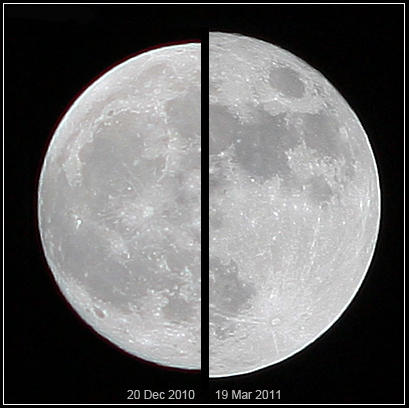
Comparison of a Lunar Perigee Full Moon, a so-called "Super-Moon," of 2011 March 19 and an average-sized Full Moon of 2010 December 20, both as viewed from Earth.
(Image Sources: Wikipedia.org, By Marcoaliaslama - Own work, CC BY-SA 3.0, https://commons.wikimedia.org/w/index.php?curid=14651085)

This month's Full Moon (Snow Moon), which occurs on Tuesday, February 19 at 10:53 a.m. EST / 15:53 UTC, will be the largest and closest Full Moon of 2019 (and, hence, considered by some a so-called "Super-Moon"), due to a Lunar Perigee (distance from Earth: 221,681 statute miles / 356,761 kilometers) on February 19 at 4:00 a.m. EST / 9:00 UTC.

Most Native Americans in the Northern Hemisphere referred to the February Full Moon as the Snow Moon for obvious reasons. Other Native American tribes have called the February Full Moon the Hunger Moon, due to the difficult hunting conditions during the harsh weather of the month.

While the January Full Moon (and for some tribes the December Full Moon) has been known by some tribes as the Wolf Moon, other tribes referred to the February Full Moon as the Wolf Moon. The Full Moon of February has also been known as the Racoon Moon and the Bare-Spots-on-the-Ground Moon.

In the Southern Hemisphere, the February / Mid-Summer Full Moon has been known as the Grain Moon, Sturgeon Moon, Red Moon, Wyrt Moon, Corn Moon, Dog Moon, and Barley Moon.

Once every 19 years (including February of last year), February has no Full Moon (then, both January and March of that year have a "Blue Moon," the second of two Full Moon phases in one calendar month). This is due to the fact that February has only 28 days (29 days once every four years during the Leap Year) while the time duration of the Moon's orbit around the Earth is even shorter: 27.32166 days.


The Full Moon is visible, weather-permitting, the night of Full Moon and the nights before and after the night of Full Moon, approximately local sunset to local sunrise.

More information: Link >>> https://earthsky.org/tonight/years-biggest-supermoon-on-february-19


Astronomical Calendar for 2019 February ---
Link >>> http://buhlplanetarium4.tripod.com/astrocalendar/2019.html#feb

 Related Blog Post ---

"Astro-Calendar: Jan. / Pix of NASA Fly-By of Ultima Thule." 2019 Jan. 2.

Link >>> https://spacewatchtower.blogspot.com/2019/01/astro-calendar-jan-nasa-flies-by-ultima.html


Source: Friends of the Zeiss.
              Friday, 2019 February 1.
              Update: Tuesday, 2019 February 19

                             Like This Post?  Please Share!

            More Astronomy & Science News - SpaceWatchtower Twitter Feed:
            Link >>> https://twitter.com/spacewatchtower

        Astronomy & Science Links: Link >>> http://buhlplanetarium.tripod.com/#sciencelinks

                Want to receive SpaceWatchtower blog posts in your in-box ?
                Send request to < spacewatchtower@planetarium.cc >.

gaw

Glenn A. Walsh - Informal Science Educator & Communicator:
< http://buhlplanetarium2.tripod.com/weblog/spacewatchtower/gaw/ >
Electronic Mail: < gawalsh@planetarium.cc >
Project Director, Friends of the Zeiss: < http://buhlplanetarium.tripod.com/fotz/ >
SpaceWatchtower Editor / Author: < http://spacewatchtower.blogspot.com/ >
Formerly Astronomical Observatory Coordinator & Planetarium Lecturer, original Buhl Planetarium & Institute of Popular Science (a.k.a. Buhl Science Center), Pittsburgh's science & technology museum from 1939 to 1991.
Formerly Trustee of the Andrew Carnegie Free Library and Music Hall, Pittsburgh suburb of Carnegie, Pennsylvania.
Author of History Web Sites on the Internet --
* Buhl Planetarium, Pittsburgh:
  < http://www.planetarium.cc >
* Adler Planetarium, Chicago:
  < http://adlerplanetarium.tripod.com >
* Astronomer, Educator, Optician John A. Brashear:
  < http://johnbrashear.tripod.com >
* Andrew Carnegie & Carnegie Libraries:
  < http://www.andrewcarnegie.cc >