Saturday, August 31, 2013

Astronomical Calendar: 2013 September


Planet Earth will experience the Autumnal Equinox, the beginning of the season of Autumn in
the Northern Hemisphere, on 2013 September 22 at 4:44 p.m. EDT (20:44 Coordinated
Universal Time). (Image Source: timeanddate.com )


Astronomical Calendar for 2013 September:

Link >>> http://buhlplanetarium4.tripod.com/astrocalendar/2013.html#sep


The current month's Astronomical Calendar can also be found on the cover page of the History of The Buhl Planetarium and Institute of Popular Science, Pittsburgh web site at this link:

Link >>> http://buhlplanetarium.tripod.com/#astrocal


Source: Friends of the Zeiss.


Want to receive SpaceWatchtower blog posts in your inbox ?
Send request to < spacewatchtower@planetarium.cc >..

gaw

Glenn A. Walsh, Project Director,
Friends of the Zeiss < http://buhlplanetarium.tripod.com/fotz/ >
Electronic Mail - < gawalsh@planetarium.cc >
About the SpaceWatchtower Editor/Author: < http://buhlplanetarium.tripod.com/#GAW >
SpaceWatchtower Blog: < http://spacewatchtower.blogspot.com/ >
Also see: South Hills Backyard Astronomers Blog: < http://shbastronomers.blogspot.com/ >
SPACE & SCIENCE NEWS, ASTRONOMICAL CALENDAR:
< http://buhlplanetarium.tripod.com/#news >
Twitter: < https://twitter.com/spacewatchtower >
Facebook: < http://www.facebook.com/pages/SpaceWatchtower/238017839577841?sk=wall >
Author of History Web Sites on the Internet --
* Buhl Planetarium, Pittsburgh:
  < http://www.planetarium.cc >
* Adler Planetarium, Chicago:
  < http://adlerplanetarium.tripod.com >
* Astronomer, Educator, Optician John A. Brashear:
  < http://johnbrashear.tripod.com >
* Andrew Carnegie & Carnegie Libraries:
  < http://www.andrewcarnegie.cc >
* Civil War Museum of Andrew Carnegie Free Library:
  < http://garespypost.tripod.com >
* Duquesne Incline cable-car railway, Pittsburgh:
  < http://inclinedplane.tripod.com >
* Public Transit:
  < http://andrewcarnegie2.tripod.com/transit >

Thursday, August 29, 2013

Newest Dark Sky Park in New Mexico

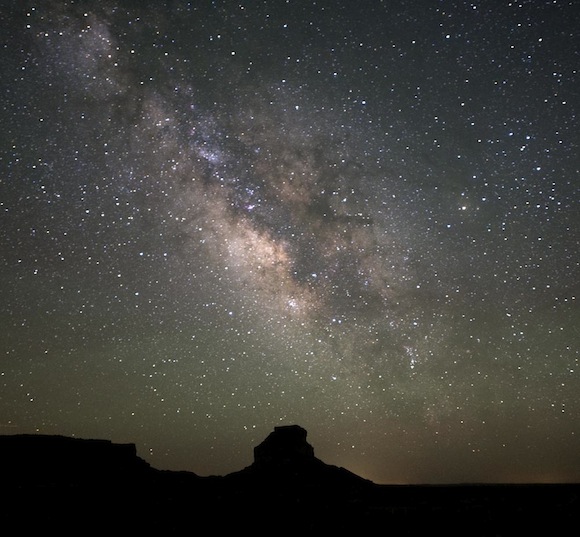
The 34,000-acre Chaco Culture National Historical Park is home to many ancient wonders including the remains of a civilization that thrived over 1,000 years ago. The park, which has been protecting its archaeological riches since it was established in 1907, is now protecting its views of the starry skies too. It has just been named as the International Dark-Sky Association's newest Dark Sky Park.

Milky-Way-Fajada-Butte
“Milky Way, Fajada Butte” by Stan Honda

“Once the night sky was something that was very much a part of the human experience at Chaco and around the globe,” says IDA Executive Director Bob Parks. “We are delighted that Chaco is now preserving the nighttime environment alongside their historic treasures.”

As a Gold-tier IDA Dark Sky Park, Chaco has shown its commitment to preserving its near-pristine night skies. The park has adopted a set of strict lighting guidelines that include the use of dark-sky friendly lighting now and in the future, ensuring that it will do its part to keep the nighttime environment natural and unspoiled for generations to come.

More - Link >>> http://earthsky.org/science-wire/new-mexican-skies-protected-with-dark-sky-park-designation

Source: EarthSky.org .

Want to receive SpaceWatchtower blog posts in your inbox ?
Send request to < spacewatchtower@planetarium.cc >..

gaw

Glenn A. Walsh, Project Director,
Friends of the Zeiss < http://buhlplanetarium.tripod.com/fotz/ >
Electronic Mail - < gawalsh@planetarium.cc >
About the SpaceWatchtower Editor/Author: < http://buhlplanetarium.tripod.com/#GAW >
SpaceWatchtower Blog: < http://spacewatchtower.blogspot.com/ >
Also see: South Hills Backyard Astronomers Blog: < http://shbastronomers.blogspot.com/ >
SPACE & SCIENCE NEWS, ASTRONOMICAL CALENDAR:
< http://buhlplanetarium.tripod.com/#news >
Twitter: < https://twitter.com/spacewatchtower >
Facebook: < http://www.facebook.com/pages/SpaceWatchtower/238017839577841?sk=wall >
Author of History Web Sites on the Internet --
* Buhl Planetarium, Pittsburgh:
  < http://www.planetarium.cc >
* Adler Planetarium, Chicago:
  < http://adlerplanetarium.tripod.com >
* Astronomer, Educator, Optician John A. Brashear:
  < http://johnbrashear.tripod.com >
* Andrew Carnegie & Carnegie Libraries:
  < http://www.andrewcarnegie.cc >
* Civil War Museum of Andrew Carnegie Free Library:
  < http://garespypost.tripod.com >
* Duquesne Incline cable-car railway, Pittsburgh:
  < http://inclinedplane.tripod.com >
* Public Transit:
  < http://andrewcarnegie2.tripod.com/transit >

Tuesday, August 27, 2013

NASA: Water Found on Moon's Surface Hints at Water Below


NASA-funded lunar research has yielded evidence of water locked in mineral grains on the surface of the moon from an unknown source deep beneath the surface.

Using data from NASA's Moon Mineralogy Mapper (M3) instrument aboard the Indian Space Research Organization's Chandrayaan-1 spacecraft, scientists remotely detected magmatic water, or water that originates from deep within the moon's interior, on the surface of the moon.

The findings, published Aug. 25 in Nature Geoscience, represent the first detection of this form of water from lunar orbit. Earlier studies had shown the existence of magmatic water in lunar samples returned during the Apollo program.

M3 imaged the lunar impact crater Bullialdus, which lies near the lunar equator. Scientists were interested in studying this area because they could better quantify the amount of water inside the rocks due to the crater's location and the type of rocks it held. The central peak of the crater is made up of a type of rock that forms deep within the lunar crust and mantle when magma is trapped underground.

More - Link >>> http://www.nasa.gov/press/2013/august/nasa-funded-scientists-detect-water-on-moons-surface-that-hints-at-water-below/#.UhzZTUoZSO4

Source: NASA.

Want to receive SpaceWatchtower blog posts in your inbox ?
Send request to < spacewatchtower@planetarium.cc >..

gaw

Glenn A. Walsh, Project Director,
Friends of the Zeiss < http://buhlplanetarium.tripod.com/fotz/ >
Electronic Mail - < gawalsh@planetarium.cc >
About the SpaceWatchtower Editor/Author: < http://buhlplanetarium.tripod.com/#GAW >
SpaceWatchtower Blog: < http://spacewatchtower.blogspot.com/ >
Also see: South Hills Backyard Astronomers Blog: < http://shbastronomers.blogspot.com/ >
SPACE & SCIENCE NEWS, ASTRONOMICAL CALENDAR:
< http://buhlplanetarium.tripod.com/#news >
Twitter: < https://twitter.com/spacewatchtower >
Facebook: < http://www.facebook.com/pages/SpaceWatchtower/238017839577841?sk=wall >
Author of History Web Sites on the Internet --
* Buhl Planetarium, Pittsburgh:
  < http://www.planetarium.cc >
* Adler Planetarium, Chicago:
  < http://adlerplanetarium.tripod.com >
* Astronomer, Educator, Optician John A. Brashear:
  < http://johnbrashear.tripod.com >
* Andrew Carnegie & Carnegie Libraries:
  < http://www.andrewcarnegie.cc >
* Civil War Museum of Andrew Carnegie Free Library:
  < http://garespypost.tripod.com >
* Duquesne Incline cable-car railway, Pittsburgh:
  < http://inclinedplane.tripod.com >
* Public Transit:
  < http://andrewcarnegie2.tripod.com/transit >
Saturday, August 24, 2013

Comet ISON to Fly by Mars

Around the world, astronomers are buzzing with anticipation over the approach of Comet ISON.  On Thanksgiving Day 2013, the icy visitor from the outer solar system will skim the sun's outer atmosphere and, if it survives, could emerge as one of the brightest comets in years.

First, though, it has to fly by Mars.

"Comet ISON is paying a visit to the Red Planet," says astronomer Carey Lisse of the Johns Hopkins University Applied Physics Lab. "On Oct 1st, the comet will pass within 0.07 AU from Mars, about six times closer than it will ever come to Earth."

Mars Comet (splash)
A new ScienceCast video anticipates Comet ISON's close flyby of Mars on Oct. 1, 2013. Play it

Mars rovers and satellites will get a close-up view.  It’s too early to say whether Curiosity will be able to see the comet from the surface of Mars—that depends on how much ISON brightens between now and then. Lisse says the best bet is NASA’s Mars Reconnaissance Orbiter.  The MRO satellite is equipped with a powerful half-meter telescope named HiRISE that is more than capable of detecting the comet’s atmosphere and tail. Observations are planned on four dates: August 20th, Sept 29th, and Oct 1st and 2nd.

More - Link >>> http://science.nasa.gov/science-news/science-at-nasa/2013/23aug_marsison/

Source: NASA Science News.

Current Position of Comet ISON:
Link >>> http://www.heavens-above.com/comet.aspx?cid=C%2F2012%20S1&lat=40.441&lng=-79.996&loc=Pittsburgh&alt=235&tz=EST

Want to receive SpaceWatchtower blog posts in your inbox ?
Send request to < spacewatchtower@planetarium.cc >..

gaw

Glenn A. Walsh, Project Director,
Friends of the Zeiss < http://buhlplanetarium.tripod.com/fotz/ >
Electronic Mail - < gawalsh@planetarium.cc >
About the SpaceWatchtower Editor/Author: < http://buhlplanetarium.tripod.com/#GAW >
SpaceWatchtower Blog: < http://spacewatchtower.blogspot.com/ >
Also see: South Hills Backyard Astronomers Blog: < http://shbastronomers.blogspot.com/ >
SPACE & SCIENCE NEWS, ASTRONOMICAL CALENDAR:
< http://buhlplanetarium.tripod.com/#news >
Twitter: < https://twitter.com/spacewatchtower >
Facebook: < http://www.facebook.com/pages/SpaceWatchtower/238017839577841?sk=wall >
Author of History Web Sites on the Internet --
* Buhl Planetarium, Pittsburgh:
  < http://www.planetarium.cc >
* Adler Planetarium, Chicago:
  < http://adlerplanetarium.tripod.com >
* Astronomer, Educator, Optician John A. Brashear:
  < http://johnbrashear.tripod.com >
* Andrew Carnegie & Carnegie Libraries:
  < http://www.andrewcarnegie.cc >
* Civil War Museum of Andrew Carnegie Free Library:
  < http://garespypost.tripod.com >
* Duquesne Incline cable-car railway, Pittsburgh:
  < http://inclinedplane.tripod.com >
* Public Transit:
  < http://andrewcarnegie2.tripod.com/transit >

Thursday, August 22, 2013

NASA to Revive Asteroid-Hunting Satellite

Back to Hunt More Asteroids This artist's concept shows the Wide-field Infrared Survey Explorer, or WISE spacecraft, in its orbit around Earth. In September of 2013, engineers will attempt to bring the mission out of hibernation to hunt for more asteroids and comets in a project called NEOWISE. Image credit: NASA/JPL-Caltech
› Full image and caption


 A NASA spacecraft that discovered and characterized tens of thousands of asteroids throughout the solar system before being placed in hibernation will return to service for three more years starting in September, assisting the agency in its effort to identify the population of potentially hazardous near-Earth objects, as well as those suitable for asteroid exploration missions.

The Wide-field Infrared Survey Explorer (WISE) will be revived next month with the goal of discovering and characterizing near-Earth objects (NEOs), space rocks that can be found orbiting within 28 million miles (45 million kilometers) from Earth's path around the sun. NASA anticipates WISE will use its 16-inch (40-centimeter) telescope and infrared cameras to discover about 150 previously unknown NEOs and characterize the size, albedo and thermal properties of about 2,000 others -- including some which could be candidates for the agency's recently announced asteroid initiative.

"The WISE mission achieved its mission's goals and as NEOWISE extended the science even further in its survey of asteroids. NASA is now extending that record of success, which will enhance our ability to find potentially hazardous asteroids, and support the new asteroid initiative," said John Grunsfeld, NASA's associate administrator for science in Washington. "Reactivating WISE is an excellent example of how we are leveraging existing capabilities across the agency to achieve our goal."

More - Link >>> http://www.jpl.nasa.gov/news/news.php?release=2013-257&cid=release_2013-257

Source: NASA/Jet Propulsion Laboratory.

Want to receive SpaceWatchtower blog posts in your inbox ?
Send request to < spacewatchtower@planetarium.cc >..

gaw

Glenn A. Walsh, Project Director,
Friends of the Zeiss < http://buhlplanetarium.tripod.com/fotz/ >
Electronic Mail - < gawalsh@planetarium.cc >
About the SpaceWatchtower Editor/Author: < http://buhlplanetarium.tripod.com/#GAW >
SpaceWatchtower Blog: < http://spacewatchtower.blogspot.com/ >
Also see: South Hills Backyard Astronomers Blog: < http://shbastronomers.blogspot.com/ >
SPACE & SCIENCE NEWS, ASTRONOMICAL CALENDAR:
< http://buhlplanetarium.tripod.com/#news >
Twitter: < https://twitter.com/spacewatchtower >
Facebook: < http://www.facebook.com/pages/SpaceWatchtower/238017839577841?sk=wall >
Author of History Web Sites on the Internet --
* Buhl Planetarium, Pittsburgh:
  < http://www.planetarium.cc >
* Adler Planetarium, Chicago:
  < http://adlerplanetarium.tripod.com >
* Astronomer, Educator, Optician John A. Brashear:
  < http://johnbrashear.tripod.com >
* Andrew Carnegie & Carnegie Libraries:
  < http://www.andrewcarnegie.cc >
* Civil War Museum of Andrew Carnegie Free Library:
  < http://garespypost.tripod.com >
* Duquesne Incline cable-car railway, Pittsburgh:
  < http://inclinedplane.tripod.com >
* Public Transit:
  < http://andrewcarnegie2.tripod.com/transit >

Tuesday, August 20, 2013

'Blue Moon' Tuesday Night

File:December 2009 partrial lunar eclipse-cropped.jpg
Another definition of a visible "blue moon" from the Total Lunar Eclipse of 2009 December.
(Image Source: Wikipedia.org )

By Glenn A. Walsh
Reporting for SpaceWatchtower

The August Full Moon will occur on Tuesday Evening, 2013 August 20 at 9:45 p.m. EDT (August 21, 01:45 Coordinated Universal Time). And, this is actually considered a "Blue Moon."

While most people consider a "Blue Moon" to be the second Full Moon in a calendar month, the more classical definition of a "Blue Moon" is the third Full Moon in a calendar season which has four full moons. Most calendar seasons have three full moons, for the three months per season.

However, this year (2013) the Summer season actually has four full moons: June 23, July 22, August 20, and September 19. Hence, the August Full Moon is considered a "Blue Moon," by the classical definition. The previous "Blue Moon," by the classical definition, was on 2010 November 21. The last "Blue Moon," by the new and more popular definition of the second Full Moon in one calendar month, was on 2012 August 31.

The third Full Moon in a season with four full moons was called a "Blue Moon," so that the nicknames normally given to the three full moons of a season by the Native Americans, and later adopted by farmers who immigrated to America from Europe, could remain consistent for that particular season. In the 19th century, the Maine Farmers' Almanac started listing "Blue Moons," as an aid to farmers.

In March of 1946, Sky and Telescope Magazine misinterpreted the classical "Blue Moon" definition, by interpreting the 1937 Maine Farmers' Almanac as promoting eleven months with one full moon and one month with two full moons. Hence, started the more popularly-known definition of a "Blue Moon" being the second Full Moon in a calendar month. The daily radio program, StarDate, found the 1946 misinterpretation and popularized it in their broadcast of 1980 January 31.

Is one "Blue Moon" definition better than another? Folklorist Phillip Hiscock of Memorial University of Newfoundland wrote of the new definition in his article "Folklore of the 'Blue Moon'," for the 1993 December issue of the International Planetarium Society's quarterly journal Planetarian: "Old folklore it is not, but real folklore it is."

Native Americans had several names for the Full Moon of August: Sturgeon Moon, Red Moon, Grain Moon, Green Corn Moon, or simply Corn Moon. Of course, these referred to the time of year when harvesting grain or corn was beginning, the best time to catch sturgeon, or the red appearance of the Moon as it rises in the haze of late Summer.

In Earth's Southern Hemisphere which is in the middle of the Winter season, the Full Moon of August is known by the names Snow Moon, Storm Moon, Hunger Moon, and Wolf Moon.

More on a "Blue Moon":
Link 1 >>> http://earthsky.org/space/when-is-the-next-blue-moon
Link 2 >>> http://en.wikipedia.org/wiki/Blue_moon

More on the Full Moon: Link >>> http://en.wikipedia.org/wiki/Full_moon

More on Full Moon Names:
Link 1 >>> http://earthsky.org/astronomy-essentials/full-moon-names
Link 2 >>> http://www.farmersalmanac.com/full-moon-names/
Link 3 >>> http://en.wikipedia.org/wiki/Farmers%27_Almanac_full_moon_names#Farmers.27_Almanacs

Source: Glenn A. Walsh, Reporting for SpaceWatchtower, a project of Friends of the Zeiss.

Want to receive SpaceWatchtower blog posts in your inbox ?
Send request to < spacewatchtower@planetarium.cc >..

gaw

Glenn A. Walsh, Project Director,
Friends of the Zeiss < http://buhlplanetarium.tripod.com/fotz/ >
Electronic Mail - < gawalsh@planetarium.cc >
About the SpaceWatchtower Editor/Author: < http://buhlplanetarium.tripod.com/#GAW >
SpaceWatchtower Blog: < http://spacewatchtower.blogspot.com/ >
Also see: South Hills Backyard Astronomers Blog: < http://shbastronomers.blogspot.com/ >
SPACE & SCIENCE NEWS, ASTRONOMICAL CALENDAR:
< http://buhlplanetarium.tripod.com/#news >
Twitter: < https://twitter.com/spacewatchtower >
Facebook: < http://www.facebook.com/pages/SpaceWatchtower/238017839577841?sk=wall >
Author of History Web Sites on the Internet --
* Buhl Planetarium, Pittsburgh:
  < http://www.planetarium.cc >
* Adler Planetarium, Chicago:
  < http://adlerplanetarium.tripod.com >
* Astronomer, Educator, Optician John A. Brashear:
  < http://johnbrashear.tripod.com >
* Andrew Carnegie & Carnegie Libraries:
  < http://www.andrewcarnegie.cc >
* Civil War Museum of Andrew Carnegie Free Library:
  < http://garespypost.tripod.com >
* Duquesne Incline cable-car railway, Pittsburgh:
  < http://inclinedplane.tripod.com >
* Public Transit:
  < http://andrewcarnegie2.tripod.com/transit >

Saturday, August 17, 2013

SpaceX Founder Proposes Super-Fast Intercity Transit System

An artist's impression of the Hyperloop podCourtesy Elon Musk: An artist's impression of the Hyperloop pod

Almost a year after Elon Musk, chief executive of Tesla Motors (TSLA) and SpaceX, first floated the idea of a superfast mode of transportation, he has finally revealed the details: a solar-powered, city-to-city elevated transit system that could take passengers and cars from Los Angeles to San Francisco in 30 minutes. In typical Musk fashion, the Hyperloop, as he calls it, immediately poses a challenge to the status quo—in this case, California’s $70 billion high-speed train that has been knocked by Musk and others as too expensive, too slow, and too impractical.
In Musk’s vision, the Hyperloop would transport people via aluminum pods enclosed inside of steel tubes. He describes the design as looking like a shotgun with the tubes running side by side for most of the journey and closing the loop at either end. These tubes would be mounted on columns 50 to 100 yards apart, and the pods inside would travel up to 800 miles per hour. Some of this Musk has hinted at before; he now adds that pods could ferry cars as well as people. “You just drive on, and the pod departs,” Musk told Bloomberg Businessweek in his first interview about the Hyperloop.

More - Link >>> http://www.businessweek.com/articles/2013-08-12/revealed-elon-musk-explains-the-hyperloop

Source: Bloomberg BusnessWeek Magazine.

Want to receive SpaceWatchtower blog posts in your inbox ?
Send request to < spacewatchtower@planetarium.cc >..

gaw

Glenn A. Walsh, Project Director,
Friends of the Zeiss < http://buhlplanetarium.tripod.com/fotz/ >
Electronic Mail - < gawalsh@planetarium.cc >
About the SpaceWatchtower Editor/Author: < http://buhlplanetarium.tripod.com/#GAW >
SpaceWatchtower Blog: < http://spacewatchtower.blogspot.com/ >
Also see: South Hills Backyard Astronomers Blog: < http://shbastronomers.blogspot.com/ >
SPACE & SCIENCE NEWS, ASTRONOMICAL CALENDAR:
< http://buhlplanetarium.tripod.com/#news >
Twitter: < https://twitter.com/spacewatchtower >
Facebook: < http://www.facebook.com/pages/SpaceWatchtower/238017839577841?sk=wall >
Author of History Web Sites on the Internet --
* Buhl Planetarium, Pittsburgh:
  < http://www.planetarium.cc >
* Adler Planetarium, Chicago:
  < http://adlerplanetarium.tripod.com >
* Astronomer, Educator, Optician John A. Brashear:
  < http://johnbrashear.tripod.com >
* Andrew Carnegie & Carnegie Libraries:
  < http://www.andrewcarnegie.cc >
* Civil War Museum of Andrew Carnegie Free Library:
  < http://garespypost.tripod.com >
* Duquesne Incline cable-car railway, Pittsburgh:
  < http://inclinedplane.tripod.com >
* Public Transit:
  < http://andrewcarnegie2.tripod.com/transit >