Saturday, July 13, 2013

Space Station to Test New Laser Communication System


This artist's concept shows how the Optical Payload for Lasercomm Science (OPALS) laser will beam data to Earth from the International Space Station. (Credit: NASA)
NASA will use the International Space Station to test a new communications technology that could dramatically improve spacecraft communications, enhance commercial missions and strengthen transmission of scientific data.

The Optical Payload for Lasercomm Science (OPALS), an optical technology demonstration experiment, could improve NASA's data rates for communications with future spacecraft by a factor of 10 to 100. OPALS has arrived at NASA's Kennedy Space Center in Florida from the agency's Jet Propulsion Laboratory in Pasadena, Calif. It is scheduled to launch to the space station later this year aboard a SpaceX Dragon commercial resupply capsule on the company's Falcon 9 rocket.

"OPALS represents a tangible stepping stone for laser communications, and the International Space Station is a great platform for an experiment like this," said Michael Kokorowski, OPALS project manager at JPL. "Future operational laser communication systems will have the ability to transmit more data from spacecraft down to the ground than they currently do, mitigating a significant bottleneck for scientific investigations and commercial ventures."
More - Link >>> http://www.sciencedaily.com/releases/2013/07/130711151404.htm?utm_source=feedburner&utm_medium=email&utm_campaign=Feed%3A+sciencedaily%2Fspace_time+%28ScienceDaily%3A+Space+%26+Time+News%29

Sources: NASA/Jet Propulsion Laboratory, ScienceDaily.com .

Related Blog Posts ---

NASA’s 1st Laser Communication System Ready for Launch (2013 March 18):

Link >>> http://spacewatchtower.blogspot.com/2013/03/nasas-1st-laser-communication-system.html


1st Laser Communication w/ Lunar Satellite: Mona Lisa  (2013 Jan. 18):

Link >>> http://spacewatchtower.blogspot.com/2013/01/1st-laser-communication-w-lunar.html


Want to receive SpaceWatchtower blog posts in your inbox ?
Send request to < spacewatchtower@planetarium.cc >..

gaw

Glenn A. Walsh, Project Director,
Friends of the Zeiss < http://friendsofthezeiss.org >
Electronic Mail - < gawalsh@planetarium.cc >
About the Editor/Author: < http://buhlplanetarium.tripod.com/#GAW >
SPACE & SCIENCE NEWS, ASTRONOMICAL CALENDAR:
< http://buhlplanetarium.tripod.com/#news >
Twitter: < https://twitter.com/spacewatchtower >
Facebook: < http://www.facebook.com/pages/SpaceWatchtower/238017839577841?sk=wall >
Blog: < http://spacewatchtower.blogspot.com/ >
Author of History Web Sites on the Internet --
* Buhl Planetarium, Pittsburgh:
  < http://www.planetarium.cc >
* Adler Planetarium, Chicago:
  < http://adlerplanetarium.tripod.com >
* Astronomer, Educator, Optician John A. Brashear:
  < http://johnbrashear.tripod.com >
* Andrew Carnegie & Carnegie Libraries:
  < http://www.andrewcarnegie.cc >
* Civil War Museum of Andrew Carnegie Free Library:
  < http://garespypost.tripod.com >
* Duquesne Incline cable-car railway, Pittsburgh:
  < http://inclinedplane.tripod.com >
* Public Transit:
  < http://andrewcarnegie2.tripod.com/transit >

Thursday, July 11, 2013

NASA Maps Solar System's Tail

Like a comet, the solar system has a tail. NASA's Interstellar Boundary Explorer (IBEX) has for the first time mapped out the structure of this tail, which is shaped like a four-leaf clover.

Scientists describe the tail, called the heliotail, based on the first three years of IBEX imagery in a paper published in the July 10 edition of the Astrophysical Journal.

Solar System Tail (splash)
A new video from NASA explores the solar system's comet-like tail. Play it
While telescopes have spotted such tails around other stars, it has been difficult to see whether our star produced one. The particles found in the tail -- and throughout the entire heliosphere, the region of space influenced by our sun -- do not shine, so they cannot be seen with conventional instruments.

"By examining the neutral atoms, IBEX has made the first observations of the heliotail," said David McComas, IBEX principal investigator at Southwest Research Institute in San Antonio, Texas, and the paper's lead author. "Many models have suggested the heliotail might look like this or like that, but we have had no observations. We always drew pictures where the tail of the solar system just trailed off the page, since we couldn't even speculate about what it really looked like."

More - Link >>> http://science.nasa.gov/science-news/science-at-nasa/2013/10jul_ibex/

Source: NASA Science News.

Want to receive SpaceWatchtower blog posts in your inbox ?
Send request to < spacewatchtower@planetarium.cc >..

gaw

Glenn A. Walsh, Project Director,
Friends of the Zeiss < http://friendsofthezeiss.org >
Electronic Mail - < gawalsh@planetarium.cc >
About the Editor/Author: < http://buhlplanetarium.tripod.com/#GAW >
SPACE & SCIENCE NEWS, ASTRONOMICAL CALENDAR:
< http://buhlplanetarium.tripod.com/#news >
Twitter: < https://twitter.com/spacewatchtower >
Facebook: < http://www.facebook.com/pages/SpaceWatchtower/238017839577841?sk=wall >
Blog: < http://spacewatchtower.blogspot.com/ >
Author of History Web Sites on the Internet --
* Buhl Planetarium, Pittsburgh:
  < http://www.planetarium.cc >
* Adler Planetarium, Chicago:
  < http://adlerplanetarium.tripod.com >
* Astronomer, Educator, Optician John A. Brashear:
  < http://johnbrashear.tripod.com >
* Andrew Carnegie & Carnegie Libraries:
  < http://www.andrewcarnegie.cc >
* Civil War Museum of Andrew Carnegie Free Library:
  < http://garespypost.tripod.com >
* Duquesne Incline cable-car railway, Pittsburgh:
  < http://inclinedplane.tripod.com >
* Public Transit:
  < http://andrewcarnegie2.tripod.com/transit >

Tuesday, July 9, 2013

Antimatter Seen in Solar Flares


(Image Source: Space.com )

Antimatter has been detected in solar flares via microwave and magnetic-field data, according to a presentation by the New Jersey Institute of Technology research professor of physics Gregory Fleishman and two co-researchers at the 44th meeting of the American Astronomical Society’s Solar Physics Division. This research sheds light on the puzzling strong asymmetry between matter and antimatter by gathering data on a very large scale using the Sun as a laboratory.

While antiparticles can be created and then detected with costly and complex particle-accelerator experiments, such particles are otherwise very difficult to study. However, Fleishman and the two co-researchers have reported the first remote detection of relativistic antiparticles — positrons — produced in nuclear interactions of accelerated ions in solar flares through the analysis of readily available microwave and magnetic-field data obtained from solar-dedicated facilities and spacecraft. That such particles are created in solar flares is not a surprise, but this is the first time their immediate effects have been detected.

The results of this research have far-reaching implications for gaining valuable knowledge through remote detection of relativistic antiparticles at the Sun and, potentially, other astrophysical objects by means of radio-telescope observations. The ability to detect these antiparticles in an astrophysical source promises to enhance our understanding of the basic structure of matter and high-energy processes such as solar flares, which regularly have a widespread and disruptive terrestrial impact, but also offer a natural laboratory to address the most fundamental mysteries of the universe we live in.

More - Link >>> http://www.laboratoryequipment.com/news/2013/07/antimatter-seen-solar-flares?et_cid=3357920&et_rid=544607214&linkid=http%3a%2f%2fwww.laboratoryequipment.com%2fnews%2f2013%2f07%2fantimatter-seen-solar-flares

Sources: New Jersey Institute of Technology, Laboratory Equipment Magazine.

Want to receive SpaceWatchtower blog posts daily in your inbox ?
Send request to < spacewatchtower@planetarium.cc >..

gaw

Glenn A. Walsh, Project Director,
Friends of the Zeiss < http://friendsofthezeiss.org >
Electronic Mail - < gawalsh@planetarium.cc >
About the Editor/Author: < http://buhlplanetarium.tripod.com/#GAW >
SPACE & SCIENCE NEWS, ASTRONOMICAL CALENDAR:
< http://buhlplanetarium.tripod.com/#news >
Twitter: < https://twitter.com/spacewatchtower >
Facebook: < http://www.facebook.com/pages/SpaceWatchtower/238017839577841?sk=wall >
Blog: < http://spacewatchtower.blogspot.com/ >
Author of History Web Sites on the Internet --
* Buhl Planetarium, Pittsburgh:
  < http://www.planetarium.cc >
* Adler Planetarium, Chicago:
  < http://adlerplanetarium.tripod.com >
* Astronomer, Educator, Optician John A. Brashear:
  < http://johnbrashear.tripod.com >
* Andrew Carnegie & Carnegie Libraries:
  < http://www.andrewcarnegie.cc >
* Civil War Museum of Andrew Carnegie Free Library:
  < http://garespypost.tripod.com >
* Duquesne Incline cable-car railway, Pittsburgh:
  < http://inclinedplane.tripod.com >
* Public Transit:
  < http://andrewcarnegie2.tripod.com/transit >

Monday, July 8, 2013

Russian Meteor Heard Round World Twice

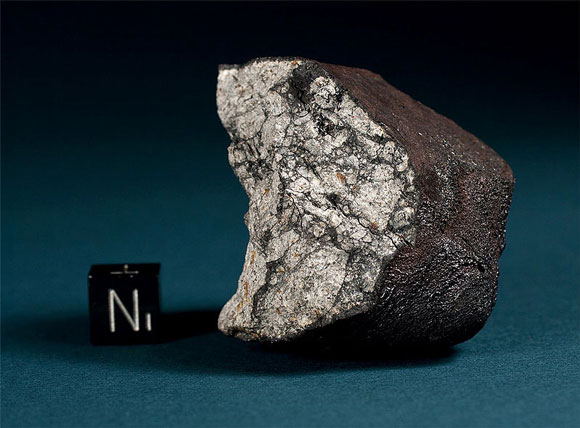
chelyabinsk-meteorite-fragment-580

Fragment of the Chelyabinsk meteorite. Image Credit: Svend Buhl.


The meteor that exploded over Chelyabinsk, Russia on February 15, 2013 was so powerful that it sent out ultra-low frequency soundwaves that traveled around the world at least twice, according to new research published in the journal Geophysical Research Letters.

The meteor was estimated to be 17 meters (56 feet) in diameter and it weighed about 10,000 metric tons. It entered Earth’s atmosphere and approached Russia traveling at speeds near 20 kilometers per second (45,000 miles per hour). The meteor eventually exploded 19 to 24 kilometers (12 to 15 miles) above Earth’s surface. The shockwave from the explosion shattered windows and damaged buildings in nearby cities.

New analyses of data collected by a global network of 20 infrasound sensors indicate that some ultra-low frequency soundwaves from the explosion circled around the globe at least twice. Infrasound refers to low frequency sound that is below 20 Hz (Hertz) or 20 cycles per second. While humans are incapable of hearing infrasound, these soundwaves travel long distances and some animals such as whales and elephants can use this type of sound for communication purposes.

More - Link >>> http://earthsky.org/earth/explosion-from-russian-meteor-heard-round-the-world-twice

Source: EarthSky.org .

Related Blog Posts ---

Russian Meteor Infrasound 'Heard' in U.S.  (2013 May 5):

Link >>> http://spacewatchtower.blogspot.com/2013/05/russian-meteor-infrasound-heard-in-us.html


1938 Fireball Explosion Over W PA Remembered  (2013 March 11):

Link >>> http://spacewatchtower.blogspot.com/2013/03/1938-fireball-explosion-over-w-pa.html


NASA Asteroid Search Program Decade Behind Schedule (2013 March 19):

Link >>> http://spacewatchtower.blogspot.com/2013/03/nasa-asteroid-search-program-decade.html


Could a Comet Hit Mars in 2014? (2013 March 2):

Link >>> http://spacewatchtower.blogspot.com/2013/03/could-comet-hit-mars-in-2014.html


Rare 40-pound Meteorite Found in Antarctica (2013 March 1):

Link >>> http://spacewatchtower.blogspot.com/2013/03/rare-40-pound-meteorite-found-in_1.html


Russia Meteor's Origin Tracked Down (2013 Feb. 26):

Link >>> http://spacewatchtower.blogspot.com/2013/02/russia-meteors-origin-tracked-down.html


Rocket to Smack Asteroid Planned by Johns Hopkins University (2013 Feb. 25):

Link >>> http://spacewatchtower.blogspot.com/2013/02/rocket-to-smack-asteroid-planned-by.html


Russian 'Meteorite Rush' Begins as Scientists Find Fragments (2013 Feb. 18):

Link >>> http://spacewatchtower.blogspot.com/2013/02/russian-meteorite-rush-begins-as.html


Russian Meteor: Fragments Found; NASA Revises Estimates; UN Action? (2013 Feb. 17):

Link >>> http://spacewatchtower.blogspot.com/2013/02/russian-meteor-fragments-found-nasa.html


Meteor Fall Recovery Begins in Russia (2013 Feb. 16):

 Link >>> http://spacewatchtower.blogspot.com/2013/02/meteor-fall-recovery-begins-in-russia.html

Asteroid Buzzes Earth in Record-Breaking Flyby (2013 Feb. 15):

Link >>> http://spacewatchtower.blogspot.com/2013/02/asteroid-buzzes-earth-in-record.html


Meteorite Hits Central Russia, 500+ People Hurt  (2013 Feb. 15):

Link >>> http://spacewatchtower.blogspot.com/2013/02/meteorite-hits-central-russia-500.html


Space Miners: Earth-Buzzing Asteroid May Be Worth $195 Billion (2013 Feb. 13):

Link >>> http://spacewatchtower.blogspot.com/2013/02/space-miners-earth-buzzing-asteroid-may.html


Feb. 15: Close Earth Flyby of Large Asteroid (2013 Feb. 4):

Link >>> http://spacewatchtower.blogspot.com/2013/02/feb-15-close-earth-flyby-of-large.html


Want to receive SpaceWatchtower blog posts daily in your inbox ?
Send request to < spacewatchtower@planetarium.cc >..

gaw

Glenn A. Walsh, Project Director,
Friends of the Zeiss < http://friendsofthezeiss.org >
Electronic Mail - < gawalsh@planetarium.cc >
About the Editor/Author: < http://buhlplanetarium.tripod.com/#GAW >
SPACE & SCIENCE NEWS, ASTRONOMICAL CALENDAR:
< http://buhlplanetarium.tripod.com/#news >
Twitter: < https://twitter.com/spacewatchtower >
Facebook: < http://www.facebook.com/pages/SpaceWatchtower/238017839577841?sk=wall >
Blog: < http://spacewatchtower.blogspot.com/ >
Author of History Web Sites on the Internet --
* Buhl Planetarium, Pittsburgh:
  < http://www.planetarium.cc >
* Adler Planetarium, Chicago:
  < http://adlerplanetarium.tripod.com >
* Astronomer, Educator, Optician John A. Brashear:
  < http://johnbrashear.tripod.com >
* Andrew Carnegie & Carnegie Libraries:
  < http://www.andrewcarnegie.cc >
* Civil War Museum of Andrew Carnegie Free Library:
  < http://garespypost.tripod.com >
* Duquesne Incline cable-car railway, Pittsburgh:
  < http://inclinedplane.tripod.com >
* Public Transit:
  < http://andrewcarnegie2.tripod.com/transit >

Sunday, July 7, 2013

SETI Network Formed in United Kingdom


The Lovell Telescope at Jodrell Bank inspired the first proposals to search for radio signals from extraterrestrial civilizations. (Credit: Anthony Holloway, University of Manchester)
 
A network has been launched to promote academic research in the UK relating to the Search for ExtraTerrestrial Intelligence (SETI). The UK SETI Research Network (UKSRN) brings together academics from 11 institutions across the country.

UKSRN covers a broad spectrum of research topics, including potential methods for detecting signals, the linguistic challenge of deciphering messages, the probability of an extraterrestrial civilization interacting with Earth and the longevity of civilizations.

Dr Alan Penny, the coordinator of UKSRN said, "We hope that the existence of the network will excite interest from people in the UK astronomical community that have been thinking about SETI and encourage them to contribute their work.

Dr Tim O'Brien from The University of Manchester's Jodrell Bank Observatory will describe the capability of the UK's recently commissioned e-MERLIN array of seven radio telescopes for SETI projects and report on progress in initial test observations.

"The first proposal to search for radio signals from extraterrestrial civilisations was actually inspired by the construction of the Lovell Telescope at Jodrell Bank," said O'Brien. "We went on to take part in the SETI Institute's Project Phoenix from 1998 to 2003, searching for signals from about a thousand nearby stars. At that time the equipment required to sift through the data was expensive and unusual, but our modern telescopes are potentially capable of conducting these type of observations as a matter of course."

More - Link >>> http://www.sciencedaily.com/releases/2013/07/130705121029.htm?utm_source=feedburner&utm_medium=email&utm_campaign=Feed%3A+sciencedaily%2Fspace_time+%28ScienceDaily%3A+Space+%26+Time+News%29

Sources: Royal Astronomical Society (RAS), ScienceDaily.com .

Want to receive SpaceWatchtower blog posts daily in your inbox ?
Send request to < spacewatchtower@planetarium.cc >..

gaw

Glenn A. Walsh, Project Director,
Friends of the Zeiss < http://friendsofthezeiss.org >
Electronic Mail - < gawalsh@planetarium.cc >
About the Editor/Author: < http://buhlplanetarium.tripod.com/#GAW >
SPACE & SCIENCE NEWS, ASTRONOMICAL CALENDAR:
< http://buhlplanetarium.tripod.com/#news >
Twitter: < https://twitter.com/spacewatchtower >
Facebook: < http://www.facebook.com/pages/SpaceWatchtower/238017839577841?sk=wall >
Blog: < http://spacewatchtower.blogspot.com/ >
Author of History Web Sites on the Internet --
* Buhl Planetarium, Pittsburgh:
  < http://www.planetarium.cc >
* Adler Planetarium, Chicago:
  < http://adlerplanetarium.tripod.com >
* Astronomer, Educator, Optician John A. Brashear:
  < http://johnbrashear.tripod.com >
* Andrew Carnegie & Carnegie Libraries:
  < http://www.andrewcarnegie.cc >
* Civil War Museum of Andrew Carnegie Free Library:
  < http://garespypost.tripod.com >
* Duquesne Incline cable-car railway, Pittsburgh:
  < http://inclinedplane.tripod.com >
* Public Transit:
  < http://andrewcarnegie2.tripod.com/transit >

Saturday, July 6, 2013

New Sunspot Could Launch Strong Solar Flares

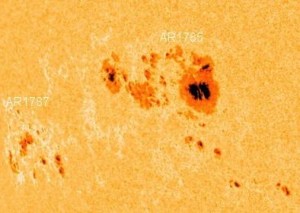
Sunspot complex AR1785-1787

Sunspot complex AR1785-1787

One of the biggest sunspot groups of Solar Cycle 24 is emerging near the sun’s southeastern limb. According to spaceweather.com:

AR1785 has a “beta-gamma-delta” magnetic field that harbors energy for powerful X-class solar flares. Another active region trailing behind it, AR1787, is only slightly less potent, with a magnetic field capable of M-class eruptions …

More - Link >>> http://earthsky.org/space/large-sunspot-group-comes-into-view

Sources: SpaceWeather.com , EarthSky.org .

More from SpaceWeather.com : Link >>> http://spaceweather.com/

Want to receive SpaceWatchtower blog posts daily in your inbox ?
Send request to < spacewatchtower@planetarium.cc >.

gaw

Glenn A. Walsh, Project Director,
Friends of the Zeiss < http://friendsofthezeiss.org >
Electronic Mail - < gawalsh@planetarium.cc >
About the Editor/Author: < http://buhlplanetarium.tripod.com/#GAW >
SPACE & SCIENCE NEWS, ASTRONOMICAL CALENDAR:
< http://buhlplanetarium.tripod.com/#news >
Twitter: < https://twitter.com/spacewatchtower >
Facebook: < http://www.facebook.com/pages/SpaceWatchtower/238017839577841?sk=wall >
Blog: < http://spacewatchtower.blogspot.com/ >
Author of History Web Sites on the Internet --
* Buhl Planetarium, Pittsburgh:
  < http://www.planetarium.cc >
* Adler Planetarium, Chicago:
  < http://adlerplanetarium.tripod.com >
* Astronomer, Educator, Optician John A. Brashear:
  < http://johnbrashear.tripod.com >
* Andrew Carnegie & Carnegie Libraries:
  < http://www.andrewcarnegie.cc >
* Civil War Museum of Andrew Carnegie Free Library:
  < http://garespypost.tripod.com >
* Duquesne Incline cable-car railway, Pittsburgh:
  < http://inclinedplane.tripod.com >
* Public Transit:
  < http://andrewcarnegie2.tripod.com/transit >

Friday, July 5, 2013

Astronomers Puzzled by Powerful Radio Bursts

radio burst over the Parkes telescope
Artist's impression of the 64-meter Parkes radio telescope shown with a bright radio burst blazing briefly far from the Milky Way's disk (red swath at right). The Milky Way image is from a hydrogen-alpha full-sky map.
Swinburne Astronomy Productions; background: H-alpha composite survey Finkbeiner 2003

If you’ve been waiting for mysterious radio signals from space, tune in. An international team of astronomers has detected four powerful bursts that appear to come from billions of light-years away. At that distance, the radio pulses would each have put out in a few thousandths of a second the same amount of energy that the Sun would need 10,000 years to emit.

(So no, it’s not E.T.)

The bizarre signals came to light as part of the High Time Resolution Universe survey, a project using the 64-meter Parkes radio telescope in Australia to search the sky for radio blips and pulsars, the spinning-lighthouse-like stellar corpses left behind by some supernovae. Because the pulsars we detect lie in our own galaxy, astronomers mostly look near the Milky Way’s plane when hunting for these zombie stars. But when grad student Dan Thornton (University of Manchester, U.K., and CSIRO, Australia) started digging through normally “boring” data far from the galaxy’s dusty gleam, he stumbled across the four enigmatic bursts.

More - Link >>> http://www.skyandtelescope.com/news/Mystery-Signals-from-Space-214153371.html

Source: Sky and Telescope Magazine.

Want to receive SpaceWatchtower blog posts daily in your inbox ?
Send request to < spacewatchtower@planetarium.cc >.

gaw

Glenn A. Walsh, Project Director,
Friends of the Zeiss < http://friendsofthezeiss.org >
Electronic Mail - < gawalsh@planetarium.cc >
About the Editor/Author: < http://buhlplanetarium.tripod.com/#GAW >
SPACE & SCIENCE NEWS, ASTRONOMICAL CALENDAR:
< http://buhlplanetarium.tripod.com/#news >
Twitter: < https://twitter.com/spacewatchtower >
Facebook: < http://www.facebook.com/pages/SpaceWatchtower/238017839577841?sk=wall >
Blog: < http://spacewatchtower.blogspot.com/ >
Author of History Web Sites on the Internet --
* Buhl Planetarium, Pittsburgh:
  < http://www.planetarium.cc >
* Adler Planetarium, Chicago:
  < http://adlerplanetarium.tripod.com >
* Astronomer, Educator, Optician John A. Brashear:
  < http://johnbrashear.tripod.com >
* Andrew Carnegie & Carnegie Libraries:
  < http://www.andrewcarnegie.cc >
* Civil War Museum of Andrew Carnegie Free Library:
  < http://garespypost.tripod.com >
* Duquesne Incline cable-car railway, Pittsburgh:
  < http://inclinedplane.tripod.com >
* Public Transit:
  < http://andrewcarnegie2.tripod.com/transit >