Sunday, April 21, 2013

3rd Wallops Rocket Launch Try 5 PM Sunday

New Private Rocket Set to Launch Today After Delays


UPDATE--NASA Partner Orbital Sciences Test Launches Antares Rocket (2013 April 21):

Link >>> http://www.nasa.gov/home/hqnews/2013/apr/HQ_13-114_Antares_launches.html


Date: 21 April 2013 Time: 07:34 AM ET
 
The new Antares rocket is Orbital Sciences' main booster for unmanned cargo missions to the International Space Station.
The new Antares rocket built by Orbital Sciences Corp. is seen atop its launch pad at NASA's Wallops Flight Facility on April 17, 2013, during an initial launch attempt for its first test flight. A last-minute glitch delayed the launch try.
CREDIT: Orbital Sciences Corp.


A U.S. spaceflight company is hoping the third time's the charm in order to launch a brand-new rocket into space on its maiden flight today (April 21).

After two delayed launched attempts, the privately built Antares rocket is once again poised to blast off from a seaside pad at NASA's Wallops Flight Facility on Virginia's Eastern Shore. Liftoff is set for 5 p.m. EDT (2100 GMT).

You can watch the Antares rocket launch live on SPACE.com beginning 4:30 p.m. ET (2030 GMT), courtesy of NASA's webcast.

Today's launch attempt will be the third in a week for Antares, which was built by the Dulles, Va.-based Orbital Sciences Corp. A minor mechanical glitch thwarted a launch try on Wednesday (April 17) just minutes before liftoff. Strong winds prevented and an attempted launch on Saturday.

The Antares rocket is designed to launch Orbital's unmanned Cygnus spacecraft on cargo delivery missions to the International Space Station for NASA. Orbital has a $1.9 billion contract to provide at least eight cargo deliveries using Cygnus and Antares, but first the company wants to make sure the rocket will perform as expected.

More - Link >>> http://www.space.com/20752-private-antares-rocket-launching-sunday.html

Source: Space.com .

NASA-TV Web Site for Viewing Launch:
Link >>> http://www.nasa.gov/multimedia/nasatv/schedule.html

UPDATE--NASA Partner Orbital Sciences Test Launches Antares Rocket (2013 April 21):

Link >>> http://www.nasa.gov/home/hqnews/2013/apr/HQ_13-114_Antares_launches.html


Related Blog Posts ---

5 PM Private Rocket Launch Visible on East Coast & Webcast  (2013 April 20):

Link >>> http://spacewatchtower.blogspot.com/2013/04/5-pm-private-rocket-launch-visible-on.html


NASA-Wallops Island Starts Commercial Cargo Space Launches w/Test (2013 April 13):

Link >>> http://spacewatchtower.blogspot.com/2013/04/nasa-wallops-island-starts-commecial.html


gaw

Glenn A. Walsh, Project Director,
Friends of the Zeiss < http://friendsofthezeiss.org >
Electronic Mail - < gawalsh@planetarium.cc >
About the Author: < http://buhlplanetarium.tripod.com/#GAW >
SPACE & SCIENCE NEWS, ASTRONOMICAL CALENDAR:
< http://buhlplanetarium.tripod.com/#news >
Twitter: < https://twitter.com/spacewatchtower >
Facebook: < http://www.facebook.com/pages/SpaceWatchtower/238017839577841?sk=wall >
Blog: < http://spacewatchtower.blogspot.com/ >
Author of History Web Sites on the Internet --
* Buhl Planetarium, Pittsburgh:
  < http://www.planetariu p.m. m.cc >
* Adler Planetarium, Chicago:
  < http://adlerplanetarium.tripod.com >
* Astronomer, Educator, Optician John A. Brashear:
  < http://johnbrashear.tripod.com >
* Andrew Carnegie & Carnegie Libraries:
  < http://www.andrewcarnegie.cc >
* Civil War Museum of Andrew Carnegie Free Library:
  < http://garespypost.tripod.com >
* Duquesne Incline cable-car railway, Pittsburgh:
  < http://inclinedplane.tripod.com >
* Public Transit:
  < http://andrewcarnegie2.tripod.com/transit >

Saturday, April 20, 2013

Comet ISON: Unique Meteor Shower Mid-January

April 19, 2013: Anticipation is building as Comet ISON plunges into the inner solar system for a close encounter with the sun in November 2013. Blasted at point-blank range by solar radiation, the sungrazer will likely become one of the finest comets in many years.

When NASA's Swift spacecraft observed the comet in January 2013, it was still near the orbit of Jupiter, but already very active. More than 112,000 pounds of dust were spewing from the comet's nucleus every minute.

It turns out, some of that dust might end up on Earth.

ISONids (splash2)
In a new ScienceCast video, experts discuss what might happen if Comet ISON peppers Earth's atmosphere with dust. Play it

Veteran meteor researcher Paul Wiegert of the University of Western Ontario has been using a computer to model the trajectory of dust ejected by Comet ISON, and his findings suggest that an unusual meteor shower could be in the offing.

"For several days around January 12, 2014, Earth will pass through a stream of fine-grained debris from Comet ISON," says Wiegert. "The resulting shower could have some interesting properties.

More - Link >>> http://science.nasa.gov/science-news/science-at-nasa/2013/19apr_isonids/

Source: NASA Science News.

gaw

Glenn A. Walsh, Project Director,
Friends of the Zeiss < http://friendsofthezeiss.org >
Electronic Mail - < gawalsh@planetarium.cc >
About the Author: < http://buhlplanetarium.tripod.com/#GAW >
SPACE & SCIENCE NEWS, ASTRONOMICAL CALENDAR:
< http://buhlplanetarium.tripod.com/#news >
Twitter: < https://twitter.com/spacewatchtower >
Facebook: < http://www.facebook.com/pages/SpaceWatchtower/238017839577841?sk=wall >
Blog: < http://spacewatchtower.blogspot.com/ >
Author of History Web Sites on the Internet --
* Buhl Planetarium, Pittsburgh:
  < http://www.planetariu p.m. m.cc >
* Adler Planetarium, Chicago:
  < http://adlerplanetarium.tripod.com >
* Astronomer, Educator, Optician John A. Brashear:
  < http://johnbrashear.tripod.com >
* Andrew Carnegie & Carnegie Libraries:
  < http://www.andrewcarnegie.cc >
* Civil War Museum of Andrew Carnegie Free Library:
  < http://garespypost.tripod.com >
* Duquesne Incline cable-car railway, Pittsburgh:
  < http://inclinedplane.tripod.com >
* Public Transit:
  < http://andrewcarnegie2.tripod.com/transit >

5 PM Private Rocket Launch Visible on East Coast & Webcast

New Private Rocket Launching on 1st Flight Today: Watch It Live

Date: 20 April 2013 Time: 08:43 AM ET
Orbital Sciences Corp. Antares rockets will launch from Pad 0A on Wallops Island, Va.
The Orbital Sciences Corporation Antares rocket is seen on the Mid-Atlantic Regional Spaceport (MARS) Pad-0A at the NASA Wallops Flight Facility on April 16, 2013 on Wallops Island, Va.The rocket is slated to launch on April 20.
CREDIT: NASA/Bill Ingalls

A new American rocket designed to fly cargo missions to the International Space Station for NASA is poised to make its launch debut from the U.S. East Coast today (April 20) after a three-day delay.

The private Antares rocket, built by the commercial spaceflight company Orbital Sciences Corp., is set to launch from a new seaside pad at NASA's Wallops Flight Facility on Wallops Island, Va.. The critical test flight has been delayed since Wednesday (April 17). Liftoff is set for 5 p.m. EDT (2100 GMT).

You can watch the Antares rocket launch live on SPACE.com beginning 4:30 p.m. ET (2030 GMT), courtesy of a NASA TV webcast. Weather permitting, the rocket's ascent toward space may even be visible from a wide swath of the U.S. East Coast from Portland, Maine, to Charleston, S.C., according to an Orbital visibility map.

More - Link >>> http://www.space.com/20749-private-antares-rocket-launch-webcast.html

Source: Space.com .

NASA-TV Web Site for Viewing Launch:
Link >>> http://www.nasa.gov/multimedia/nasatv/schedule.html

Related Blog Post ---

NASA-Wallops Island Starts Commercial Cargo Space Launches w/Test (2013 April 13):

Link >>> http://spacewatchtower.blogspot.com/2013/04/nasa-wallops-island-starts-commecial.html


gaw

Glenn A. Walsh, Project Director,
Friends of the Zeiss < http://friendsofthezeiss.org >
Electronic Mail - < gawalsh@planetarium.cc >
About the Author: < http://buhlplanetarium.tripod.com/#GAW >
SPACE & SCIENCE NEWS, ASTRONOMICAL CALENDAR:
< http://buhlplanetarium.tripod.com/#news >
Twitter: < https://twitter.com/spacewatchtower >
Facebook: < http://www.facebook.com/pages/SpaceWatchtower/238017839577841?sk=wall >
Blog: < http://spacewatchtower.blogspot.com/ >
Author of History Web Sites on the Internet --
* Buhl Planetarium, Pittsburgh:
  < http://www.planetariu p.m. m.cc >
* Adler Planetarium, Chicago:
  < http://adlerplanetarium.tripod.com >
* Astronomer, Educator, Optician John A. Brashear:
  < http://johnbrashear.tripod.com >
* Andrew Carnegie & Carnegie Libraries:
  < http://www.andrewcarnegie.cc >
* Civil War Museum of Andrew Carnegie Free Library:
  < http://garespypost.tripod.com >
* Duquesne Incline cable-car railway, Pittsburgh:
  < http://inclinedplane.tripod.com >
* Public Transit:
  < http://andrewcarnegie2.tripod.com/transit >

Friday, April 19, 2013

NASA: Asteroid Apophis Not Threat to Earth At Least for Century

Radar views of asteroid Apophis
A series of radar maps acquired in January 2013 barely resolve 99942 Apophis, a threatening near-Earth asteroid. These views, acquired with NASA's big radio dish Goldstone, California, have a horizontal resolution of about 250 feet (75 m).
NASA / JPL

A Tumbling Apophis: Good News for Earth


Posted by Kelly Beatty, April 19, 2013


Asteroid 99942 Apophis isn't a huge threat to Earth — at least not for the next century. Telescopic observations made in early 2013 show that it is both elongated and tumbling, characteristics that help predict its future location.

Asteroid 99942 Apophis has been worrisome ever since its discovery in 2004. Estimated to be a bit more than 1,000 feet (300 m) across, it would deliver the kinetic-energy equivalent of 500 megatons of TNT were it to strike Earth — which it might well do some day. At first, dynamicists predicted a dangerously close pass in 2029 and a 3% chance of collision. More observations eased those fears — but triggered worry instead about a threatening flyby in March 2036.

As I reported three months ago, radar observations made last January have seemingly ruled out any chance of an impact in 2036. Barely resolved views made with NASA's big radar dish at Goldstone, California, even show Apophis to be quite elongated (as many near-Earth asteroids are).

More - Link >>> http://www.skyandtelescope.com/news/A-Tumbling-Apophis-Good-News-for-Earth-203765511.html

Source: Sky and Telescope Magazine.

gaw

Glenn A. Walsh, Project Director,
Friends of the Zeiss < http://friendsofthezeiss.org >
Electronic Mail - < gawalsh@planetarium.cc >
About the Author: < http://buhlplanetarium.tripod.com/#GAW >
SPACE & SCIENCE NEWS, ASTRONOMICAL CALENDAR:
< http://buhlplanetarium.tripod.com/#news >
Twitter: < https://twitter.com/spacewatchtower >
Facebook: < http://www.facebook.com/pages/SpaceWatchtower/238017839577841?sk=wall >
Blog: < http://spacewatchtower.blogspot.com/ >
Author of History Web Sites on the Internet --
* Buhl Planetarium, Pittsburgh:
  < http://www.planetariu p.m. m.cc >
* Adler Planetarium, Chicago:
  < http://adlerplanetarium.tripod.com >
* Astronomer, Educator, Optician John A. Brashear:
  < http://johnbrashear.tripod.com >
* Andrew Carnegie & Carnegie Libraries:
  < http://www.andrewcarnegie.cc >
* Civil War Museum of Andrew Carnegie Free Library:
  < http://garespypost.tripod.com >
* Duquesne Incline cable-car railway, Pittsburgh:
  < http://inclinedplane.tripod.com >
* Public Transit:
  < http://andrewcarnegie2.tripod.com/transit >

Earth-like Exoplanets w/out Magnetic Field May be Lifeless

Caption <i>(Image: Credit)</i>

Magnetic death leaves Earth-like exoplanets dried out

Seemingly habitable exoplanets may be missing their magnetic shielding, leaving them exposed to damaging radiation.

To support life as we know it, planets need thick, water-rich atmospheres and liquid surface water. These conditions have so far only been hinted at, based mostly on a planet's distance from its star.

But water can get blasted away by stellar winds unless the planet has a strong magnetic field, point out Jorge Zuluaga at the University of Antioquia in Colombia and colleagues. Mars and Venus do not have magnetic fields, and it is thought that stellar winds stripped away the bulk of Mars's atmosphere, while Venus's was left with mostly carbon dioxide, making it toxic.

More - Link >>> http://www.newscientist.com/article/dn23393-magnetic-death-leaves-earthlike-exoplanets-dried-out.html

Source: New Scientist Magazine.

gaw

Glenn A. Walsh, Project Director,
Friends of the Zeiss < http://friendsofthezeiss.org >
Electronic Mail - < gawalsh@planetarium.cc >
About the Author: < http://buhlplanetarium.tripod.com/#GAW >
SPACE & SCIENCE NEWS, ASTRONOMICAL CALENDAR:
< http://buhlplanetarium.tripod.com/#news >
Twitter: < https://twitter.com/spacewatchtower >
Facebook: < http://www.facebook.com/pages/SpaceWatchtower/238017839577841?sk=wall >
Blog: < http://spacewatchtower.blogspot.com/ >
Author of History Web Sites on the Internet --
* Buhl Planetarium, Pittsburgh:
  < http://www.planetariu p.m. m.cc >
* Adler Planetarium, Chicago:
  < http://adlerplanetarium.tripod.com >
* Astronomer, Educator, Optician John A. Brashear:
  < http://johnbrashear.tripod.com >
* Andrew Carnegie & Carnegie Libraries:
  < http://www.andrewcarnegie.cc >
* Civil War Museum of Andrew Carnegie Free Library:
  < http://garespypost.tripod.com >
* Duquesne Incline cable-car railway, Pittsburgh:
  < http://inclinedplane.tripod.com >
* Public Transit:
  < http://andrewcarnegie2.tripod.com/transit >

Thursday, April 18, 2013

This Weekend’s Lyrid Meteor Shower: How to See It

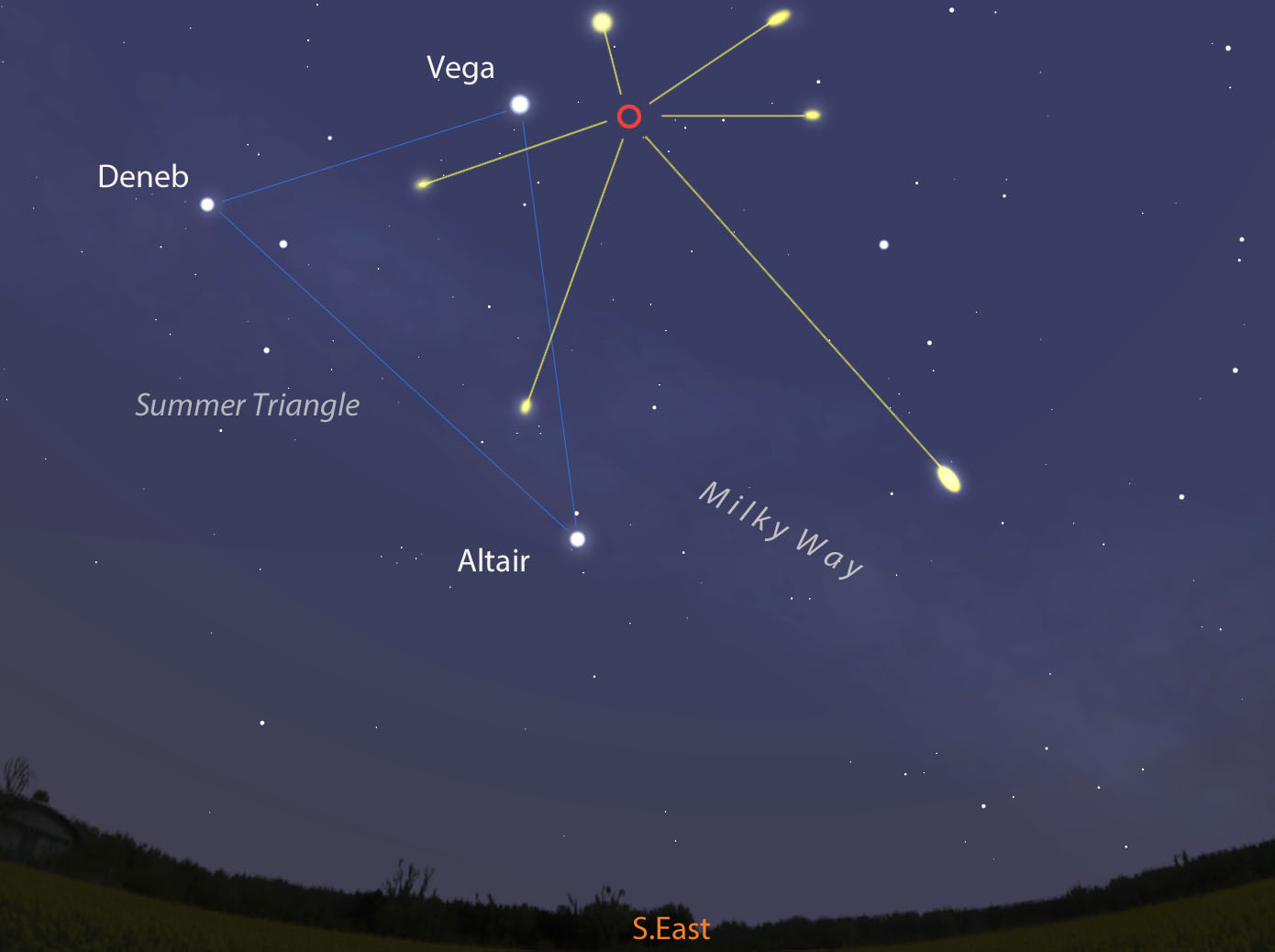
Lyrid meteors will appear to radiate (red circle) from a point near the bright star Vega in the constellation Lyra. This map shows the sky facing southeast around 3:30 a.m. April 22 - around the time of maximum. Stellarium
Lyrid meteors will appear to radiate (red circle) from a point near the bright star Vega in the constellation Lyra. This map shows the sky facing southeast around 3:30 a.m. April 22 – around the time of meteor maximum. Stellarium

by Bob King on April 17, 2013

Feeling a little meteor-starved lately? Me too. It’s been a meteor shower desert since the Quadrantids of early January. That’s about to change. This weekend brings the celestial version of April showers with the annual appearance of the Lyrids.

The Lyrids ding the bell at maximum strength this weekend April 21-22 (Sunday night-Monday morning in the Americas) hurtling meteors at the modest rate of 10-20 per hour from a point in the sky not far from bright Vega in the constellation Lyra. While some showers spread their meteor crumbs over several days, the Lyrids’ peak activity lasts less than a day. The western hemisphere – particularly the western half of North America – is favored this year.

There will be a small price to pay for the show. The Lyrid radiant, the point in the sky from which the showers members radiate, rises in the east rather late – around 10:30 p.m. local time. Then there’s the bright gibbous moon, which has a habit of drowning out fainter stars and meteors alike. That makes the best time for viewing the shower after moonset or around 4 a.m. Monday morning. Since dawn begins about 5, you’ll have one good hour. That’s plenty of time to snag at least a few flaming motes of Comet Thatcher.

Like most meteor showers, the Lyrids have a parent and single parents are the rule. For the Lyrids, it’s Comet Thatcher, discovered on April 5, 1861, a week before the start of the Civil War, by amateur astronomer A.E. Thatcher observing from New York City. Later it was found to be linked to the Lyrid meteor shower.

More - Link >>> http://www.universetoday.com/101519/this-weekends-lyrid-meteor-shower-how-to-see-it/

Source: UniverseToday.com .

Lyrid meteor shower peaks this weekend: its brush with history (2013 April 19 - Source: The Washington Post):

Link >>> http://www.washingtonpost.com/blogs/capital-weather-gang/wp/2013/04/19/lyrid-meteor-shower-peaks-this-weekend-its-brush-with-history/


More on the Lyrid Meteor Shower:
Link >>> http://www.spaceweather.com/meteors/lyrids/lyrids.html

gaw

Glenn A. Walsh, Project Director,
Friends of the Zeiss < http://friendsofthezeiss.org >
Electronic Mail - < gawalsh@planetarium.cc >
About the Author: < http://buhlplanetarium.tripod.com/#GAW >
SPACE & SCIENCE NEWS, ASTRONOMICAL CALENDAR:
< http://buhlplanetarium.tripod.com/#news >
Twitter: < https://twitter.com/spacewatchtower >
Facebook: < http://www.facebook.com/pages/SpaceWatchtower/238017839577841?sk=wall >
Blog: < http://spacewatchtower.blogspot.com/ >
Author of History Web Sites on the Internet --
* Buhl Planetarium, Pittsburgh:
  < http://www.planetariu p.m. m.cc >
* Adler Planetarium, Chicago:
  < http://adlerplanetarium.tripod.com >
* Astronomer, Educator, Optician John A. Brashear:
  < http://johnbrashear.tripod.com >
* Andrew Carnegie & Carnegie Libraries:
  < http://www.andrewcarnegie.cc >
* Civil War Museum of Andrew Carnegie Free Library:
  < http://garespypost.tripod.com >
* Duquesne Incline cable-car railway, Pittsburgh:
  < http://inclinedplane.tripod.com >
* Public Transit:
  < http://andrewcarnegie2.tripod.com/transit >

NASA: Distant Planets Ideal for Life Found


Alien Planets.JPEG


NASA's planet-hunting telescope has discovered two planets that seem like ideal places for some sort of life to flourish. They are just the right size and in just the right place near their star.

The distant duo are the best candidates for habitable planets that astronomers have found so far, said William Borucki, the chief scientist for NASA's Kepler telescope.

The discoveries, published online Thursday in the journal Science, mark a milestone in the search for planets where life could exist.

More - Link >>> http://abcnews.go.com/Technology/wireStory/nasa-sees-distant-planets-ideal-life-18990451#.UXBX4FE_2YA

Sources: Associated Press News Wire Service, ABC News.

Also, Penn State Grad from Beaver Falls on NASA Science Team (Source: Pittsburgh Post-Gazette):
Link >>> http://www.post-gazette.com/stories/news/science/nasa-discovers-two-earth-like-planets-penn-state-grad-on-scientific-team-684053/

gaw

Glenn A. Walsh, Project Director,
Friends of the Zeiss < http://friendsofthezeiss.org >
Electronic Mail - < gawalsh@planetarium.cc >
About the Author: < http://buhlplanetarium.tripod.com/#GAW >
SPACE & SCIENCE NEWS, ASTRONOMICAL CALENDAR:
< http://buhlplanetarium.tripod.com/#news >
Twitter: < https://twitter.com/spacewatchtower >
Facebook: < http://www.facebook.com/pages/SpaceWatchtower/238017839577841?sk=wall >
Blog: < http://spacewatchtower.blogspot.com/ >
Author of History Web Sites on the Internet --
* Buhl Planetarium, Pittsburgh:
  < http://www.planetariu p.m. m.cc >
* Adler Planetarium, Chicago:
  < http://adlerplanetarium.tripod.com >
* Astronomer, Educator, Optician John A. Brashear:
  < http://johnbrashear.tripod.com >
* Andrew Carnegie & Carnegie Libraries:
  < http://www.andrewcarnegie.cc >
* Civil War Museum of Andrew Carnegie Free Library:
  < http://garespypost.tripod.com >
* Duquesne Incline cable-car railway, Pittsburgh:
  < http://inclinedplane.tripod.com >
* Public Transit:
  < http://andrewcarnegie2.tripod.com/transit >